How Your Weight Changes Your CPAP Needs
If you’re using a CPAP machine for sleep apnea and struggling to lose weight, you’re not alone. But here’s the truth: your weight isn’t just a side note in your sleep treatment-it’s the main driver of how hard your CPAP has to work. For every pound you lose, your airway gets a little more open. That means less pressure needed from your machine, fewer breathing pauses at night, and sometimes, even the chance to stop using CPAP altogether.
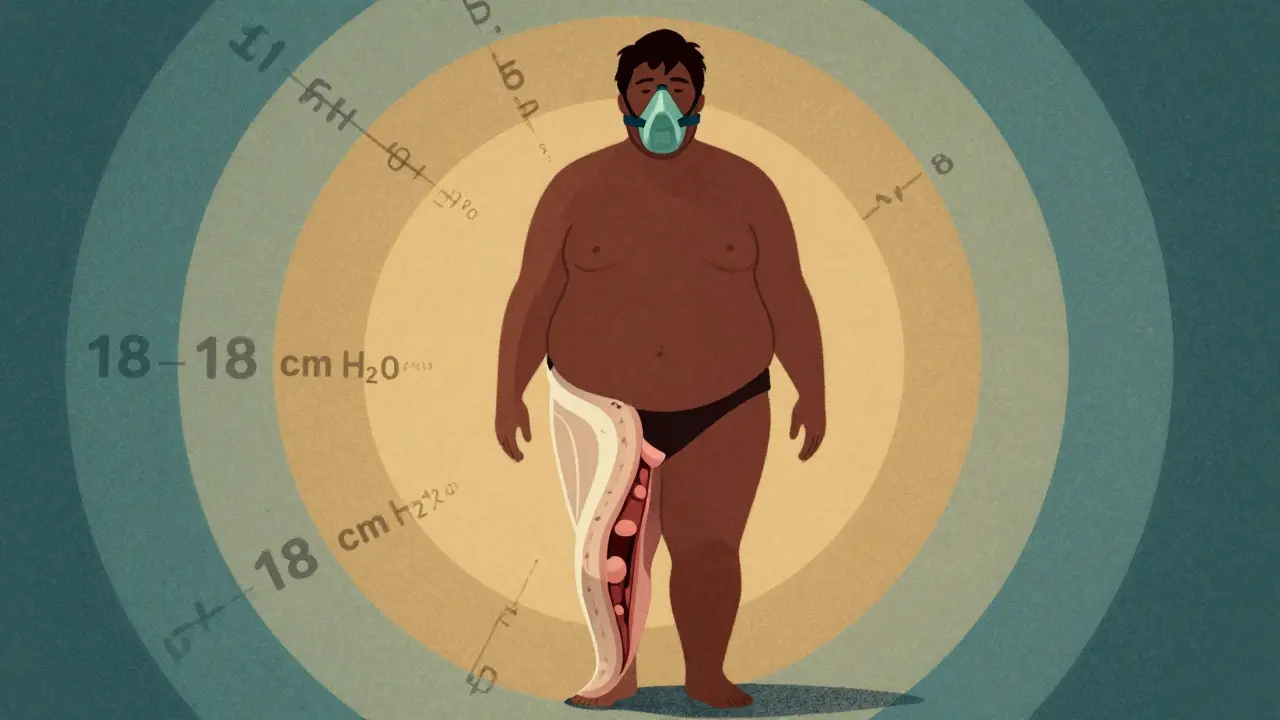
It’s not magic. It’s physics. Extra fat around your neck and belly squeezes your airway shut while you sleep. The heavier you are, the more pressure your CPAP machine needs to blast air through that narrow passage. Most machines run between 4 and 20 cm H₂O. Someone with a BMI of 25 might need 8 cm H₂O. Someone with a BMI of 40? They’re often on 14, 16, or even 18 cm H₂O. That’s a lot of force just to keep breathing.
The Math Behind Weight and Apnea
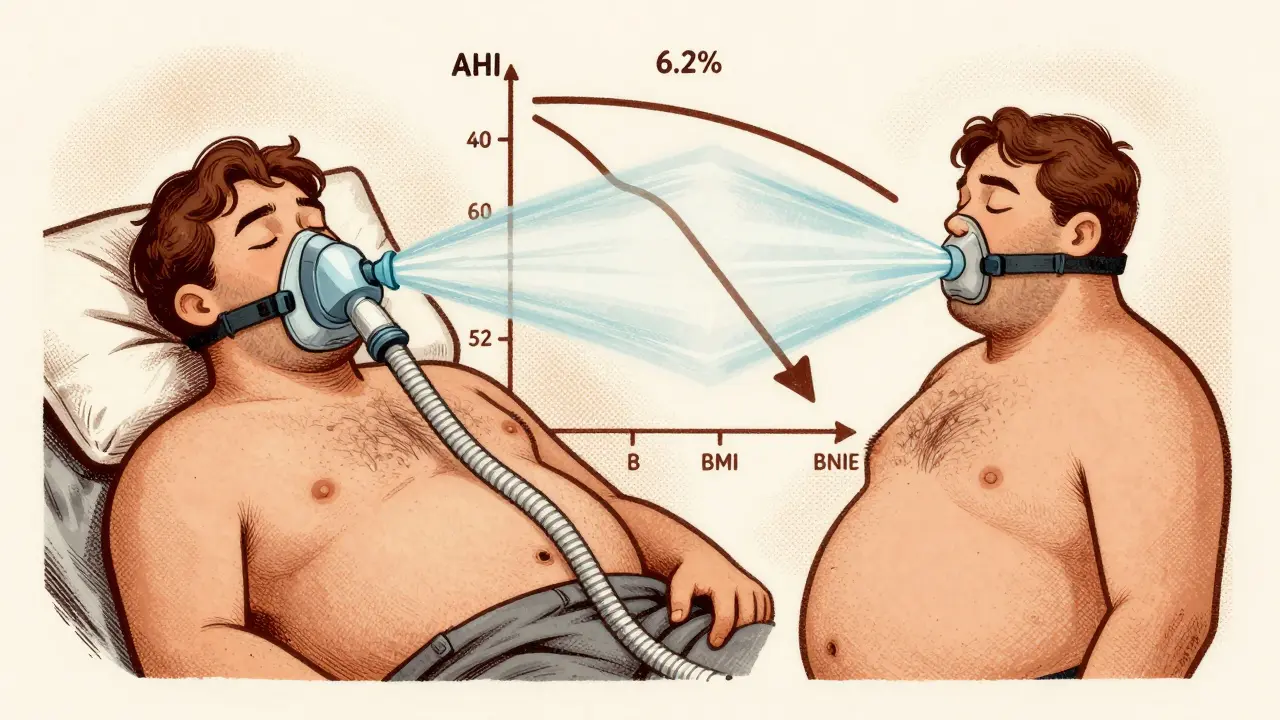
A 2022 study of over 400 veterans found something surprising: for every 1-point drop in BMI, your apnea-hypopnea index (AHI)-the number of breathing pauses per hour-goes down by 6.2%. In practical terms, that means if you drop 7 pounds, your AHI drops about 7%. That’s not a guess. That’s a proven equation.
Let’s say you’re 5’10” and weigh 230 pounds. Your BMI is 33. Your AHI is 30. You’re on 14 cm H₂O. If you lose 20 pounds, your BMI drops to 29. Your AHI could fall to around 24. That’s a 20% improvement. For some people, that’s enough to drop from moderate to mild sleep apnea. For others, it’s enough to lower their CPAP pressure from 14 to 10 cm H₂O-making the machine far more comfortable to wear.
And here’s the kicker: losing just 5-10% of your body weight can cut your AHI in half. That’s not a vague recommendation. It’s what the Obesity Medicine Association says works. For a 200-pound person, that’s 10 to 20 pounds. Doable. Life-changing.
Why CPAP Can Make Weight Loss Harder
Here’s the twist: using CPAP can sometimes make you gain weight. It sounds backwards, right? But studies show that after starting CPAP, many people eat more and burn fewer calories.
Why? Because when you stop gasping for air at night, your body thinks it’s no longer in survival mode. Your ghrelin (the hunger hormone) goes up. Your leptin (the fullness hormone) goes down. Your metabolism slows by about 5%. One study found people on CPAP ate an extra 287 calories a day-roughly a large banana and a handful of almonds. Without realizing it, they were undoing their progress.
And it’s not just appetite. Daytime fatigue used to keep you off your feet. Now that CPAP gives you energy, you might feel better-but not necessarily more motivated to move. Many people assume better sleep means automatic weight loss. It doesn’t. You still have to eat less and move more.
But here’s the good news: if you use CPAP for 5+ hours a night, you actually start losing belly fat-even without dieting. One study found a 4.7% drop in visceral fat after just three months. That’s the dangerous fat wrapped around your organs. It’s the kind that raises your risk of diabetes and heart disease. So CPAP isn’t the enemy. It’s a tool. But it only works if you pair it with real lifestyle changes.
How Much Weight Do You Need to Lose to See Results?
You don’t need to lose 50 pounds to feel a difference. You need to lose enough to open your airway.
Studies show:
- 5% weight loss → 20-30% reduction in AHI
- 10% weight loss → 40-50% reduction in AHI, often enough to lower CPAP pressure
- 15-20% weight loss → Up to 80% chance of eliminating moderate sleep apnea
For someone with a BMI over 35, losing 10% can mean dropping from a 16 cm H₂O setting to 12 cm H₂O. That’s not just easier to sleep with-it’s easier to stick with. High pressure is the #1 reason people quit CPAP. Less pressure? Better adherence.
And if you’re in the mild range (AHI 5-15)? Losing 10% could get you off CPAP entirely. One survey of 1,200 users found that 31% of mild OSA patients stopped using CPAP after significant weight loss. Their sleep was good enough without it.
Why CPAP Pressure Settings Change With Weight
Your CPAP machine doesn’t guess your pressure. It’s calibrated based on your body’s resistance. More fat = more resistance = more pressure needed.
The Fattal study found that for every 1-point increase in BMI, you need about 0.5 cm H₂O more pressure to keep your airway open. That means if you gain 10 pounds and your BMI rises by 1.5 points, your machine might need to push 0.75 cm H₂O harder. That’s not a big number-but it’s enough to make your mask leak, your nose dry out, or your throat feel sore.
That’s why retesting matters. If you’ve lost weight, don’t just assume your settings are still right. Go back for a sleep study. Most clinics will adjust your pressure in 1 cm H₂O steps until your AHI stays under 5. Many patients find they can drop their pressure by 2-3 cm H₂O after losing 10-15 pounds. That’s a game-changer for comfort.
What Happens When You Don’t Lose Weight?
Patients with a BMI over 40 face a tough reality: CPAP works less well for them. Studies show only 63% of Class III obese patients (BMI ≥40) reach the goal of AHI <5, compared to 89% of normal-weight users. Why? Thicker necks, more abdominal fat, and higher pressure needs make it harder to get a good seal, avoid leaks, and tolerate the machine.
Many end up needing advanced devices like auto-adjusting CPAPs (AutoSet), bilevel machines (BiPAP), or even mandibular advancement devices. Some need supplemental oxygen. Others never get consistent sleep because the pressure feels like a firehose.
And the cycle continues: poor sleep → fatigue → less movement → more weight → worse apnea. It’s not your fault. It’s a biological trap. But it’s not unbreakable.
Real People, Real Results
Reddit user u/SleepWarrior42 lost 45 pounds-from BMI 38 to 31. His AHI dropped from 32 to 9. His CPAP pressure went from 14 to 9. He says, “I only need it for back sleeping now.”
Another user, a 52-year-old woman from Ohio, lost 32 pounds after starting CPAP and a diet plan. Her doctor took her off the machine entirely after her follow-up sleep study showed an AHI of 3. She hadn’t felt this rested in 15 years.
These aren’t outliers. They’re the rule-if you combine CPAP with real weight loss.

What Actually Works for Weight Loss With Sleep Apnea
Diets that work for general weight loss don’t always work for sleep apnea. You need to target fat around your neck and upper airway.
Research shows:
- Low-carb diets reduce upper airway fat faster than low-fat diets
- Protein-rich meals help preserve muscle while losing fat
- Even small increases in daily steps-like going from 4,200 to 7,800-boost sleep quality and reduce AHI
And don’t underestimate sleep itself. Better sleep means better decisions. You’re less likely to grab chips at midnight. You’re more likely to walk after dinner. You’re more likely to say no to the second slice of pizza.
Best results come from teams: a sleep specialist, a dietitian, and a doctor trained in obesity medicine. The SAVE-OSA trial showed patients with coordinated care lost 42% more weight than those getting standard advice.
What to Do Next
Step 1: Check your current BMI. If it’s over 25, weight loss should be part of your treatment plan.
Step 2: Talk to your sleep doctor about retesting your AHI after you lose 10% of your body weight. Don’t wait a year. Do it after 3-6 months.
Step 3: If your pressure is above 12 cm H₂O, ask if you qualify for a newer auto-adjusting machine. Newer models like ResMed’s AirSense 11 and Philips’ DreamStation 3 can track your weight and adjust pressure automatically.
Step 4: Don’t blame CPAP if you gain weight. Blame the lack of diet and movement. Fix those, and the machine will feel easier.
Step 5: Celebrate small wins. Losing 5 pounds? That’s 5% less AHI. That’s better sleep. That’s more energy. That’s your body breathing easier. That’s progress.
Final Thought: Your Weight Isn’t a Failure. It’s a Lever.
You didn’t choose sleep apnea. But you can choose to use your weight as a tool-not a punishment. Every pound lost is a step toward breathing easier, sleeping deeper, and needing less help from machines. CPAP saves your life. But weight loss? That gives your life back.


i just got my cpap last year and thought it was gonna fix everything... turns out i still gotta stop eating pizza at 2am. why is this so hard?? 🤦♀️
Thank you for this meticulously researched and profoundly insightful article. It is imperative that we recognize the physiological interplay between adipose tissue and upper airway dynamics. I have personally observed a 22% reduction in my AHI following a 12% body weight reduction, and my pressure settings were successfully lowered from 16 to 11 cm H₂O. Your work is commendable.
so let me get this straight-you’re telling me the solution to sleep apnea is… diet and exercise? groundbreaking. next you’ll tell me smoking causes lung cancer. what a shocker. we’ve all been living in a simulation where machines fix biology.
i lost 18 lbs and my cpap pressure dropped from 15 to 10. i didn’t even realize how loud i was snoring until it stopped. now i just need to stop eating cereal for dinner. help.
you know what’s worse than sleep apnea? people who think losing weight is the only answer. what about people with small airways? what about genetics? what about the fact that some of us have been obese since we were 12? this isn’t a moral failure. it’s a medical condition. cpap is my lifeline, not my punishment.
This is an exceptionally well-articulated exposition on the physiological mechanisms underlying the relationship between adiposity and obstructive sleep apnea. The statistical correlations presented are compelling, and the emphasis on objective clinical outcomes-particularly the reduction in visceral adipose tissue-is both scientifically rigorous and clinically significant. Thank you for elevating the discourse.
i used to think cpap was my enemy... then i realized it was just holding up a mirror. the machine doesn’t care if i’m lazy. it just says: ‘hey, your body’s screaming for help, and you’re ignoring it.’ so yeah, i lost 14 lbs. i still use cpap. but now i sleep like a baby. and i don’t hate myself as much. 🌙❤️
bro i got cpap after i gained 30 lbs during lockdown. now i lost 15 and my machine beeps less. but my wife still says i snore. maybe she’s just mad i stole the blankets.
I find it deeply troubling that society continues to reduce complex physiological conditions to simplistic moral narratives. You imply that weight loss is a virtue, and that those who struggle are somehow deficient. But let us not forget: the pharmaceutical industry profits from perpetual dependency on devices like CPAP. Are we truly healing-or just monetizing compliance?
The fact that you’re presenting this as a universal truth reveals a fundamental ignorance of human biology. BMI is a crude metric designed for population-level epidemiology, not individual clinical decision-making. A person with a BMI of 35 may have 12% body fat and a perfect airway. Meanwhile, a BMI of 28 with visceral adiposity may require 20 cm H₂O. This article is dangerously reductive. You’re not helping-you’re misleading.