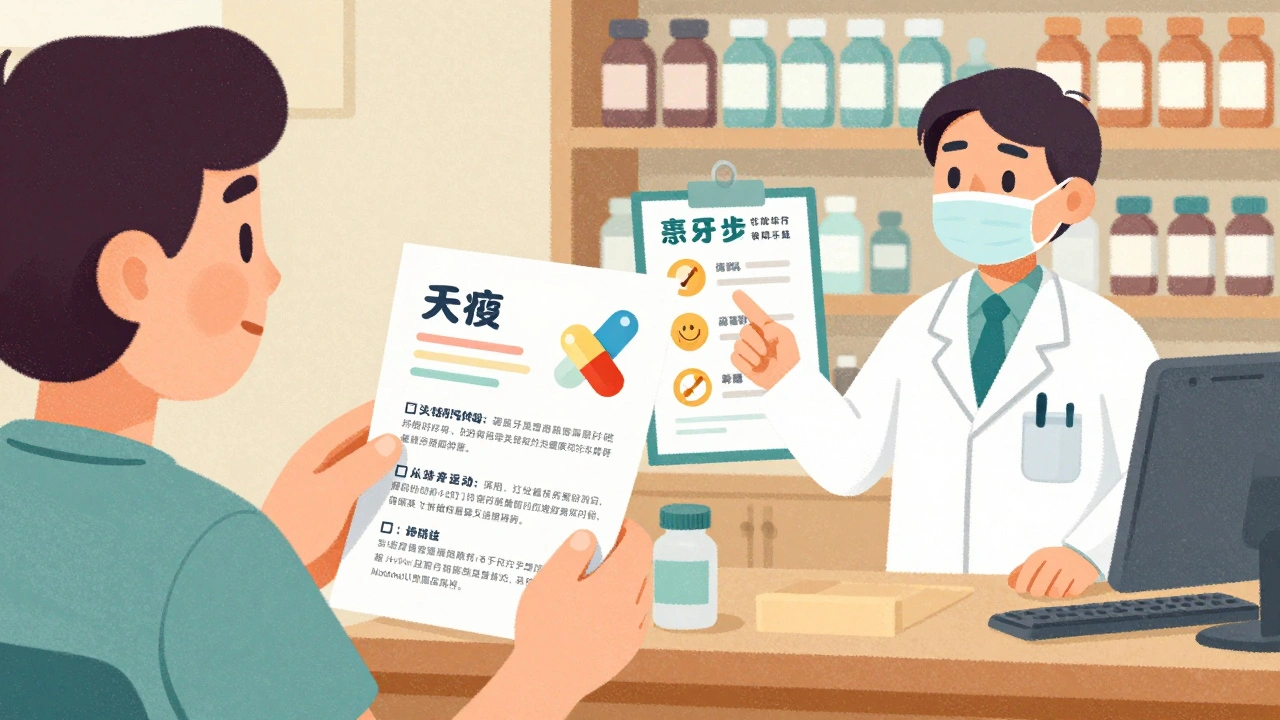
Most people think their doctor gives them all the info they need about their meds. But here’s the truth: pharmacists are the real experts on how to take your pills safely and effectively. They know the exact timing, interactions, storage tricks, and what to do when things go wrong. Yet too many patients leave the pharmacy with nothing but a bottle and a vague sense of hope.
It’s not your fault. Pharmacists are busy. Chain pharmacies often have counseling times under two minutes. But you don’t have to accept that. You can-and should-ask for better. Here’s exactly what to request, based on national guidelines, real patient experiences, and what actually works.
Ask for a Customized, Written Handout
Don’t settle for a generic printed sheet that says “take once daily.” Ask for one made just for you. The American Society of Health-System Pharmacists (ASHP) says these materials must include: the name of the drug, why you’re taking it, how much to take, when, and how. But go further. Request details like: what to do if you miss a dose, how long until you feel better, and what side effects are normal versus dangerous.
Pharmacies like those using the Patient Education Reference Center (PERC) have over 15,000 evidence-based handouts. Many are available in Spanish and other languages. Ask if they can print one with your name, your specific dose, and your pill color. Seeing your actual medication pictured on the sheet helps older adults and people with low vision remember what to take.
Request a Demonstration-Then Do It Back
For inhalers, insulin pens, auto-injectors, or even liquid medications, reading instructions isn’t enough. You need to see it done-and then do it yourself in front of the pharmacist.
A 2023 study found that 76% of patients who got a live demo with return demonstration could use their device correctly. Only 41% could do it after just verbal instructions. Ask: “Can you show me how to use this? Then let me try it back?”
Patients with diabetes often don’t know how to rotate injection sites. One Reddit user shared that their pharmacist printed a diagram showing exactly where to inject Lantus insulin each day. That one handout fixed their adherence problem overnight. Don’t assume your doctor explained it. Ask the pharmacist to show you.
Ask for Instructions in Your Preferred Language
If English isn’t your first language, you’re at higher risk of making dangerous mistakes. The FDA and ASHP both say materials must be available in languages patients understand. PERC offers Spanish handouts for 92% of common medications. Other platforms like UpToDate provide materials in 18 languages.
Don’t wait for them to offer it. Say: “Can you give me this in [language]?” If they say no, ask if they can call a translation line or email you a link to a video. Many pharmacies now have QR codes on handouts that link to short instructional videos in multiple languages.

Ask for a Personalized Medication Schedule
Most people take multiple medications. A sheet listing “Metformin 500mg twice daily” and “Lisinopril 10mg once daily” doesn’t help if you’re not sure when to take them with meals or if they clash.
Ask your pharmacist to make a simple daily chart: morning, afternoon, evening. Put it in a box with your actual pills. Add notes like “take with food” or “avoid grapefruit.” A 2023 study in the Annals of Pharmacotherapy showed that 73% of patients improved adherence when given this kind of personalized schedule.
Even better: ask them to sync your refills so you pick up everything once a month. That’s when they can review everything together, answer questions, and update your schedule.
Ask About Costs and Cheaper Alternatives
Sixty-two percent of patients say they need cheaper options but never get help finding them. Pharmacists can check for generic versions, manufacturer coupons, or patient assistance programs. They can also suggest therapeutic alternatives that work the same but cost less.
Don’t be shy. Say: “This is expensive. Is there a lower-cost version or program I can use?” Many pharmacists have access to tools that instantly compare prices at nearby pharmacies. One pharmacist in Hamilton told a patient they could save $80/month by switching from a brand-name statin to a generic-plus got a coupon for free delivery.
Ask for Documentation in Your Medical Record
By law, 47 U.S. states require pharmacists to document counseling for Medicaid patients. But even if you’re not on Medicaid, you can ask them to note your education in your pharmacy record. This helps if you switch pharmacies or see a new doctor.
Ask: “Can you put a note in my file that I received counseling on my new blood pressure pill?” It’s not a big deal for them-but it’s huge for your future care.

Use the 7 Essential Questions
Before you leave, run through these seven questions. Write them down. Bring them with you.
- What is this medication for?
- How and when should I take it?
- What should I do if I miss a dose?
- What side effects should I watch for?
- How will I know if it’s working?
- How should I store it?
- Is there anything else I need to know?
These aren’t just questions-they’re your rights. The Joint Commission of Pharmacy Practitioners’ 2025 guidelines say pharmacists must confirm you understand each point. If they skip one, ask again. If they brush you off, ask to speak to the pharmacist-in-charge.
Why This Matters More Than You Think
Half of all people don’t take their meds as prescribed. That’s not laziness-it’s confusion. Medication errors cause 7,000 deaths a year in the U.S. alone. But when patients get clear, personalized education from pharmacists, hospital visits drop by 30% and costs fall by $4.30 for every $1 spent on counseling.
Medicare Part D will require pharmacist-led education as a standard benefit starting in January 2026. That means more access, more accountability, and more support. But you still have to ask. No one’s coming to your door with a handout.
What to Do If They Say No
Some pharmacists are rushed. Some don’t have the right materials. If you’re turned away:
- Ask if they can email you a link to a trusted source like UpToDate or the CDC’s patient guides.
- Visit a different pharmacy-especially an independent one. Chain stores have higher pressure to move quickly; independents often have more time.
- Call your doctor’s office and ask them to fax a patient education sheet to your pharmacy.
- Use free tools like MedlinePlus.gov or the American Heart Association’s medication guides.
Remember: You’re not being difficult. You’re being smart. Medications are powerful. Getting them right isn’t optional-it’s life or death.

Pharmacists are overworked so dont expect them to hold your hand
THIS. I asked for a written schedule for my 7 meds and my pharmacist printed it with little icons for morning/night and even drew a little sun and moon. I cried. I finally feel in control. Thank you for saying this.
My grandma used to forget which pill was which until her pharmacist printed her handouts with pics of the actual pills. She’s been on the same meds for 12 years and never had a mix-up again. 😊
Ask for the handout. Ask for the demo. Ask for the schedule. It’s not asking too much. You’re not being difficult-you’re being alive. 💪
In India, we rarely get this level of counseling. I had to go to a private pharmacy in Delhi and pay extra just to get a translated leaflet for my diabetes meds. The system is broken, but you can still fight for yourself.
the whole thing feels like a corporate marketing ploy dressed up as patient advocacy… pharmacists arent saints theyre salespeople with white coats
Have you considered that the real issue isn't patient education... it's the structural collapse of pharmaceutical accountability? The FDA doesn't enforce counseling standards... the ASHP is a lobbying arm for hospital systems... and these 'handouts' are just liability shields disguised as care. You're being manipulated into believing you're empowered when you're just a data point in a $400B industry that profits from your confusion.
They’re hiding something. Why do they only give you the handout if you ASK? Why isn’t it automatic? Who’s profiting from your ignorance? I bet the drug companies pay the pharmacies to keep you confused so you keep buying brand names. And don’t even get me started on the QR codes-they’re tracking you.
Why are you so desperate for handouts? You think reading a pamphlet will save you? You’re not a child. You’re an adult. If you can’t remember to take your meds, maybe you shouldn’t be taking them. This whole post is just enabling laziness. Get your act together.
While I appreciate the sentiment, the article lacks a rigorous citation framework and exhibits a concerning conflation of ASHP guidelines with regulatory mandates. One must distinguish between best practices and statutory obligations, lest we inadvertently propagate epistemic overreach under the guise of patient empowerment. Moreover, the anecdotal reliance on Reddit testimonials as evidence is methodologically unsound.