When you fill a prescription for a brand-name drug like Lipitor or Zoloft, you’ve probably seen a generic version on the shelf. It looks different, costs less, and works the same. That’s because generics are chemically identical copies of small-molecule drugs. But what if your medicine is a biologic - a complex drug made from living cells, like Humira, Enbrel, or Herceptin? You can’t just swap it for a chemical twin. Instead, you get something called a biosimilar. And yes, it’s the closest thing biologics have to an authorized generic.
What Exactly Is a Biosimilar?
A biosimilar isn’t a copy. It’s a highly similar version of a biologic drug that’s already been approved. The FDA calls it "highly similar" because biologics are made in living systems - think yeast, bacteria, or animal cells - not in a chemical factory. Even tiny changes in temperature, pH, or fermentation time can cause small, natural differences between batches. That’s why you can’t make an exact duplicate like you do with aspirin or metformin.
To get approved, a biosimilar must prove it matches the original biologic in structure, how it works in the body, and how safe it is. The FDA doesn’t require repeating every single clinical trial. Instead, manufacturers show a "totality of evidence" - from lab tests to real-world patient data. The goal? No clinically meaningful difference in safety, purity, or effectiveness. That’s not marketing speak. It’s science.
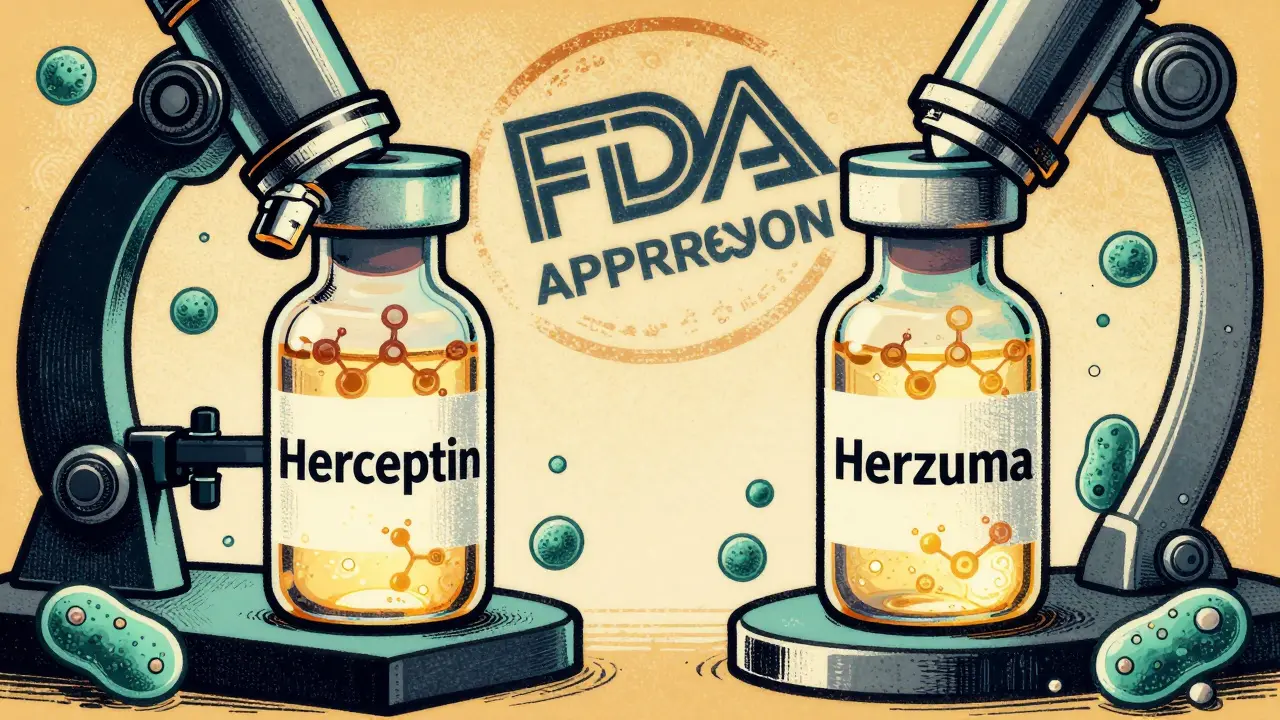
Take trastuzumab, the drug used to treat breast cancer. The brand name is Herceptin. The biosimilar is Herzuma. In clinical trials involving over 1,000 patients, both versions showed the same tumor response rates and side effect profiles. Patients didn’t know which one they got. And in real life, people switching from Herceptin to Herzuma reported no new symptoms or flare-ups.
Biosimilars vs. Authorized Generics: The Key Difference
Authorized generics are made by the original brand company or its partner. They’re chemically identical. You can swap them without thinking twice. Biosimilars? Not so simple.
Here’s why:
- Generics: Made from simple chemical formulas. One pill = one molecule. FDA requires bioequivalence - meaning the body absorbs it the same way. Approval is fast and cheap.
- Biosimilars: Made from living cells. Thousands of tiny structural variations exist naturally. FDA requires dozens of tests: structural analysis, immune response, pharmacokinetics, efficacy, and safety. Approval takes years and costs millions.
Cost savings reflect that difference. Generics cut prices by 80-85%. Biosimilars? Usually 10-50%. Still a big win, especially for drugs that cost $100,000 a year. But it’s not a slam dunk.
Interchangeable Biosimilars: The Real Game-Changer
Not all biosimilars are created equal. Some are labeled "interchangeable." That’s the closest thing to an authorized generic in the biologic world.
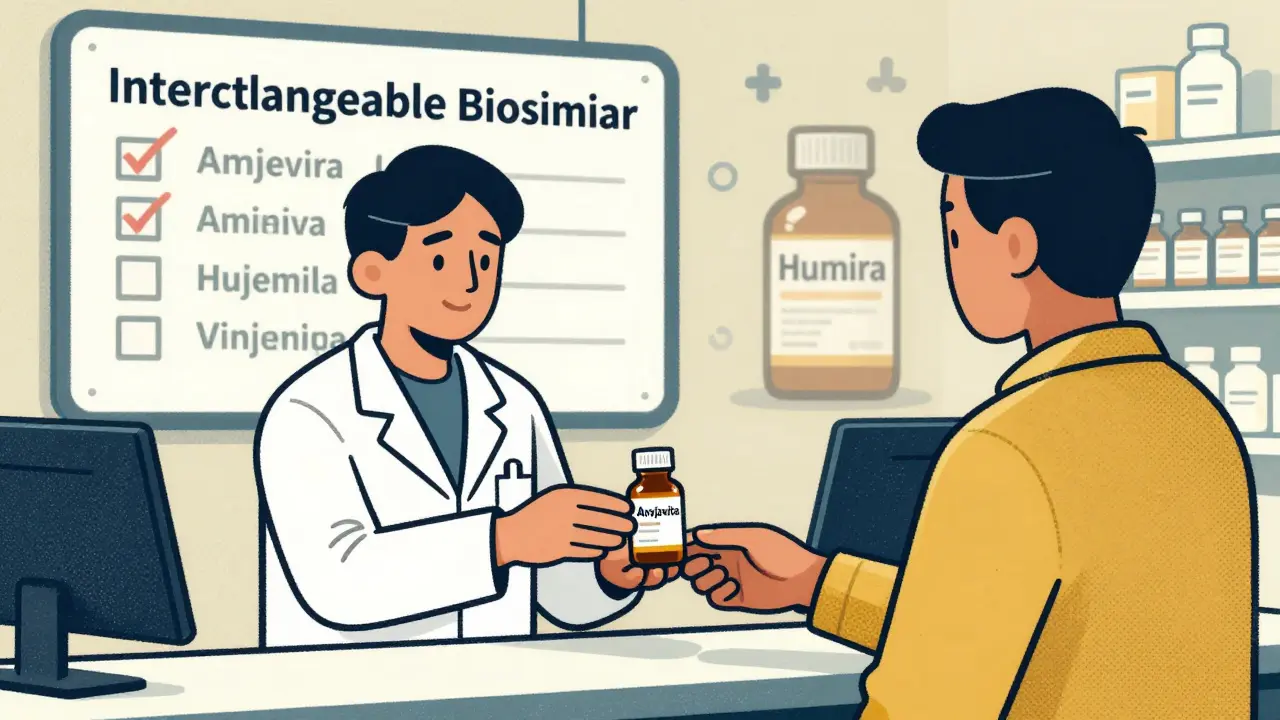
An interchangeable biosimilar can be swapped at the pharmacy without asking the doctor. Just like a generic. This requires extra proof: the biosimilar must work the same even if you switch back and forth between it and the original. Think of it like swapping your coffee maker - you can’t have one that brews differently every time you switch brands.
The FDA approved the first interchangeable biosimilar for Humira (adalimumab) in November 2023. It’s called Amjevita. That’s huge. Humira was the top-selling drug in the U.S. for years, with annual sales over $20 billion. Now, pharmacists can substitute Amjevita automatically - unless the doctor says no.
State laws matter here. Forty-nine states have rules about biosimilar substitution. But only 32 - including California, New York, and Texas - allow pharmacists to swap interchangeable biosimilars without telling the prescriber. In the other states, you might still need a new prescription.
Why Aren’t More People Using Them?
Despite 76 biosimilars approved by the FDA as of late 2023, they make up less than 20% of biologic prescriptions. Why?
- Physician hesitation: Many doctors still worry about switching patients, especially in chronic conditions like rheumatoid arthritis or cancer. One oncologist told me, "I’ve seen patients do great on Herceptin. Why risk it?" But studies show no drop in outcomes.
- Patient fear: Patients hear "similar" and think "less effective." A 2022 Arthritis Foundation survey found 37% of patients were forced to switch by their insurer. Only 12% had worse symptoms - but the anxiety was real.
- Insurance confusion: Some plans put biosimilars on a higher tier, making them cost more than the brand. Others don’t cover them at all. A KFF analysis in 2023 showed only 62% of Medicare Part D plans treat biosimilars the same as brand biologics.
There’s also the "switching horror story." One Reddit user described a rheumatoid arthritis patient who went through three switches - brand, biosimilar A, then biosimilar B - and developed new injection site reactions. Was it the drugs? The timing? No one knows. But it stuck.
Still, the data says otherwise. The Biosimilars Council reports that biosimilars have added over 344 million extra days of therapy for patients who otherwise couldn’t afford treatment. In hospitals, 87% now have formal biosimilar adoption programs. They’re saving millions.
How Are Biosimilars Made and Regulated?
Manufacturing a biologic is like baking a cake with living ingredients. You can’t just follow a recipe. You need strict controls. The FDA requires every biosimilar to be made under Current Good Manufacturing Practices (cGMP). That means:
- Facilities are inspected regularly
- Each batch is tested for purity
- Traceability is built in - if a problem arises, they can track it back to the exact tank
Labeling has improved too. Since 2021, all biosimilars must clearly state the reference product name and approved uses. No more confusion. If a biosimilar is approved for rheumatoid arthritis and psoriasis, it can’t be used for something else.
And here’s something most people don’t know: biosimilars are tracked in real-time. The FDA and CDC monitor adverse events. If a pattern emerges - say, more allergic reactions with one product - they can act fast.
What’s Next for Biosimilars?
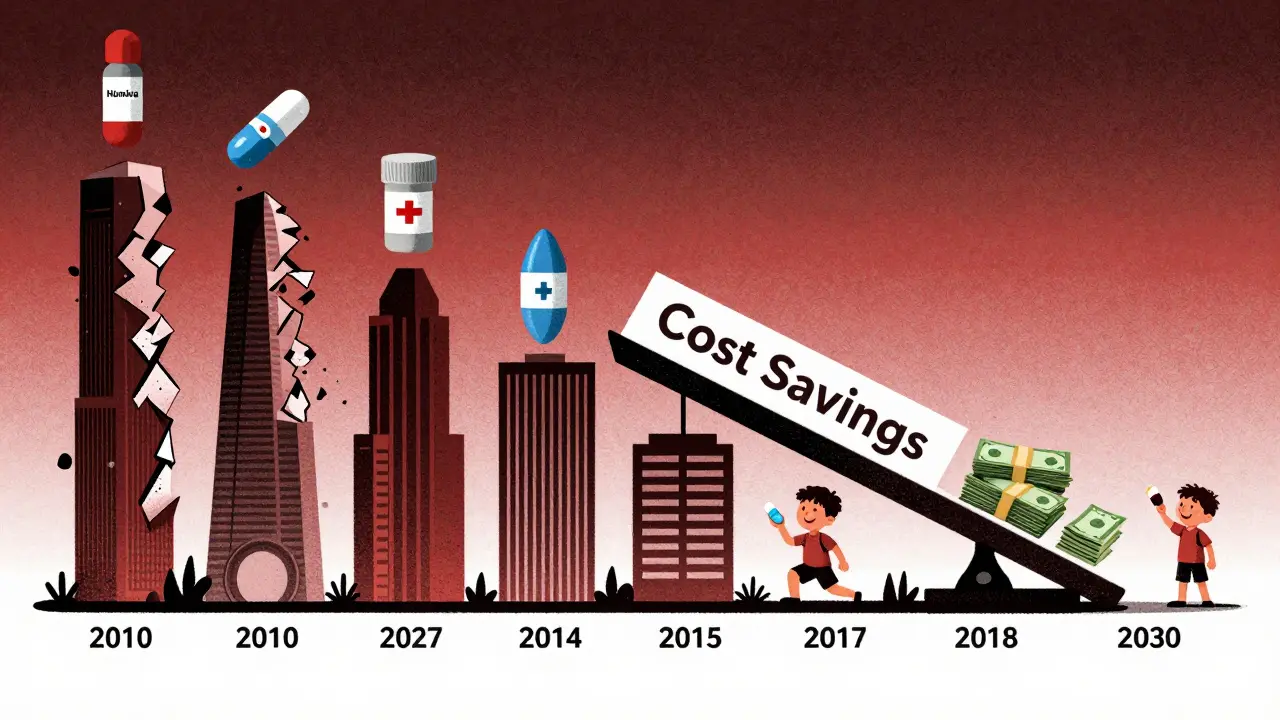
The pipeline is full. The FDA aims to approve 15-20 new biosimilars each year by 2025. Major patent cliffs are coming. By 2028, over $115 billion in global biologic sales will face biosimilar competition.
Cost savings? The Congressional Budget Office estimates $53 billion in Medicare savings alone between 2024 and 2033. That’s enough to cover insulin for millions of Americans.
Big players are stepping up. Amgen has 12 approved biosimilars. Sandoz and Pfizer each have 8. And new companies from Europe and Asia are entering the U.S. market.
The real turning point? Interchangeability. Once pharmacists can swap biosimilars without a doctor’s permission - like they do with generics - adoption will explode. It’s not a matter of if. It’s a matter of when.
What Should You Do?
If you’re on a biologic:
- Ask your doctor: "Is there a biosimilar available for my drug?"
- Check your insurance formulary. Is the biosimilar on the same tier?
- If you’re switched without your knowledge, ask why. You have a right to know.
- Don’t assume biosimilars are "second-rate." They’re held to the same safety standard as the original.
For patients with chronic conditions - arthritis, cancer, Crohn’s - biosimilars aren’t just cheaper. They’re life-changing. One woman in Wisconsin told me: "I was on Humira. My copay was $1,100. My biosimilar? $220. I didn’t lose a single day of work. My pain didn’t come back. I didn’t even notice the difference."
Are biosimilars as safe as brand-name biologics?
Yes. The FDA requires biosimilars to prove no clinically meaningful differences in safety, purity, or effectiveness. They undergo rigorous testing - including immune response, pharmacokinetics, and real-world patient data - before approval. Thousands of patients have used biosimilars without increased risk. The FDA monitors adverse events continuously.
Can I be switched to a biosimilar without my doctor’s permission?
Only if the biosimilar is labeled "interchangeable" and your state allows pharmacist substitution. As of 2026, 32 states - including California, New York, and Texas - permit this. In other states, the pharmacist must contact your doctor first. Always check your state’s laws and ask your pharmacy.
Why do biosimilars cost less than brand biologics but not as much as generics?
Biologics are made in living cells, not chemical labs. Manufacturing them is complex, expensive, and hard to replicate exactly. Biosimilar makers must prove similarity through dozens of tests - unlike generics, which only need to show bioequivalence. That’s why biosimilars save 10-50%, while generics save 80-85%.
What’s the difference between a biosimilar and a generic?
Generics are exact chemical copies of small-molecule drugs. Biosimilars are highly similar, but not identical, versions of complex biologic drugs made from living cells. Generics can be swapped freely. Biosimilars require more proof of similarity and, until recently, couldn’t be automatically substituted.
Do biosimilars cause more side effects?
No. Clinical trials and real-world data show biosimilars have the same side effect profile as their reference products. The FDA requires manufacturers to prove no new or worsening side effects. Some patients report injection site reactions after switching - but studies show these are rare and often unrelated to the drug itself.
Which companies make biosimilars?
Major manufacturers include Amgen (12 approved biosimilars), Sandoz (8), and Pfizer (7). Other players like Biogen, Samsung Bioepis, and Mylan are also active. The FDA has approved 76 biosimilars as of late 2023, with more expected each year.
So biosimilars are like the cousin of generics? Not identical, but close enough that your body won't notice? Kinda wild that we can make a living-cell drug and call it 'similar' and still call it safe. I'm just glad my insulin isn't one of these yet.
They say no clinically meaningful difference. But what if 'meaningful' is defined by a pharmaceutical lobbyist? I’ve seen patients crash after switching. No one talks about the long-term immune effects. And who’s tracking the 10-year outcomes? Not the FDA. Not the drug companies.
I have RA and switched from Humira to a biosimilar last year. My doctor explained everything. My copay dropped from $1,200 to $180. I didn’t feel any different. Honestly? I’m grateful. It’s not magic, but it’s real relief. Don’t let fear stop you from asking.
Interesting how the regulatory approach mirrors cultural attitudes. In Australia, we treat biosimilars like we treat public transport - not perfect, but efficient and worth using. The stigma around 'not original' is real, but the data doesn’t lie. More transparency would help.
They say 'no clinically meaningful difference' - but what about the 12% of patients who had worse symptoms? They’re just data points to them. And don’t get me started on how insurance companies force switches without warning. This isn’t healthcare. It’s cost-cutting with a smiley face. 😒
I work in a clinic that switched 80% of our biologic patients to biosimilars last year. The results? Less financial stress. Fewer skipped doses. More people sticking with treatment. One guy told me he could finally afford to take his kid to the zoo. That’s not just savings. That’s dignity. And yeah, it’s science - not snake oil.
It’s funny how we treat molecules like they’re sacred. We accept that two batches of beer brewed in the same factory can taste different - but when it’s a drug made in yeast? Suddenly it’s a crisis. Maybe we’re just scared of complexity. Or maybe we’re scared of change.
The FDA’s 'totality of evidence' standard is actually one of the most rigorous frameworks in medicine. It’s not a shortcut - it’s a smarter one. We don’t need to repeat 500-patient trials if the structural, immunological, and pharmacokinetic data align. That’s efficiency, not laziness.
Let’s be clear: biosimilars are not 'generic light.' They’re a triumph of biotech precision. The manufacturing process alone involves hundreds of quality checkpoints, real-time monitoring, and traceability systems that would make a NASA engineer nod in approval. This isn’t cutting corners. It’s engineering excellence.
You think the 10-50% savings is good? Wait till 2028 when 115 billion in biologics go off patent. We’re talking about insulin, rheumatoid drugs, cancer meds - all dropping 60-70%. The pharma giants are already lobbying to keep biosimilars on tier 3. Don’t let them win.
I’ve been on a biosimilar for 3 years. No issues. My doctor didn’t even tell me until after the switch - and I didn’t notice. My body didn’t care. My wallet did. If you’re scared to switch, ask for data. Not opinions. The data says you’re safe. And honestly? That’s more than we got with a lot of old-school meds.
So we spent 20 years making drugs that cost $100k/year... then made a cheaper version... and now we’re arguing about whether it’s 'the same.' We’re humans. We overcomplicate everything. 🤦♂️
I get why people are nervous. But if you think the original brand is perfect, you haven’t read the clinical trial data. Even the brand has batch variations. The biosimilar just has more documentation. That’s not a flaw - that’s transparency.
I’ve heard stories. People switching to biosimilars and getting sick. Then the company says 'it’s just coincidence.' What if it’s not? What if they’re hiding the long-term immune reactions? Who’s funding the studies? Who owns the labs? Think about it.
You call that 'rigorous testing'? Please. They run 300 patients for 6 months and call it a day. The original biologic had 12,000 patient-years of data. Biosimilars get a pass because Big Pharma wants to protect its monopoly on the brand. This isn’t science. It’s corporate calculus.