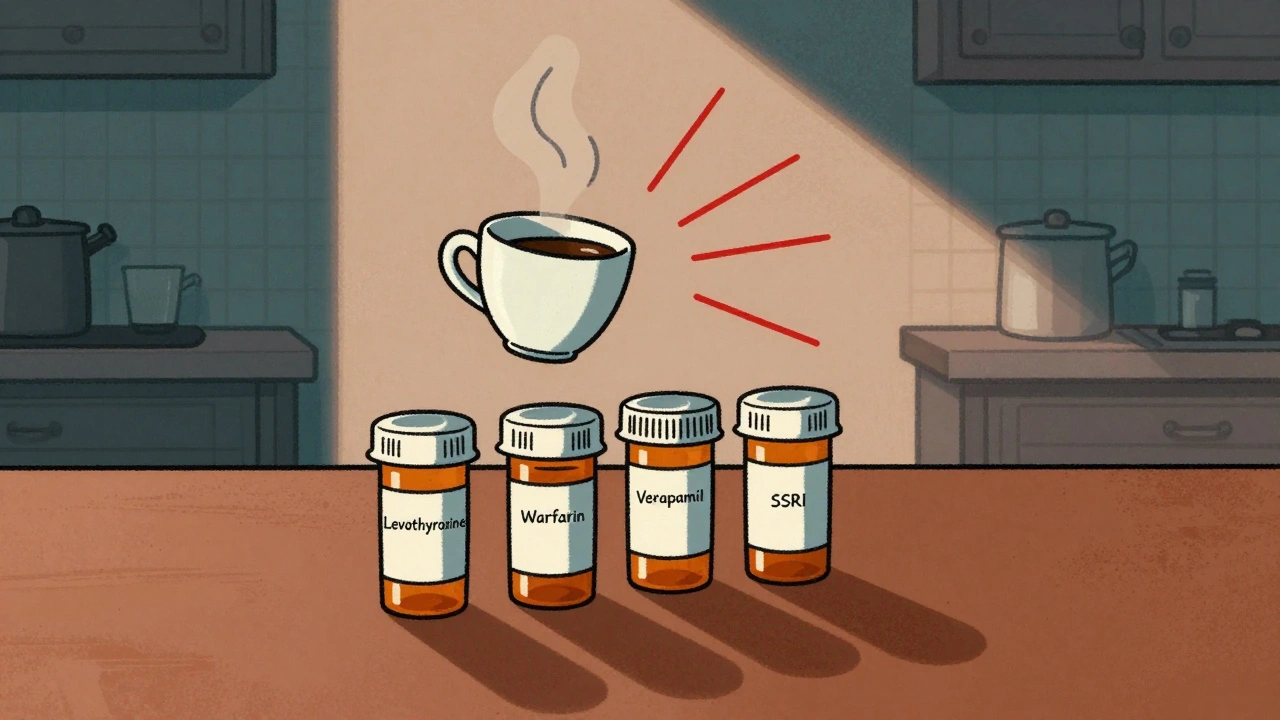
Most people drink coffee without thinking twice. But if you're on medication, that morning cup could be doing more than just waking you up-it might be making your drugs less effective, or even dangerous. Caffeine isn't just a harmless stimulant. It's a powerful chemical that interacts with your body's drug-processing systems in ways most people don't realize. And these interactions aren't theoretical. People are ending up in emergency rooms because they didn't know coffee could mess with their heart medication, thyroid pills, or blood thinners.
How Caffeine Changes How Your Medications Work
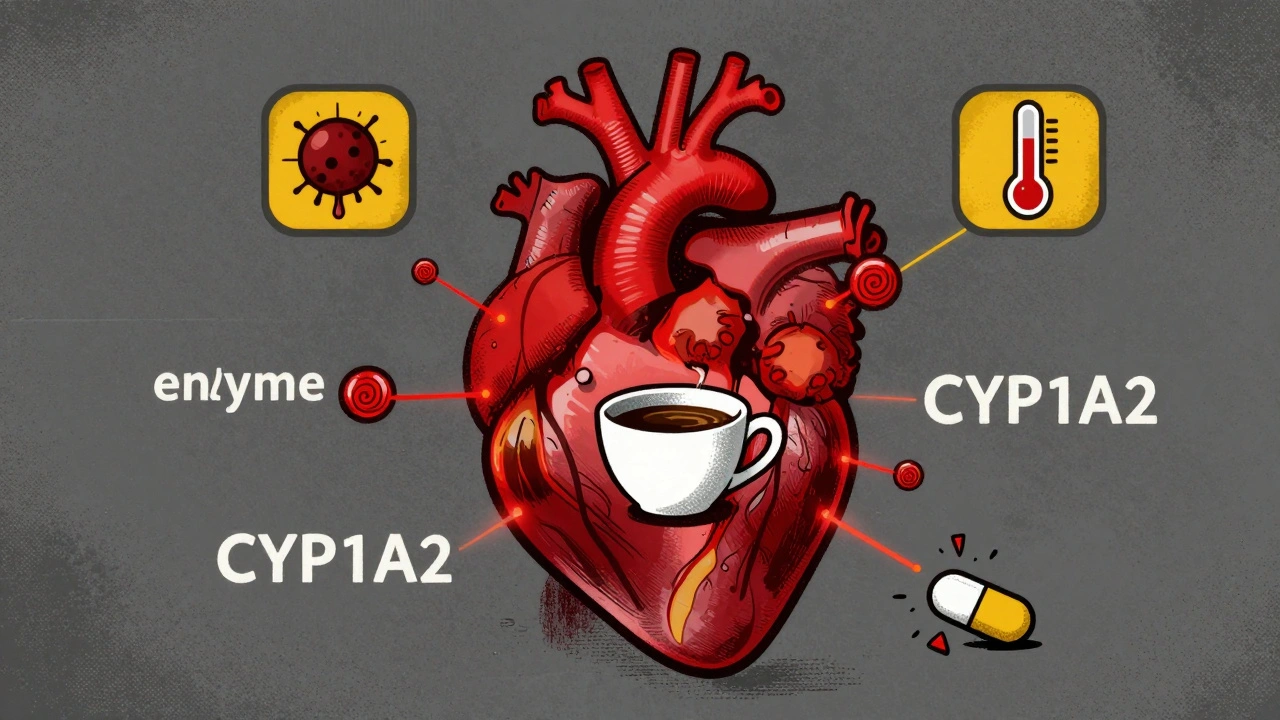
Caffeine doesn't just buzz through your system like sugar. It actively interferes with how your liver breaks down drugs. The enzyme CYP1A2 handles about 10% of all prescription medications-and caffeine blocks it. When caffeine sits in your liver, it slows down the breakdown of other drugs. That means those drugs stick around longer, building up to dangerous levels. Or, in other cases, caffeine blocks absorption in your gut, so your body doesn't get enough of the medicine at all.
This isn't about drinking too much coffee. Even one cup can cause problems if you're on the wrong medication. The timing matters too. Taking your pill and then chugging coffee 10 minutes later? That’s enough to throw off absorption. The effects aren’t always obvious. You might feel fine, but your blood test tells a different story.
Levothyroxine and Coffee: A Silent Threat to Thyroid Health
If you take levothyroxine for hypothyroidism, coffee is your enemy. Studies show that drinking coffee within an hour of taking your pill can reduce absorption by up to 55%. That’s not a small drop-it’s enough to send your TSH levels soaring. One patient, who went from a stable TSH of 1.8 to 8.7 after drinking coffee with her pill, had to restart her treatment from scratch. Her endocrinologist confirmed: it was textbook coffee interference.
The American Thyroid Association says you need to wait at least 60 minutes after taking levothyroxine before drinking coffee. Some experts recommend 90 minutes if you’re still seeing fluctuations. And it’s not just coffee. Tea, energy drinks, and even some medications with caffeine can do the same thing. If your thyroid levels keep jumping without reason, check your morning routine. It might not be your dose-it might be your cup.
Warfarin and Caffeine: The Hidden Bleeding Risk
Warfarin (Coumadin) is one of the most common blood thinners in the world. But it’s also one of the most sensitive to caffeine. When you drink coffee, caffeine blocks CYP1A2, which is the same enzyme that breaks down warfarin. That means warfarin builds up in your blood. Your INR-a measure of how long your blood takes to clot-can jump 15 to 25% within 24 hours of drinking coffee. An INR above 4.0 is dangerous. It means you’re at risk of bleeding inside your brain, stomach, or elsewhere.
A University of Michigan survey found that 41% of warfarin patients who drank more than 200 mg of caffeine daily (about two cups of coffee) had unexplained INR spikes above 4.0. Seventeen percent of them ended up in the ER because of bleeding. The FDA says you must keep your caffeine intake consistent. If you usually drink two cups a day, don’t suddenly switch to five. And if you don’t drink coffee, don’t start-especially if you’re on warfarin. Even energy drinks can trigger this reaction. One can of a popular energy drink contains 80 to 300 mg of caffeine. That’s more than enough to throw your INR out of range.
Heart Medications: Caffeine Can Cancel Out Your Treatment
If you’re on a calcium-channel blocker like verapamil or diltiazem for high blood pressure or heart rhythm problems, coffee can cut its effectiveness by 25 to 30%. Harvard Health found that caffeine competes with these drugs for absorption in your intestines. So even if you take your pill correctly, coffee can prevent your body from absorbing it properly.
And then there’s adenosine, used during cardiac stress tests. If you’ve had coffee, tea, or even chocolate in the last 24 hours, the test won’t work. The caffeine blocks adenosine’s effect. Doctors have to reschedule the test-and delay your diagnosis. One study showed that caffeine reduces adenosine’s effectiveness by 70 to 90%. That’s not a minor inconvenience. It’s a medical risk.
Antidepressants and Anxiety: When Coffee Makes Things Worse
SSRIs like fluoxetine, sertraline, and fluvoxamine are commonly prescribed for depression and anxiety. But caffeine can reduce their absorption by up to 33%. That means you’re not getting the full dose. Patients report feeling like their medication stopped working-even though they haven’t changed their dose. On Drugs.com, 63% of users who combined caffeine with SSRIs reported increased anxiety, jitteriness, or insomnia. That’s not just side effects. That’s the medication failing.
Not all antidepressants react the same way. Bupropion doesn’t interact with caffeine. But if you’re on fluvoxamine, the interaction is strong. The FDA warns that fluvoxamine can also slow caffeine breakdown, making you feel wired for hours after one cup. If you’re on an SSRI and suddenly feel more anxious or restless, check your caffeine intake. It might not be your mental health-it might be your coffee.
Theophylline and Asthma: A Dangerous Mix
Theophylline is an older asthma medication that works by opening airways. But it’s metabolized by the same enzyme as caffeine-CYP1A2. When you take both, caffeine can increase theophylline levels by 15 to 20%. That might sound good, but it’s not. Theophylline has a narrow safety window. Too much causes nausea, rapid heartbeat, tremors, and even seizures. In a 2024 study of 317 asthma patients on theophylline, 22% developed a heart rate over 100 bpm after drinking caffeine. That’s a red flag.
Experts now recommend limiting caffeine to under 100 mg per day if you’re on theophylline. That’s one small coffee. Two cups? Too much. Energy drinks? Avoid them completely. Many patients don’t realize their asthma medication is this sensitive. If your symptoms are getting worse despite taking your inhaler and pills, caffeine might be the hidden trigger.
Decongestants and Caffeine: A Recipe for High Blood Pressure
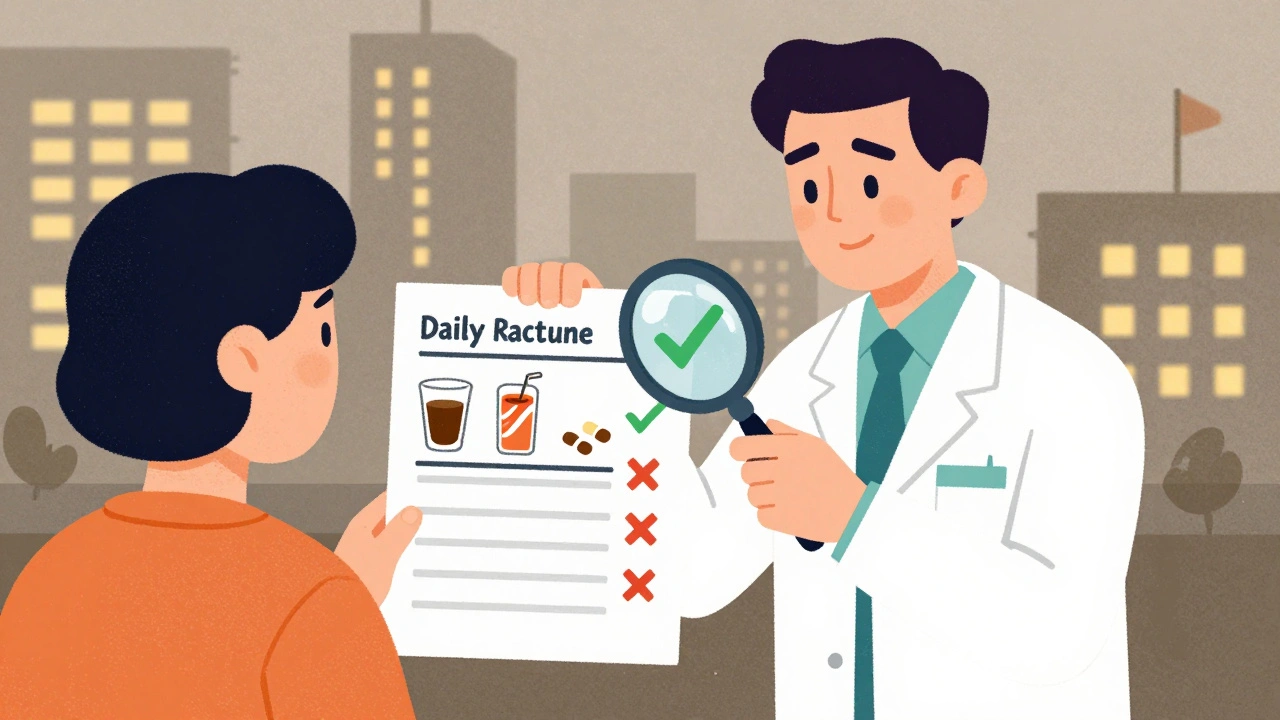
Many cold and allergy meds contain pseudoephedrine or phenylephrine. These are stimulants that raise your heart rate and blood pressure. Add caffeine? You’re stacking two stimulants. Dr. John Higgins from UT Southwestern says this combo can spike heart rates by 20 to 30 beats per minute in sensitive people. That’s like running a sprint after sitting all day.
And it gets worse with ephedrine. The Mayo Clinic says combining ephedrine with caffeine increases the risk of hypertensive crisis by 47%. In clinical trials, 68% of patients saw systolic blood pressure rise over 30 mmHg. That’s enough to cause stroke or heart attack in older adults or those with existing heart conditions. If you have high blood pressure, heart disease, or even just a family history, avoid decongestants with caffeine. Read labels. Look for “pseudoephedrine,” “phenylephrine,” or “stimulant” on the ingredient list.
What You Should Do Right Now
Don’t panic. But do take action.
- Check your meds. Look up every prescription and OTC drug you take. Search for “caffeine interaction” on Drugs.com or the FDA’s website.
- Separate coffee and pills. Wait at least 60 minutes after taking levothyroxine, verapamil, or SSRIs before drinking coffee. For warfarin, keep your caffeine intake consistent-no sudden spikes.
- Avoid energy drinks. They’re loaded with caffeine and other stimulants like taurine and ginseng that can independently affect drug metabolism. They’re not safer than coffee-they’re riskier.
- Track your symptoms. If your medication seems less effective, or you’re feeling jittery, anxious, or your heart races, caffeine might be the cause.
- Talk to your pharmacist. Pharmacists are trained to spot these interactions. Ask them to review your full list of medications and caffeine sources.
What’s Changing in 2025
Doctors and pharmacists are waking up to this problem. The American Pharmacists Association now requires all certified pharmacists to screen for 17 high-risk caffeine-drug combinations during medication reviews. The FDA has seen a 37% jump in adverse event reports related to caffeine and meds since 2020. And new research is pushing for personalized advice.
A $4.7 million NIH study launched in January 2025 is looking at how your genes affect caffeine metabolism. Some people break down caffeine quickly. Others hold onto it for hours. If you’re a slow metabolizer, even one cup can be dangerous. By 2028, genetic testing might be standard before prescribing certain drugs.
Electronic health records are starting to flag these risks too. Epic Systems rolled out a pilot program in 47 hospitals that automatically warns doctors if a patient on warfarin or levothyroxine orders coffee with their prescription. Early results show a 29% drop in interaction-related ER visits.
This isn’t about giving up coffee. It’s about using it safely. If you’re on medication, caffeine isn’t just a beverage. It’s a drug interaction waiting to happen.
Okay but real talk-how many of us have been drinking coffee with our thyroid meds and just thought we were ‘being lazy’ when we felt tired all day? I was one of them. My TSH was all over the place for months. My doctor finally asked me about my morning routine… and I almost cried when I realized it wasn’t my fault. I just needed to wait an hour. One hour. That’s it. Now I drink my coffee like a ritual, not a reflex. Life changed.
Y’all need to stop treating caffeine like it’s harmless. It’s a drug. A legal, socially accepted drug that messes with your liver enzymes like a drunk DJ at a pharmacy. I’m a pharmacist. I’ve seen people come in with INR levels of 6.8 after ‘just one energy drink.’ One. And they act like it’s normal. It’s not. Your coffee isn’t your friend. Your meds are. Prioritize.
my doc never told me about the coffee thing with my levothyroxine… i thought i was just bad at taking meds on time. turns out i was just drinking coffee too fast. now i wait 90 mins and i feel like a new person. also, if you take warfarin-don’t even think about switching from coffee to energy drinks. i did. ended up in the er with a nosebleed that wouldn’t stop. not fun. stay safe, folks.
so let me get this straight… i can’t have coffee with my meds, but i can have 3 energy drinks and a Red Bull shot after my heart pill? because ‘consistency’? lol. yeah right. this whole thing feels like a conspiracy to make us drink decaf and buy more expensive tea. also, why is no one talking about how much sugar is in these ‘safe’ alternatives?
i just found out my anxiety isnt from stress-its from coffee with my sertraline. i thought i was just ‘high strung’ but no. i cut back to half a cup in the afternoon and my panic attacks dropped by 80%. i’m crying happy tears. also, i still drink tea. just not with pills. 🥹
you know what’s really going on? big pharma and big coffee are in cahoots. they want you to think it’s ‘your fault’ you feel weird. but really, they just want you to keep buying meds AND coffee so you never stop spending. they don’t want you to know you can take your pill with water and wait. they want you addicted. also, tea is worse than coffee. trust me. i’ve seen the charts.
you’re all overreacting. it’s one cup. who cares? if your meds are that fragile, maybe you shouldn’t be on them. i’ve been drinking coffee with my warfarin for 10 years. no problems. you people need to chill. also, your thyroid is fine. just eat more carbs.
While the CYP1A2-mediated pharmacokinetic interactions are well-documented in peer-reviewed literature (e.g., Pharm Res 2021;38:1204–15), the clinical relevance is often overstated in pop-med discourse. The real issue lies in pharmacogenomic variability-CYP1A2*1F allele carriers exhibit 3x greater inhibition. Until we screen for rs762551, blanket warnings are reductionist. Also, your ‘one cup’ assumption ignores bioavailability variance from roast type and brewing method. #Pharmacogenomics
thank you for this. i’m a single mom and i was taking my meds with my coffee because i was tired and in a rush. i felt guilty like i was failing. now i know it’s not me. it’s the system. i made a little chart for my fridge: ‘pill first, coffee later’. i even put a timer on my phone. it’s so simple. why didn’t anyone tell me this before?
There’s an ontological tension here: caffeine is simultaneously a cultural ritual and a biochemical modulator. We’ve anthropologized coffee as comfort, but pharmacologically, it’s a competitive inhibitor with narrow therapeutic windows. The tragedy isn’t the interaction-it’s the epistemic failure of medical education. If your doctor doesn’t ask about your morning routine, they’re not treating you-they’re prescribing. We need systemic change, not just individual discipline.
So I just Googled ‘caffeine + my meds’ and found out I’ve been sabotaging my antidepressant for two years. I thought I was just ‘not a morning person.’ Turns out I was just a walking caffeine-drug collision. Now I drink my coffee at noon. And guess what? I’m sleeping. I’m not crying randomly. I’m actually… okay. This is the most important thing I’ve learned since high school. Thanks, stranger on the internet.
just started waiting 60 mins after my pill and now i can actually feel my heart beating normally. no more racing. no more jitters. i used to think i was just ‘anxious’-turns out i was just overdosed on coffee + meds. also, i switched to decaf in the morning and now i don’t miss the buzz. life’s better without the crash. 🤘
It’s not about avoiding coffee. It’s about respecting the chemistry. Your body isn’t a machine you can hack with habit. It’s a dynamic system. Caffeine isn’t evil-it’s powerful. And power demands awareness. If you’re on medication, you’re not just a consumer. You’re a participant in a biochemical negotiation. Show up with intention.
my grandma from mexico used to say: ‘si tomas medicina, no tomes café’-if you take medicine, don’t drink coffee. she didn’t know about CYP1A2, but she knew what worked. i’m so glad we’re finally catching up to traditional wisdom. also, i now make herbal tea for my morning ritual. it’s warm, it’s calm, and it doesn’t ruin my meds. 🌿❤️