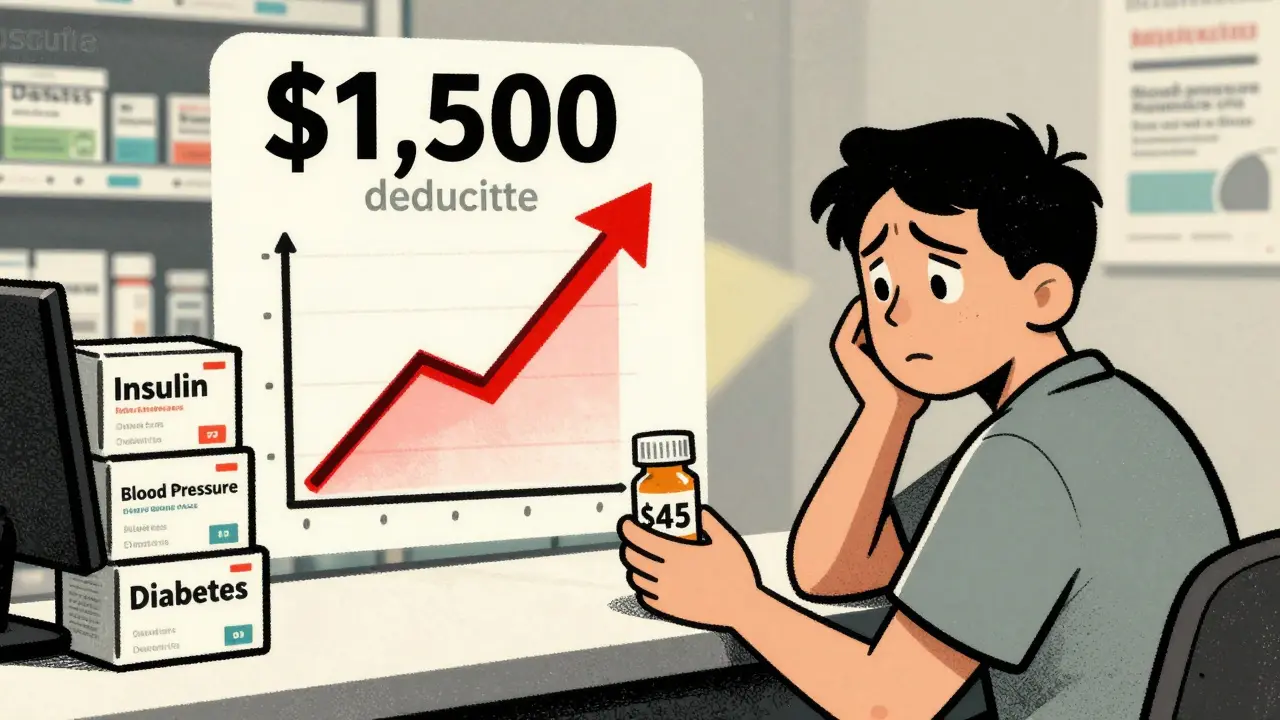
When you pick up your prescription, the pharmacist hands you the bottle and says, "That’ll be $45." You’re confused. Your insurance is supposed to cover this, right? But you’ve already paid $1,200 this year just to get your meds. Why are you still paying so much? The answer lies in cost sharing - the system that makes you pay part of your healthcare bills, even when you have insurance.
Deductibles, copays, and coinsurance aren’t just buzzwords. They’re real numbers that directly affect how much you pay for your medications. And if you don’t understand them, you could end up with surprise bills - even when you think you’re covered.
What Is a Deductible, Really?
Your deductible is the amount you pay out of pocket before your insurance starts helping with costs. For example, if your plan has a $1,500 deductible, you pay 100% of your medication costs until you’ve spent that much in a year. After that, your insurance kicks in.
It doesn’t matter if you’re buying a $5 generic or a $500 specialty drug. Until you hit your deductible, you’re on your own. That’s why people on high-deductible plans often delay filling prescriptions - not because they don’t need them, but because they can’t afford to pay full price.
Some plans have separate deductibles for prescriptions. Others combine medical and drug costs into one total. Check your plan documents. If you take multiple medications, your deductible might be met faster than you think - especially if you’re managing a chronic condition like diabetes or high blood pressure.
Copays: The Fixed Fee at the Pharmacy
A copay is a flat fee you pay each time you fill a prescription. It’s usually $10, $25, or $40 - no matter how much the drug actually costs. Copays are common in lower-deductible plans, like silver or gold tiers.
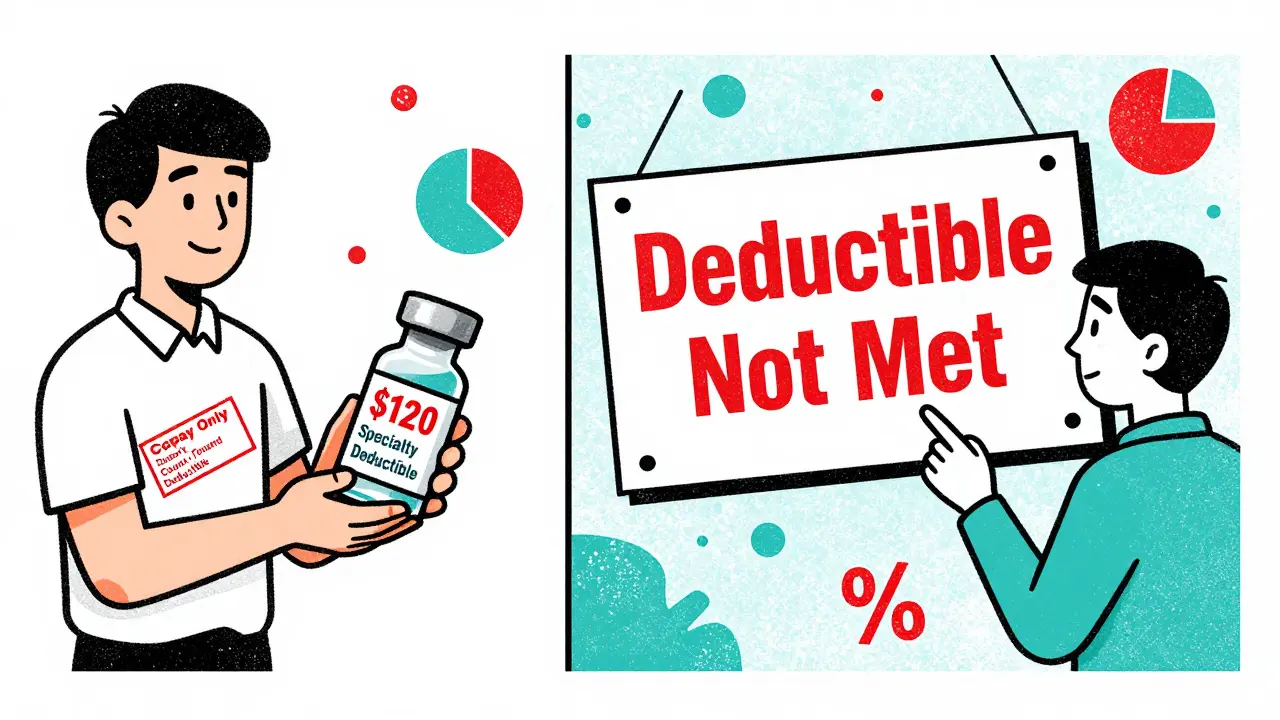
Here’s how it works: You have a $30 copay for tier 2 drugs. Your insulin costs $120, but you only pay $30. Your insurance covers the rest. Simple, right? But here’s the catch: copays often don’t count toward your deductible. They only count toward your out-of-pocket maximum.
That means you could pay $30 every month for six months - $180 total - and still not be close to meeting your $1,500 deductible. Then, when you need a new medication that costs $800, you still pay the full $800 because your deductible isn’t met yet. This is where people get burned.
Some plans waive copays for preventive meds or generic drugs. Others have tiered copays: $5 for generics, $45 for brand-name, $100 for specialty drugs. Always ask your pharmacist: "Is this covered at a lower tier?" You might save hundreds.
Coinsurance: The Percentage You Pay After the Deductible
Coinsurance is when you pay a percentage of the drug’s cost - not a fixed amount. After you meet your deductible, your plan might cover 80%, so you pay 20%. If your medication costs $500, you pay $100. If it’s $1,200, you pay $240.
This is where things get tricky. Coinsurance applies to the allowed amount - not the actual price. Insurance companies negotiate prices with pharmacies and drug makers. That negotiated rate is what your coinsurance is based on. So even if the pharmacy charges $600, your insurer might only count $400 toward your coinsurance. You pay 20% of $400 - $80 - not $120.
Specialty drugs for conditions like rheumatoid arthritis or multiple sclerosis often have coinsurance rates of 25% to 50%. That means a $10,000 monthly drug could cost you $2,500 to $5,000 - unless your plan has a cap. That’s why many people with chronic illnesses end up in financial crisis, even with insurance.
Out-of-Pocket Maximum: The Safety Net
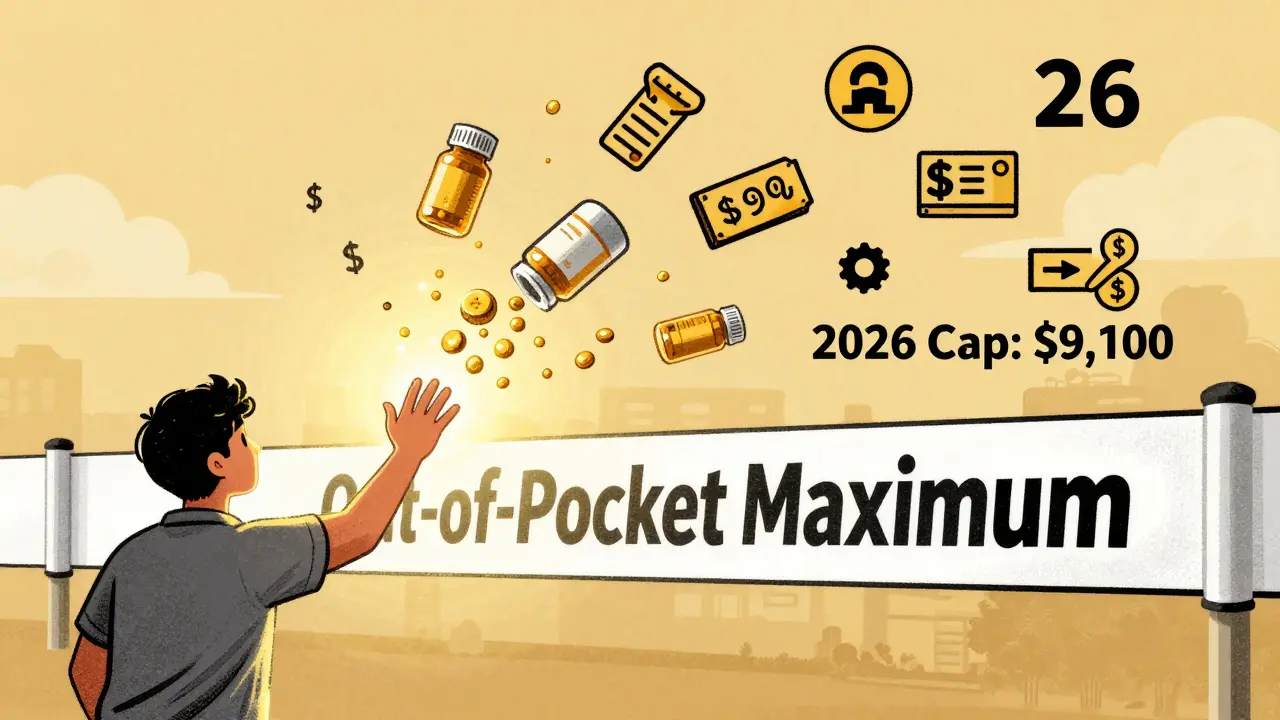
There’s a limit to how much you can be forced to pay in a year. That’s your out-of-pocket maximum. In 2026, the federal cap is $9,100 for individuals and $18,200 for families. Once you hit that number, your insurance pays 100% of all covered services - including meds - for the rest of the year.
Here’s the key: deductibles, copays, and coinsurance all count toward this limit. But premiums don’t. That’s a common mistake. People think their monthly payment is part of their out-of-pocket cost. It’s not. Only what you pay at the pharmacy, ER, or doctor’s office counts.
Let’s say you have a $2,000 deductible, $30 copays, and 20% coinsurance. You take three meds: one $150/month generic, one $400/month brand-name, and one $1,200/month specialty drug. By August, you’ve paid $7,800 in total out-of-pocket. In September, you hit your max. Your last $1,200 drug? Free. Your $150 generic? Free. Your insurance picks up the full cost from here on out.
How Plans Differ - Bronze vs. Platinum
Not all plans are created equal. Bronze plans have low monthly premiums but high deductibles - often $7,000 or more. That means you pay almost everything out of pocket until you hit that high number. Good if you’re healthy. Terrible if you need regular meds.
Platinum plans? High premiums, low deductibles - sometimes as low as $100. You pay more each month, but your meds cost way less upfront. If you’re on a biologic for psoriasis or take daily insulin, platinum might save you thousands over the year.
Here’s a real example: A person with type 1 diabetes needs $1,800/month of insulin. In a bronze plan with a $7,000 deductible, they pay $1,800/month until they hit $7,000 - that’s four months. Then they switch to coinsurance. If it’s 30%, they pay $540/month for the next eight months. Total out-of-pocket: $10,320. But they hit the $9,100 cap in October. After that? Free insulin.
In a platinum plan with a $500 deductible and $20 copay, they pay $500 once, then $20/month. Total out-of-pocket: $290. That’s a $10,000 difference.
What You Can Do Right Now
Don’t wait for a surprise bill. Take control:
- Read your Summary of Benefits and Coverage (SBC). Every insurer must give you this. Look for the section on "Prescription Drugs." It shows real examples of how much you’d pay for common meds.
- Ask your pharmacist: "Is this drug on my plan’s formulary? What tier? What’s my copay or coinsurance?" They can check in seconds.
- Use your insurer’s online cost estimator. Enter your drug name and pharmacy. It’ll show your exact cost before you fill it.
- Check if your drug has a manufacturer coupon or patient assistance program. Many brands offer $0 copays for qualifying patients.
- Know your out-of-pocket max. Track your spending. When you’re close, you can plan for big meds without fear.
And never assume your insurance covers something. Always confirm. A 2022 study found that 65% of surprise bills could’ve been avoided if people checked their cost-sharing rules before getting care.
Special Cases: Insulin, Mental Health, and Preventive Drugs
Thanks to the Inflation Reduction Act of 2022, Medicare beneficiaries pay no more than $35 per month for insulin - no deductible, no coinsurance. That’s huge. But it only applies to Medicare. If you’re on private insurance, you still pay full price unless your plan has its own cap.
Many plans now cover preventive meds - like statins or birth control - with $0 copay, even before you meet your deductible. That’s thanks to the Affordable Care Act. But not all preventive drugs are treated equally. Ask: "Is this considered preventive under my plan?"
Mental health meds often have higher cost-sharing than other prescriptions. That’s changing, but slowly. Some plans still require prior authorization or step therapy - meaning you have to try cheaper drugs first. Don’t accept that without pushing back. Your health matters more than a policy rule.
Final Tip: Ask for the Generic
Generic drugs work the same as brand-name. They’re just cheaper. And your plan usually rewards you with lower copays or coinsurance. A generic version of your medication could cut your monthly cost from $300 to $20. That’s $3,360 saved a year.
Ask your doctor: "Is there a generic version?" If they say no, ask why. Sometimes it’s just habit. Sometimes it’s not true. You have the right to know your options.
Cost sharing isn’t designed to punish you. It’s meant to make insurance affordable for everyone. But without understanding it, you’re playing a game with rules you don’t know. Take the time to learn your plan. Ask questions. Track your spending. You’re not just paying for meds - you’re protecting your financial health too.
Do copays count toward my deductible?
Usually, no. Copays are fixed fees paid at the pharmacy and typically don’t count toward your deductible. They do count toward your out-of-pocket maximum, though. Always check your plan’s Summary of Benefits to confirm how your specific plan works.
What’s the difference between coinsurance and a copay?
A copay is a fixed dollar amount you pay per prescription - like $25 - no matter what the drug costs. Coinsurance is a percentage - like 20% - of the drug’s allowed cost, and you only pay it after you’ve met your deductible. So if your drug costs $500 and your coinsurance is 20%, you pay $100. If it’s $1,000, you pay $200.
Can I get help paying for expensive medications?
Yes. Many drug manufacturers offer patient assistance programs that lower or eliminate your cost-sharing. Nonprofits like the Patient Advocate Foundation and NeedyMeds can help you apply. Some states also have prescription assistance programs. Always ask your pharmacist or insurer: "Is there financial help for this drug?"
Why do I pay more at an out-of-network pharmacy?
Out-of-network pharmacies don’t have negotiated rates with your insurer. That means your coinsurance is based on the higher, full retail price - not the discounted rate. You might pay 50% instead of 20%. Always use in-network pharmacies unless it’s an emergency.
Do preventive medications count toward my deductible?
No. Under the Affordable Care Act, most preventive services - including certain vaccines, screenings, and birth control - must be covered with $0 cost-sharing, even before you meet your deductible. But not all meds are classified as preventive. Check your plan’s list to see which ones qualify.
If you’re managing a chronic condition, your out-of-pocket costs can add up fast. But knowing how deductibles, copays, and coinsurance work gives you power. You can plan ahead, find cheaper alternatives, and avoid being blindsided by bills. Don’t let confusion cost you more than it should.



I used to think my $45 copay was a steal until I realized I’d paid $1,200 just to hit my deductible. No one tells you that copays don’t count toward it. I was literally paying for meds I didn’t even get coverage on yet. My pharmacist had to explain it to me - not my insurer. That’s messed up.
bro why do we even have this system?? like wtf is the point of insurance if i still gotta pay 5k before i get any help?? my insulin costs 1.2k/mo and i’m just supposed to ‘plan ahead’?? nah fam. this is just corporate greed with a fancy name. #medpricegouging
Okay but… isn’t this just capitalism being capitalism? We’re all just pawns in a game where the house always wins. I mean, if you’re not rich, you’re basically paying to stay alive. And they call it ‘affordable care.’ 😂
THIS. I’m on a bronze plan and my anxiety med went from $20 to $180 overnight because my deductible reset. I cried in the pharmacy aisle. 😭 Thank you for explaining coinsurance - I finally get it. Also, generics are life. I switched mine last month. $15 now. 🙏
Just wanted to say I appreciate how clear this breakdown is. I’ve been avoiding reading my SBC for months because it felt like legalese. But now I’m going through it with my mom - she’s on Medicare and doesn’t realize her insulin cap doesn’t apply to her private plan. Thanks for the nudge.
It is of paramount importance to recognize that the structural inequities embedded within the cost-sharing paradigm disproportionately affect low-income populations, particularly those managing chronic conditions. The notion that individuals should 'track their spending' assumes a level of financial literacy and temporal bandwidth that is not universally accessible. Moreover, the reliance on patient assistance programs - while commendable - functions as a band-aid on a systemic wound. One must ask: why is healthcare commodified at all?
so like… if you’re rich, you just pay the premium and everything’s fine. if you’re not… you’re just supposed to ‘ask your pharmacist’ and ‘use coupons’? 🤡 i’m not a financial advisor. i’m a teacher who needs my thyroid med. this system is designed to confuse people into giving up. i’m done.
One cannot help but observe that the American healthcare system, in its current iteration, functions not as a social contract but as a predatory financial instrument. The normalization of cost-sharing mechanisms, particularly for life-sustaining medications, constitutes a moral failure of the highest order. One is left to wonder whether the pursuit of profit has entirely eclipsed the Hippocratic imperative.
Correction: The out-of-pocket maximum for 2026 is $9,100 for individuals, not $9,100 for families. The family cap is $18,200. Also, the Inflation Reduction Act caps insulin at $35/month for Medicare Part D, not all private plans. Fix your facts before you post.
My cousin in India pays $2 for her diabetes pills. Here, I pay $120. I don’t understand how a country with so much money makes people choose between food and medicine. Please don’t say ‘ask your pharmacist’ - they’re just workers too. This isn’t about individual action. It’s about change.