Bleeding Risk Simulator
Simulator: Toggle options below to see how they theoretically impact bleeding risk markers.
Current Status
Monitoring...
Symptom Checklist
If you experience these, it may indicate your blood is too thin.
Here is something many patients overlook: mixing herbal supplements with blood thinners isn’t always harmless. When you take Dong Quai, also known as Angelica sinensis, alongside warfarina common anticoagulant medication, you might be stepping into a zone where your blood becomes too thin. This isn’t just theoretical. There is real-world data showing how these two substances collide to spike bleeding risks.
If you manage atrial fibrillation, deep vein thrombosis, or heart valve issues, you likely know the name warfarin. It has been the standard of care for decades. But when you reach for natural remedies to ease menopausal symptoms or menstrual cramps, you might pick up Dong Quai without realizing it shares a chemical family with your prescription. That overlap is where the danger hides.
Quick Key Takeaways
- Avoid Combination: Most medical guidelines advise against using Dong Quai while on warfarin due to unpredictable bleeding risks.
- Mechanism: Dong Quai contains coumarin derivatives that can mimic or enhance the effect of warfarin, pushing INR levels too high.
- Monitor INR: If you use both, frequent International Normalized Ratio checks are essential to stay in the safe therapeutic window.
- Symptoms Watch: Unusual bruising, nosebleeds, or gum bleeding are early signs of over-anticoagulation.
- Consult First: Always clear herbal supplements with your cardiologist or pharmacist before adding them to your regimen.
What Exactly Is Dong Quai?
To understand the risk, you need to know what you are taking. Dong Quai is a root harvested from the Angelica sinensis plant. Traditionally, this herb has served a vital role in Traditional Chinese Medicine for over 2,000 years, often called "female ginseng" because of its reputation for supporting women’s health.
Historically documented in texts like the Shen Nong Ben Cao Jing, it remains popular today. Around 70% of the global supply comes from Gansu Province in China. People often consume it as a dried root, tea, capsule, or tincture. While many find it soothing for conditions like premenstrual syndrome or hot flashes, its chemical makeup includes potent compounds such as ferulic acid and osthole. These aren’t just inert plant fibers. They actively interact with your body’s clotting system.
How Warfarin Works and Why Stability Matters
Warfarin operates by inhibiting vitamin K-dependent clotting factors. Unlike newer anticoagulants, it does not have a direct antidote in most cases once bleeding starts. Its half-life ranges from 20 to 60 hours, meaning it stays in your system for a long time. This creates a narrow therapeutic index. You want your International Normalized Ratio, or INR, between 2.0 and 3.0 for most standard conditions. Go lower, and clots form. Go higher, and spontaneous bleeding occurs.
Because the margin for error is slim, anything you add to your routine that affects liver enzymes or platelets shifts that balance. Even small dietary changes can swing your INR. Adding a potent herb like Dong Quai acts less like a side salad and more like a heavy seasoning that ruins the recipe.
The Science Behind the Interaction
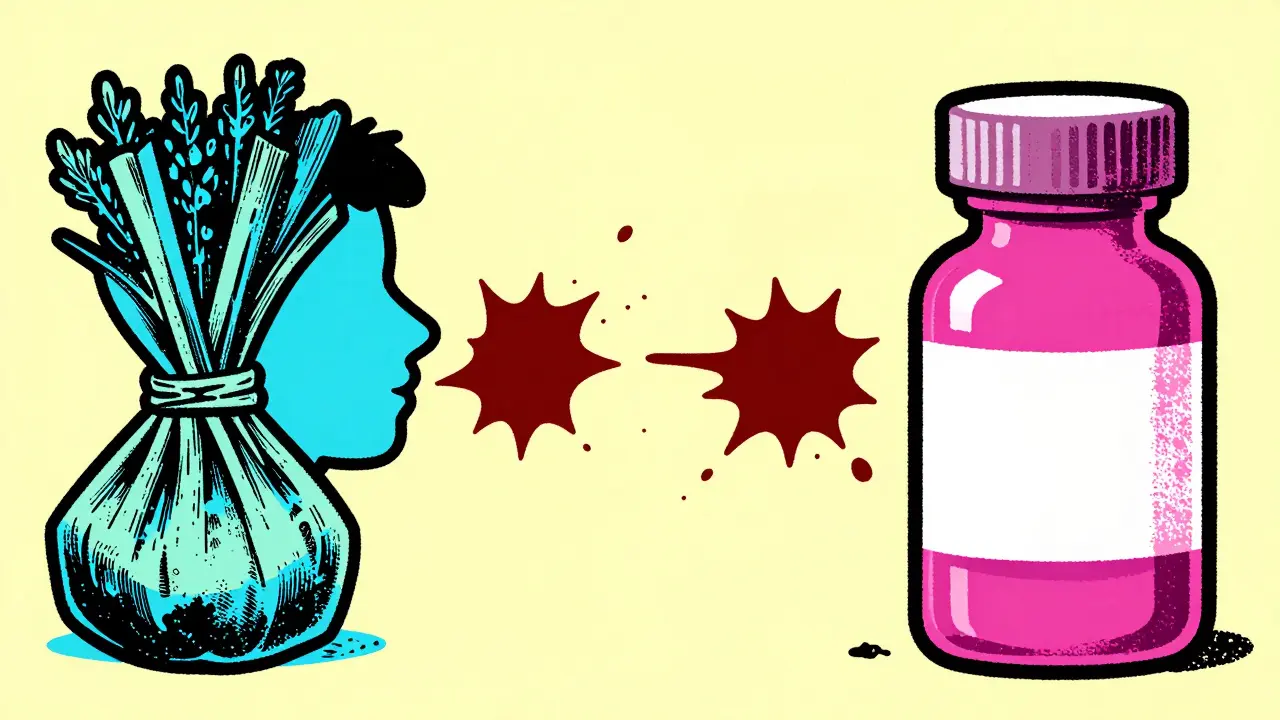
Why do these two clash? It comes down to pharmacodynamics and pharmacokinetics. Pharmacodynamically, Dong Quai inhibits platelet aggregation. Think of platelets as the first responders to a wound site. When they stick together, they plug leaks. Dong Quai makes them less sticky. Warfarin prevents the chemical cascade that solidifies the plug. When you combine them, you get a double blockade on clotting.
Pharmacokinetically, the picture is murkier but still concerning. Some studies suggest Dong Quai may inhibit cytochrome P450 enzymes, specifically CYP2C9 and CYP3A4. Your liver uses these enzymes to break down warfarin. If the herb slows this breakdown, warfarin builds up in your blood. A 2015 review in the British Journal of Clinical Pharmacology noted this potential dual mechanism. Animal steady-state studies showed increased prothrombin time even when warfarin concentrations stayed stable, proving the herb acts on the blood chemistry directly.
| Substance | Primary Action | Effect on Clotting Time |
|---|---|---|
| Warfarin | Inhibits Vitamin K Cycle | Increases PT/INR |
| Dong Quai | Antiplatelet Aggregation + Enzyme Inhibition | Further Increases PT/INR |
| Combined Effect | Additive/Potentiation | Significant Bleeding Risk |
Clinical Guidelines and Institutional Warnings
You are not alone in worrying about this mix. Major institutions have taken a hard stance. The Cleveland Clinic updated their anticoagulation guidelines in 2022 to explicitly recommend avoiding Dong Quai in warfarin-treated patients. Their reasoning is simple: there is insufficient safety data to justify the risk. Similarly, the University of California San Diego categorizes it under supplements that increase bleeding risk, placing it alongside garlic, ginkgo, and fish oil.
The American Heart Association identified Dong Quai as a "high-risk herb" for patients on cardiovascular drugs in their 2020 Scientific Statement. While human clinical trials are scarcer than animal studies, the consensus among experts like Dr. Catherine Ulbricht is that the additive effects could push an INR from a safe 2.5 to a dangerous 4.0. At that level, a minor bump becomes a major hemorrhage.
Real-World Consequences for Patients
Data from forums and case reports tell a cautionary tale. A user discussion on an anticoagulant support community described an INR spike from 2.8 to 5.1 after starting Dong Quai for menopause. That patient required hospital observation. Another survey found that nearly 70% of warfarin users didn’t know Chinese herbs could interfere with their meds. Yet, when told, 82% said they would stop immediately.
Regulatory bodies like the FDA have received hundreds of adverse event reports linking herbal products to anticoagulant complications. While specific Dong Quai cases were a smaller fraction, the pattern holds. Variability in manufacturing means one bottle of supplement might contain five times more active ingredient than another. This lack of standardization makes dose prediction nearly impossible.
Managing the Risk and Safe Alternatives
If you absolutely must explore herbal options, do not do it in secret. Transparency is your best defense. Here is a practical checklist for managing this scenario:
- Baseline Check: Get your INR checked before adding any new supplement.
- Rapid Monitoring: Recheck INR within 3 to 5 days of starting Dong Quai. Follow up at 7 and 14 days.
- Dose Adjustment: Some clinicians suggest reducing warfarin dosage by 15% initially if the herb cannot be stopped, but this requires daily oversight.
- Symptom Awareness: Watch for black stools, red urine, or prolonged bleeding from small cuts.
- Alternative Therapies: Consider non-herbal options for symptom relief, such as lifestyle changes or clinically vetted treatments.
Navigating supplement safety doesn’t mean banning nature entirely, but it means respecting the potency of modern medicine. Your heart health depends on the balance of that fine-tuned anticoagulation therapy.
Can I ever take Dong Quai if I am on Warfarin?
Most guidelines recommend avoidance. However, if you have a compelling reason, consult your doctor first. You must monitor your INR much more frequently than usual, potentially twice a week until stability is confirmed.
What symptoms indicate my blood is too thin?
Look for unusual bruising, bleeding gums, nosebleeds, pink or red urine, dark tarry stools, or headaches that won’t go away. These are signs your INR has spiked dangerously high.
Does food grade Dong Quai differ from medicinal doses?
Yes, but the risk persists. Because the root contains coumarin derivatives naturally, even culinary amounts can trigger interactions. Tea made from the root carries significant potency compared to processed extracts.
How quickly does the interaction happen?
Changes in INR can occur within 3 to 5 days of starting the herb. However, full steady-state effects might take longer, which is why weekly monitoring is safer initially.
Are there safer alternatives for menopausal symptoms?
Discuss options like soy isoflavones or specific therapies with your provider. Some herbs like chamomile or lavender tea generally pose less bleeding risk, but always verify with your prescribing physician.
The disregard for pharmacological interactions displayed by patients is frankly unacceptable. Medical professionals study enzyme pathways while individuals consume random roots. Consequences of hepatic enzyme inhibition are severe enough to warrant immediate cessation. Compliance with prescribed regimens must take precedence over herbal folklore. We see preventable hemorrhagic events because people trust influencers over clinicians. The scientific consensus regarding coumarin derivatives is clear. Ignoring these established mechanisms is irresponsible behavior. Stop assuming natural equates to safe.
Cytochrome p450 inhibition creates significant metabolic competition for CYP2C9 substrates. Pharmacodynamic antagonism shifts the clotting cascade threshold significantly. Bioavailability metrics fluctuate based on herbal matrix composition. Monitoring frequency should increase accordingly to maintain stability.
Please read the warnings!!! They mean it!!! Safety comes first!!! Don't ignore it!!!!! Consult your doctor immediately!!!!
It is understandable to seek relief for symptoms like hot flashes. The information provided highlights the importance of cross-referencing supplements. Caution is necessary when combining different types of medication. Balance is key for everyone.
Clinical evidence supports the avoidance strategy mentioned above!!! Pharmacokinetic overlap is genuine!!! Patients should prioritize lab values!!! INR levels dictate dosing safety!!! Always inform your provider!!! Communication is key to preventing adverse events!!!!
People need to stop being so ignorant about their health 😒 Just take your pills as written 😤 Natural does not mean harmless 🛑 Read the label before ingesting 🙄 Do not jeopardize safety for trends 😡
Nature is powerful but so are drugs :) It really depends on how you manage the intake :) Listen to your body signs :)
I appreciate the detailed breakdown of the mechanisms here :) Thank you for sharing this vital info :
Pharmaceutical companies push synthetic options to keep patents alive while ignoring botanical synergy. They claim enzymes get inhibited yet they never publish the raw cytotoxicity data. Regulatory bodies ignore ancient texts that document centuries of safe coadministration. The narrative around warfarin stability serves the interests of big pharma. Patients are told to avoid nutrients while their blood chemistry degrades. Standardized extracts differ wildly from whole root preparations used traditionally. The fear mongering protects the drug approval pipeline more than patient safety. INR monitoring is merely a revenue stream for clinics needing repeat visits. Cytochrome pathways are complex and animal studies do not translate to human physiology. They want you dependent on prescriptions forever instead of holistic balance. Independent pharmacists know the truth about herb-drug synergies. You have to research beyond the provided clinical guidelines yourself. Most doctors cannot explain the molecular binding sites anyway. Following outdated protocols prevents access to functional solutions offered by traditional systems. Wake up to the profit motives driving these warnings.
The medical establishment loves scaring the masses into dependency 😡 Real wellness isn't found in a pill bottle 💊 Their profits rely on your bleeding risks being managed poorly 👀 Ignore the manufactured panic 😈
You can find balance with care :) Keep an eye on those numbers :
The stakes are incredibly high for everyone involved :( Stay alert and protect your heart :)
Just don't mix them :)