The law that made cheap generic drugs possible
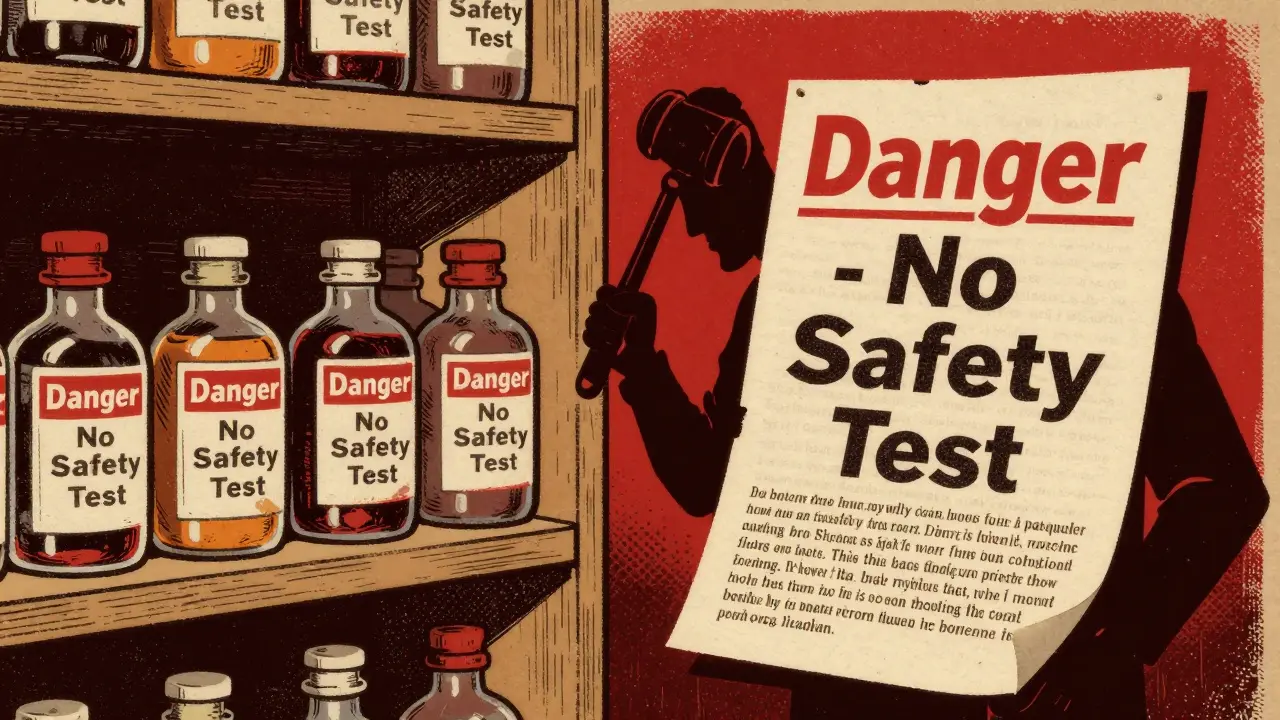
Before 1938, any company could sell a drug with no proof it was safe. One product, an antibiotic dissolved in toxic antifreeze, killed more than 100 people. That tragedy forced Congress to act. The result? The Federal Food, Drug, and Cosmetic Act - a law that didn’t just fix a safety gap. It rewrote how medicine is made, tested, and sold in America. And decades later, it became the legal backbone for every generic drug you pick up at the pharmacy today.
What the FD&C Act actually did
The FD&C Act, signed by President Roosevelt on June 25, 1938, was the first real federal control over drugs. Before this, companies didn’t need to prove anything. No safety data. No testing. No oversight. The FDA didn’t even have the power to stop dangerous products from reaching shelves. The law changed all that. It gave the FDA the authority to require manufacturers to prove their drugs were safe before selling them. It also forced clear labeling and banned false claims. But here’s the catch: it didn’t require proof that drugs actually worked. That came later.
By the early 1960s, another crisis hit. Thalidomide, a drug sold overseas for morning sickness, caused severe birth defects. In the U.S., it was mostly kept out thanks to an FDA reviewer who questioned the data. That moment pushed Congress to pass the Kefauver-Harris Amendments in 1962. Now, drugs had to prove both safety and effectiveness. That was huge. But it still didn’t help generics.
The problem with generics before 1984
If you wanted to make a copy of a brand-name drug back then, you had to start from scratch. You needed to run full clinical trials - the same expensive, years-long tests the original maker had already done. Why? Because the law didn’t recognize that a drug with the same active ingredient, dose, and form was the same thing. So, generic companies were stuck paying millions just to prove what was already known. The result? Very few generics. In 1984, only 19% of prescriptions filled were generics, even though they cost far less.
The Hatch-Waxman Amendments: the game-changer
In 1984, two lawmakers - Senator Orrin Hatch and Representative Henry Waxman - teamed up to fix this. Their solution? The Drug Price Competition and Patent Term Restoration Act. Everyone calls it Hatch-Waxman. It didn’t rewrite the FD&C Act. It added a new section: 505(j). That’s the legal engine behind every generic drug approved today.
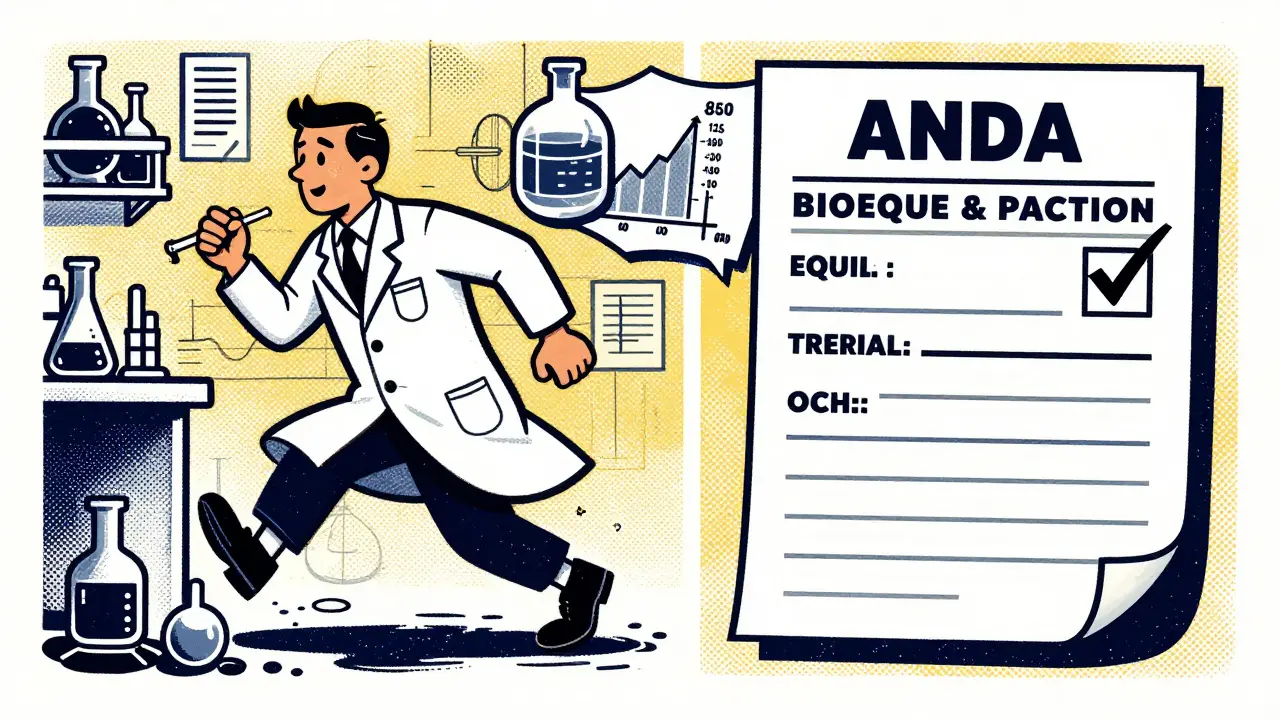
Here’s how it worked. Instead of running full trials, generic makers could file an Abbreviated New Drug Application - an ANDA. All they had to prove was two things: their drug had the same active ingredient, strength, dosage form, and route of use as the brand-name version. And second, that it was bioequivalent. That means your body absorbs it at the same rate and to the same extent as the original. The FDA uses blood tests to measure this, requiring the generic’s absorption levels to fall within 80-125% of the brand’s. No need to retest safety or effectiveness. The brand already did that.
This wasn’t just a shortcut. It was a revolution. Generic drug development went from taking 5-7 years and costing $50 million to under 2 years and $2 million. Suddenly, competition was possible.
How Hatch-Waxman balanced innovation and access
The law didn’t just help generics. It protected brand-name companies too. It gave them a 5-year extension on their patents to make up for time lost during FDA review. That’s critical. Drug development takes a decade. Patents only last 20 years. Without this, companies wouldn’t invest in new drugs.
But here’s the clever part: the first generic company to challenge a brand’s patent got 180 days of exclusive market access. No other generics could enter. That created a powerful incentive. Companies rushed to file patent challenges, knowing they could corner the market and recoup their legal costs fast. That’s why you often see one generic hit the market before others follow.
The law also created the Orange Book - the FDA’s official list of approved drugs with therapeutic equivalence ratings. It’s the bible for generic manufacturers. If a drug isn’t in the Orange Book, you can’t make a generic for it. As of 2023, it listed over 20,000 approved products.
What changed after Hatch-Waxman
The numbers tell the story. In 1984, generics made up 19% of prescriptions but only 3% of drug spending. Today? They fill 90% of prescriptions but cost just 17% of total spending. That’s over $2.2 trillion saved for American consumers since 2014, according to the Federal Trade Commission.
It’s not perfect. Brand-name companies have found ways to delay generics. They file dozens of weak patents - called patent thickets - just to keep competitors away. They refuse to sell samples to generic makers so they can’t test their products. They even file citizen petitions to the FDA, hoping to slow things down. These tactics have made it harder to bring generics to market for complex drugs like inhalers and injectables. In fact, generic entry for these drugs is 42% lower than for simple pills.
How the FDA keeps the system running
The FDA doesn’t just sit back. It updated the system with the Generic Drug User Fee Amendments (GDUFA) in 2012, then again in 2017 and 2022. These let the FDA collect fees from generic companies to fund faster reviews. In the 1990s, it took over 30 months to approve an ANDA. Today, 95% are approved in under 10 months. That’s a massive improvement.
The FDA also keeps a close eye on quality. In 2022, they issued 47 warning letters to generic manufacturers for violating current Good Manufacturing Practices (cGMP). The most common problems? Poor quality control and data manipulation. The penalties are steep: up to $1.1 million per violation. That’s not a slap on the wrist. It’s a deterrent.
What’s next for generics?
The law isn’t frozen in 1984. The 21st Century Cures Act and the CREATES Act of 2019 cracked down on tactics like product hopping - when a brand slightly changes a drug just to reset patent clocks. The FDA is now working on new guidance for complex generics like nasal sprays and eye drops, with draft rules expected in early 2024.
The Congressional Budget Office estimates these policies will save the federal government $158 billion in drug spending between 2023 and 2032. That’s not just about cost. It’s about access. Millions of people rely on generics to afford their medications. Without the FD&C Act and Hatch-Waxman, many wouldn’t be able to.
Why this matters to you
When you buy a generic pill for $4 instead of $400, you’re not just saving money. You’re benefiting from a 90-year-old law that was updated in 1984 to fix a broken system. It’s a rare example of government and industry working together to make healthcare more affordable without sacrificing safety. The FD&C Act didn’t just regulate drugs. It made sure that after a brand-name drug’s patent expired, the market could open up - fairly, safely, and quickly.
That’s the real legacy. Not just cheaper pills. A system that works - most of the time - for patients, companies, and the public.
What is the FD&C Act and why is it important for generic drugs?
The Federal Food, Drug, and Cosmetic Act (FD&C Act), passed in 1938, gave the FDA the power to regulate drug safety and labeling. While it didn’t originally cover generics, it created the legal structure that later allowed the Hatch-Waxman Amendments of 1984 to establish the ANDA pathway. This pathway lets generic drugmakers prove their products are equivalent to brand-name drugs without repeating costly clinical trials. Without the FD&C Act, there would be no legal basis for generic approval in the U.S.
What is an ANDA and how does it work?
ANDA stands for Abbreviated New Drug Application. It’s the application generic drugmakers submit to the FDA to get approval. Instead of proving safety and effectiveness from scratch, they must show their product has the same active ingredient, strength, dosage form, and route of administration as the brand-name drug. They also must prove bioequivalence - meaning the body absorbs it at the same rate and level. This is tested through blood studies showing absorption levels fall within 80-125% of the brand’s.
What role did the Hatch-Waxman Amendments play?
The Hatch-Waxman Amendments of 1984 added Section 505(j) to the FD&C Act, creating the ANDA pathway. This made it possible for generic drugs to enter the market quickly and affordably. It also gave brand-name companies patent extensions to encourage innovation and gave the first generic filer 180 days of exclusivity to incentivize patent challenges. It balanced competition and innovation in a way no law had before.
How does the FDA ensure generic drugs are safe and effective?
The FDA requires generics to meet the same strict quality standards as brand-name drugs. They must be manufactured in FDA-inspected facilities following current Good Manufacturing Practices (cGMP). The agency reviews bioequivalence data, inspects manufacturing sites, and monitors post-market reports. If a generic fails to meet standards, the FDA can issue warning letters, block approval, or even recall the product. In 2022, 47 warning letters were issued to generic manufacturers for cGMP violations.
Why do some generic drugs take longer to reach the market?
Brand-name companies sometimes use legal tactics to delay generics. These include filing multiple weak patents (patent thickets), refusing to sell samples needed for testing, or submitting citizen petitions to the FDA to delay approval. These tactics are especially common with complex drugs like inhalers or injectables, where testing is harder. As a result, generic entry for these products is 42% lower than for simple pills.
Are generic drugs really the same as brand-name drugs?
Yes. By law, generics must have the same active ingredient, strength, dosage form, and route of administration. They must also be bioequivalent - meaning they work the same way in the body. The FDA considers them therapeutically equivalent. Differences in inactive ingredients (like fillers or dyes) don’t affect safety or effectiveness. Millions of people use generics every day without issue. The FDA’s own data shows they are just as safe and effective.
What is the Orange Book and why is it important?
The Orange Book, officially called Approved Drug Products with Therapeutic Equivalence Evaluations, is the FDA’s official list of approved drug products and their therapeutic equivalence ratings. Generic manufacturers use it to identify which brand-name drugs can be copied and what patents apply. If a drug isn’t listed, you can’t legally make a generic version. It’s the roadmap for generic drug development and patent challenges.

This is why America still leads the world in pharma innovation. 🇺🇸 No other country has this kind of balance between innovation and access. Generic drugs? Yeah, they’re great - but only because we protected the innovators first. Don’t let the left tell you otherwise.
The FD&C Act of 1938, as a foundational instrument of regulatory epistemology, established the ontological precedence of empirical verification in pharmaceutical commerce. Subsequent legislative interventions, particularly the Hatch-Waxman Amendments, constituted a hermeneutic recalibration of therapeutic equivalence, wherein bioequivalence supplanted clinical replicability as the epistemic standard. This paradigm shift, while economically efficacious, subtly reifies the commodification of biological function.
Okay but have you ever heard that the FDA lets Chinese factories make 80% of our generic pills? And they’re not even inspected properly. 🤔 I mean, think about it - the same people who gave us the FD&C Act are now letting toxic fillers and fake lab data slide because they’re ‘too busy.’ And don’t get me started on how Big Pharma owns the Orange Book. It’s all a front. 🧠💊
This is one of those rare win-wins in government policy. People forget how expensive meds used to be - my grandma skipped insulin for years. Now? I get my blood pressure med for $4 at Walmart. 🙌 The system isn’t perfect, but it’s working for millions. Let’s keep improving it, not tearing it down.
Just to add: the 80-125% bioequivalence range isn't arbitrary. It's based on decades of pharmacokinetic studies showing that within this window, clinical outcomes are statistically identical. The FDA's bioequivalence guidelines are among the most rigorously validated in the world. Also, the GDUFA fees? They're why ANDA reviews dropped from 30+ months to under 10. Funding the regulator actually works.
Honestly I didn’t think about how much this affected my life until I started paying for my asthma inhaler. Now I get the generic for $15 instead of $300. No drama. No side effects. Just works. Thanks, Hatch-Waxman.
You’re all naive. The FDA approves generics based on data submitted by the same companies that make the brand drugs. The bioequivalence studies? Often done in the same labs. The Orange Book is a lobbying tool disguised as regulation. And the 180-day exclusivity? That’s just a pay-to-play monopoly for big generic players. This system isn’t about access - it’s about control. And the people paying? They’re the ones who don’t know any better.
Love how this story shows policy can actually work when it’s designed with both sides in mind. Innovation protected. Access guaranteed. No villains, just smart compromises. And yeah, the system’s got glitches - patent thickets, sample refusals - but we’re fixing them. The Cures Act and CREATES Act? That’s democracy in action. Keep pushing, keep improving. We’re not done yet.