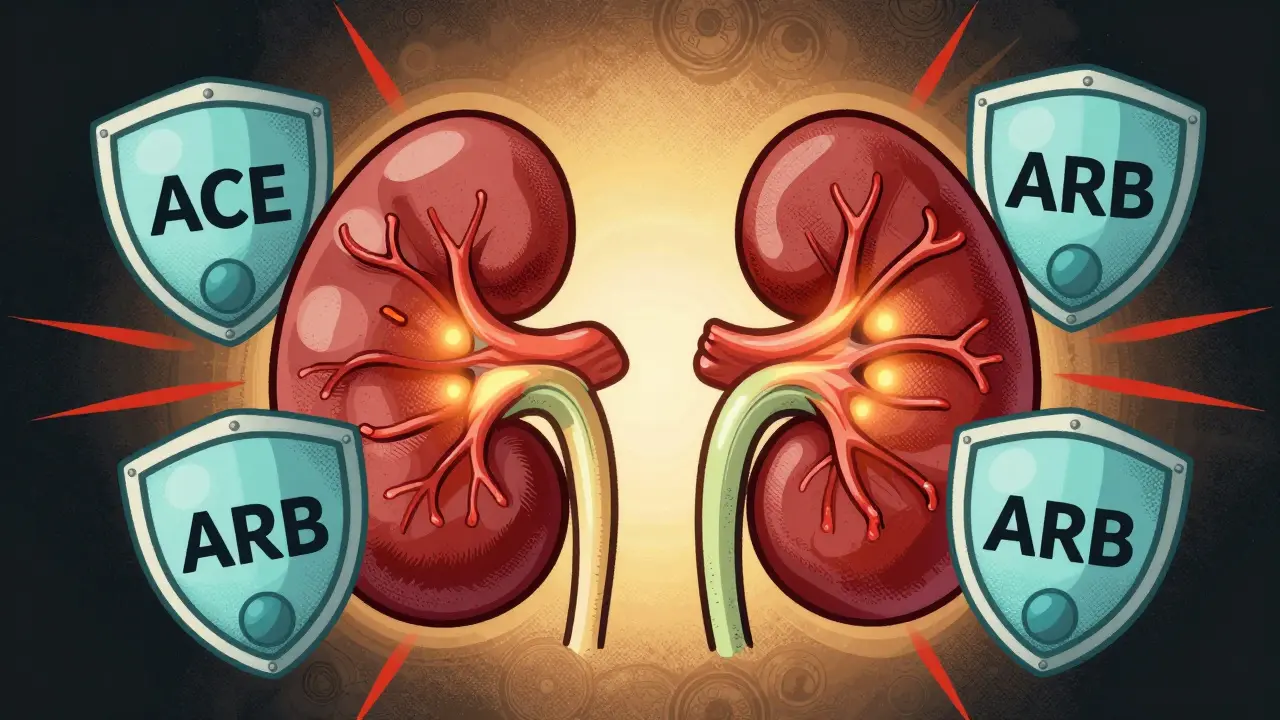
When your kidneys are damaged, high blood pressure doesn’t just make things worse-it speeds up the damage. That’s why controlling blood pressure isn’t just about avoiding headaches or dizziness. For people with chronic kidney disease (CKD), it’s one of the most important things you can do to protect what’s left of your kidney function. And when it comes to picking the right meds, ACE inhibitors and ARBs are the go-to choices for doctors-and for good reason.
Why Blood Pressure Matters So Much in Kidney Disease
Your kidneys don’t just filter waste. They also help regulate blood pressure by controlling fluid balance and releasing hormones. When kidney function drops, this system gets out of whack. High pressure inside the tiny filtering units (glomeruli) crushes them over time. The result? More protein leaks into your urine, more scarring builds up, and your kidneys slowly fail.
Studies show that keeping systolic blood pressure below 130 mmHg can cut the risk of kidney failure by up to 40% in people with proteinuria. That’s not a small win. It means delaying or even avoiding dialysis for years. But not all blood pressure pills work the same way. Most lower pressure, but only ACE inhibitors and ARBs actually protect the kidneys themselves.
How ACE Inhibitors and ARBs Work Differently from Other Blood Pressure Meds
Think of your body’s blood pressure system like a chain reaction. When your kidneys sense low blood flow, they release renin. That triggers angiotensin II, a powerful hormone that narrows blood vessels and tells your body to hold onto salt and water. That raises pressure-but it also squeezes your kidneys from the inside.
ACE inhibitors, like lisinopril or enalapril, block the enzyme that turns angiotensin I into angiotensin II. Less angiotensin II means wider blood vessels, less pressure, and less strain on the kidneys. ARBs, like losartan or valsartan, do something similar but at the other end: they block angiotensin II from attaching to its receptors. So even if angiotensin II is still around, it can’t do damage.
That’s the key difference. Other blood pressure meds-like diuretics, calcium channel blockers, or beta-blockers-lower pressure, but they don’t directly shield the kidney filters. ACE inhibitors and ARBs do. That’s why they’re the only ones recommended as first-line treatment for CKD patients with protein in their urine.
What the Evidence Shows: Real Benefits, Not Just Theory
The numbers don’t lie. In patients with diabetes or high blood pressure and kidney damage:
- ACE inhibitors and ARBs lower systolic blood pressure by 10-15 mmHg on average
- They reduce protein in the urine by 30-50%
- They slow the decline of kidney function by 20-40%
- They cut the risk of ending up on dialysis by about 25%
A 2024 study of over 1,200 patients with advanced CKD (eGFR under 20) found those taking ACE inhibitors or ARBs had a 34% lower risk of needing kidney replacement therapy over 34 months. That’s huge. Even when kidneys are severely damaged, these drugs still help.
And here’s something surprising: stopping them in late-stage CKD doesn’t help. A UK trial compared patients who kept taking their ARBs or ACE inhibitors versus those who stopped. Those who continued had better kidney function after three years. No increased deaths. No harm. Just benefit.
Why So Many People Aren’t Taking Them-Even When They Should
Despite all this, only about 58% of people with advanced CKD are on these meds. Why? Fear.
Doctors and patients worry about two things: high potassium (hyperkalemia) and sudden drops in kidney function. And yes, those can happen.
- 10-15% of people develop potassium levels above 5.0 mmol/L
- 5-10% see a temporary eGFR drop of more than 30%
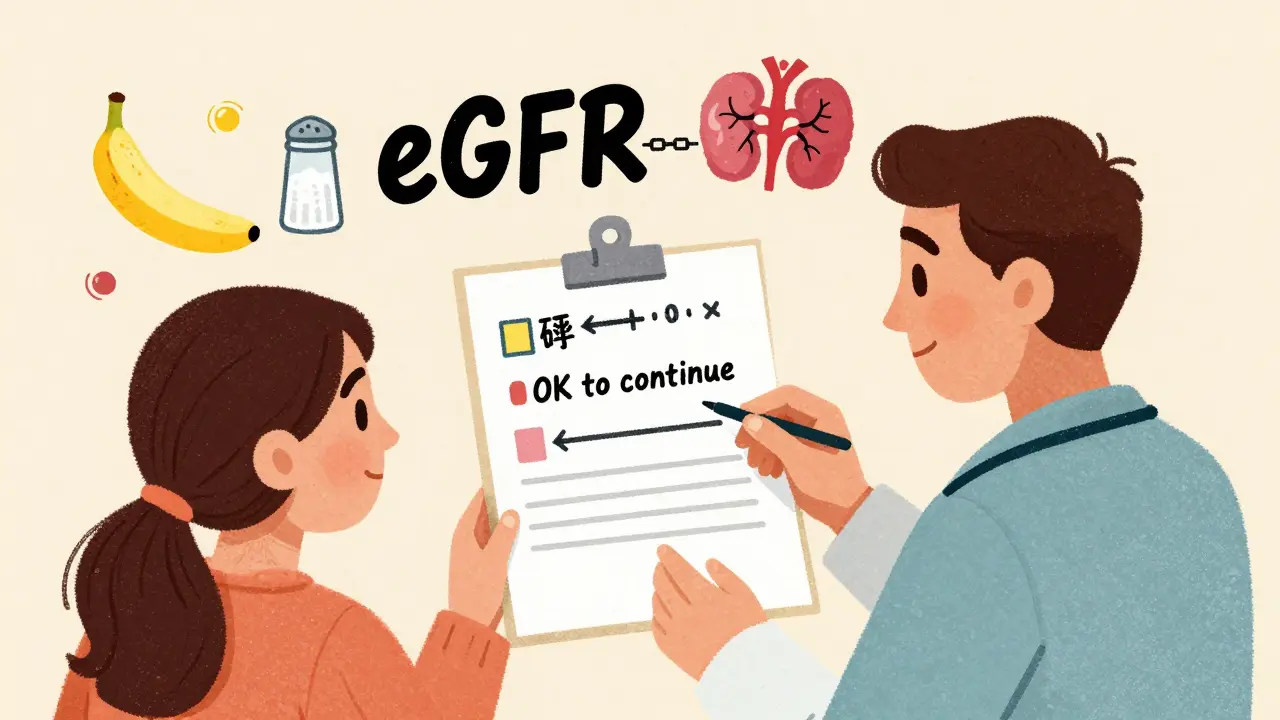
But here’s what most don’t realize: that drop in eGFR isn’t always bad. Sometimes it’s a sign the drug is working-reducing pressure inside the kidney filters. If the drop is under 30% and potassium stays below 5.5, guidelines say to keep going. Stop only if potassium hits 5.5 or higher, or if eGFR drops more than 30% and doesn’t recover.
Too many people quit because they panic over a single lab result. That’s therapeutic nihilism-and it costs lives.
ACE Inhibitors vs. ARBs: Which One Should You Take?
Both work just as well for protecting kidneys and lowering blood pressure. But they have different side effects.
ACE inhibitors are more likely to cause a dry, persistent cough-happening in 5-20% of users. That’s why some people stop taking them. They’re also linked to a rare but serious risk of angioedema (swelling of the face or throat) in about 1 in 500 to 1 in 1,000 people.
ARBs don’t cause cough or angioedema nearly as often. That’s why many doctors start with an ARB, especially if someone had a cough on an ACE inhibitor before.
But if you’re doing fine on an ACE inhibitor? There’s no need to switch. The kidney protection is the same.
What About Using Both Together?
Some studies show combining an ACE inhibitor and ARB reduces proteinuria even more-by up to 35%. But the risks go up too.
The VA Nephropathy Trial found dual therapy increased hyperkalemia by 50% and doubled the chance of acute kidney injury. For that reason, major guidelines (KDIGO, AHA, ACC) say don’t combine them routinely. Only in rare cases, under close supervision, and never in advanced CKD without strong reason.
It’s not worth the risk for most people. One drug, at the right dose, is enough.
Monitoring: What You Need to Do After Starting
Starting an ACE inhibitor or ARB isn’t a set-it-and-forget-it situation. You need to be watched.
Before you begin, your doctor should check:
- Your eGFR (kidney function)
- Your serum potassium
- Your urine albumin-to-creatinine ratio (UACR)
Then, within 1-2 weeks of starting-or after any dose increase-you need a repeat blood test. That’s non-negotiable.
If your potassium is above 5.5, or your eGFR drops more than 30%, your doctor may pause or adjust the dose. But if it’s just a mild, stable drop? Keep going. That’s normal.
After the first month, monthly checks are usually enough. Once you’re stable, you can stretch to every 3-6 months.
What About Advanced CKD? Should You Still Take Them?
This is the biggest myth: that if your kidneys are failing, these drugs won’t help-or are too dangerous.
The 2023 KDIGO guidelines say clearly: continue ACE inhibitors or ARBs in stages 4 and 5 CKD, as long as your eGFR is above 15 and potassium is under 5.0. That’s not a suggestion. That’s a recommendation based on real outcomes.
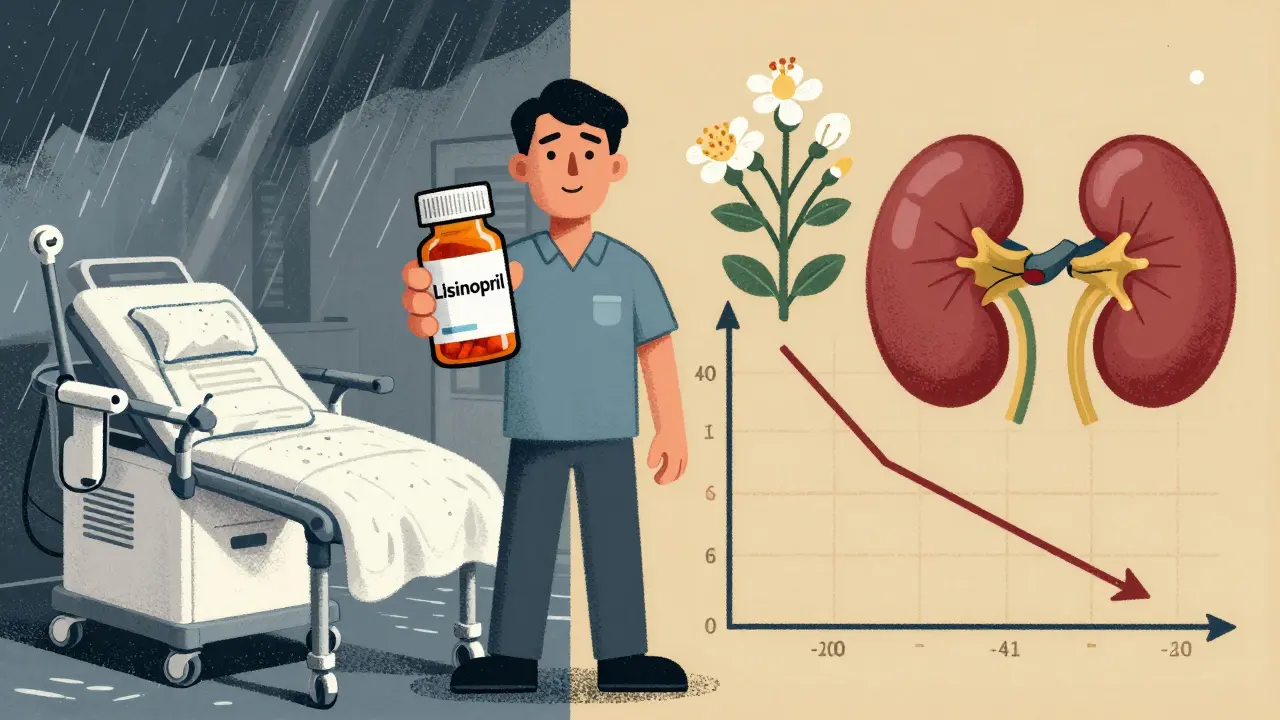
One patient I spoke with-72, stage 4 CKD, diabetes-was told by a specialist to stop lisinopril because his eGFR was 18. He did. Three months later, his kidney function dropped to 12. He restarted the drug. His eGFR stabilized at 16. He’s still off dialysis three years later.
These drugs aren’t magic. But they’re the best tool we have. And they work even when your kidneys are weak.
What’s Next? The Future of Kidney Protection
Scientists are already looking beyond ACE inhibitors and ARBs. New drugs like sacubitril/valsartan (Entresto), originally for heart failure, are now being tested for kidney protection. In one 2024 trial, it slowed kidney decline by 22% compared to enalapril alone.
But for now, the best thing you can do is make sure you’re on the right medication, at the right dose, with the right monitoring. Don’t let fear stop you. Don’t let a single lab result make you quit. These drugs have been studied for decades. Their benefits are real. Their risks are manageable.
If you have kidney disease and high blood pressure, ask your doctor: "Am I on the right medicine to protect my kidneys?" If you’re not on an ACE inhibitor or ARB-ask why.
Frequently Asked Questions
Can ACE inhibitors or ARBs reverse kidney damage?
No, they can’t reverse damage that’s already done. But they can stop or significantly slow further damage. That’s why starting early matters. If you have protein in your urine, even mild, these drugs can preserve what’s left of your kidney function for years.
I have high potassium. Should I stop my ACE inhibitor or ARB?
Not necessarily. If your potassium is between 5.0 and 5.5, your doctor might adjust your dose, suggest a low-potassium diet, or add a potassium binder like patiromer. Stopping the drug entirely removes its kidney protection. Only stop if potassium hits 5.5 or higher and doesn’t come down after adjustments.
Why do I need to check my kidney function after starting these drugs?
Because these drugs reduce pressure inside the kidney filters. That can cause a temporary drop in eGFR-sometimes by 10-30%. That’s usually a good sign it’s working. But if it drops more than 30%, it could mean something else is wrong, like dehydration or blocked arteries. Monitoring helps tell the difference.
Are ARBs safer than ACE inhibitors?
For side effects, yes. ARBs don’t cause cough or angioedema as often. But for kidney protection and blood pressure control, they’re equally effective. If you had a cough on an ACE inhibitor, switching to an ARB makes sense. If you’re doing fine on an ACE inhibitor, there’s no need to switch.
Can I take these drugs if I have heart failure too?
Yes. In fact, if you have both heart failure and kidney disease, ACE inhibitors or ARBs are even more important. They protect your heart and your kidneys at the same time. Many studies show they improve survival in people with both conditions.
Do I need to avoid salt or potassium-rich foods?
You don’t need to eliminate them, but you should avoid excessive amounts. Too much salt makes blood pressure harder to control. Too much potassium-like from salt substitutes, bananas, potatoes, or oranges-can raise levels dangerously when you’re on these drugs. Talk to a dietitian about balanced choices.
What if I miss a dose?
If you miss one dose, take it as soon as you remember-if it’s within a few hours. If it’s almost time for your next dose, skip the missed one. Don’t double up. Consistency matters more than perfection. But don’t stop taking them just because you missed a few days. Talk to your doctor if you’re having trouble sticking to the schedule.


Look, I get it-ACE inhibitors and ARBs are the gold standard, but let’s not pretend this isn’t a profit-driven narrative. Pharma pushed these drugs hard because they’re profitable, not because they’re perfect. I’ve seen patients with potassium levels hitting 6.2 and still being told to ‘keep going.’ That’s not medicine-that’s dogma. And don’t even get me started on the ‘mild drop in eGFR is fine’ line. If your kidneys are already at eGFR 18, you don’t need a 30% drop-you need a plan, not a lecture.
Been on losartan for 7 years with diabetic nephropathy. My UACR dropped from 800 to 210. My eGFR dipped 22% at first-scared the hell out of me-but it stabilized. I’m still off dialysis. These drugs aren’t magic, but they’re the closest thing we’ve got. Don’t quit because of a lab number. Talk to your nephrologist, not Reddit.
WHY DO PEOPLE STILL QUESTION THIS?!?!?!!? ACE/ARBs are THE ONLY THINGS THAT ACTUALLY PROTECT THE KIDNEYS-NOT JUST LOWER BP!!! I’ve seen so many patients STOP because they got scared by a ‘temporary’ eGFR drop-and then end up on dialysis 18 months later. It’s not ‘just a number’-it’s your LIFE. And if you’re one of those people who thinks ‘natural remedies’ or ‘low-sodium diets alone’ will save you-you’re dangerously wrong. STOP LISTENING TO YOUTUBE DOCTORS. START LISTENING TO GUIDELINES.
As someone from India where CKD is skyrocketing due to diabetes and hypertension, I’ve seen this firsthand. In rural clinics, people stop their meds because they think ‘it’s making me weak’ or ‘too expensive.’ But here’s the truth-these drugs are cheap, effective, and life-saving. I tell my patients: ‘Your kidneys don’t scream before they collapse.’ Listen to the numbers, not the fear. And yes, potassium? Watch it-but don’t panic. Eat less banana, more cabbage. Simple.
I appreciate the depth of this post. I was on lisinopril for a year and had a cough so bad I thought I had pneumonia. Switched to valsartan-no cough, same results. I’m 58, stage 3 CKD, and honestly? I feel better than I have in years. The key is consistency and monitoring. Don’t ignore labs, but don’t panic over one weird number either. Your doc’s job is to help you navigate this-not scare you into quitting.
Oh wow. Another ‘trust your doctor blindly’ sermon. Next you’ll tell me aspirin cures cancer. I’ve got a cousin who was on ARBs, got hyperkalemia, got admitted to ICU, and now she’s on dialysis. Guess what? She wasn’t ‘doing it wrong.’ The system is just… broken. These drugs aren’t holy. They’re tools. And sometimes, tools break things.
This is one of the most lucid, evidence-based summaries of ACE/ARB use in CKD I’ve encountered in recent memory. The nuance regarding eGFR fluctuations, potassium thresholds, and the distinction between ‘danger’ and ‘adaptation’ is precisely what’s missing from public discourse. The 2024 VA trial data, in particular, deserves wider dissemination. Thank you for grounding this conversation in science-not fear, not marketing, not anecdote.
Let’s be real: if you’re still taking ACE inhibitors in 2024, you’re either a doctor who hasn’t updated their textbook or a patient who’s been gaslit by Big Pharma. ARBs are better. Period. And if your doctor’s still prescribing lisinopril because ‘it’s cheaper’? Fire them. Also, ‘mild eGFR drop’ is just a euphemism for ‘we’re killing your nephrons slowly.’
Thank you for this comprehensive, meticulously referenced post. I am a nephrologist with 22 years of clinical experience, and I can confirm: the data supporting ACE inhibitors and ARBs in CKD is robust, reproducible, and clinically transformative. The concern about transient eGFR decline is valid-but must be contextualized. A 25% drop within 14 days, with stable creatinine trend and no volume depletion, is a pharmacologic response-not a failure. I have patients with eGFR 14 who remain off dialysis for 5+ years on ARBs. Discontinuation, absent hyperkalemia >5.5 or hemodynamic instability, is the greater risk. Monitoring is not optional-it is the standard of care. And yes: we continue them in stage 4, even stage 5, if potassium permits. The KDIGO guidelines are clear. The evidence is overwhelming. The question is not whether to use them-but how to use them wisely.