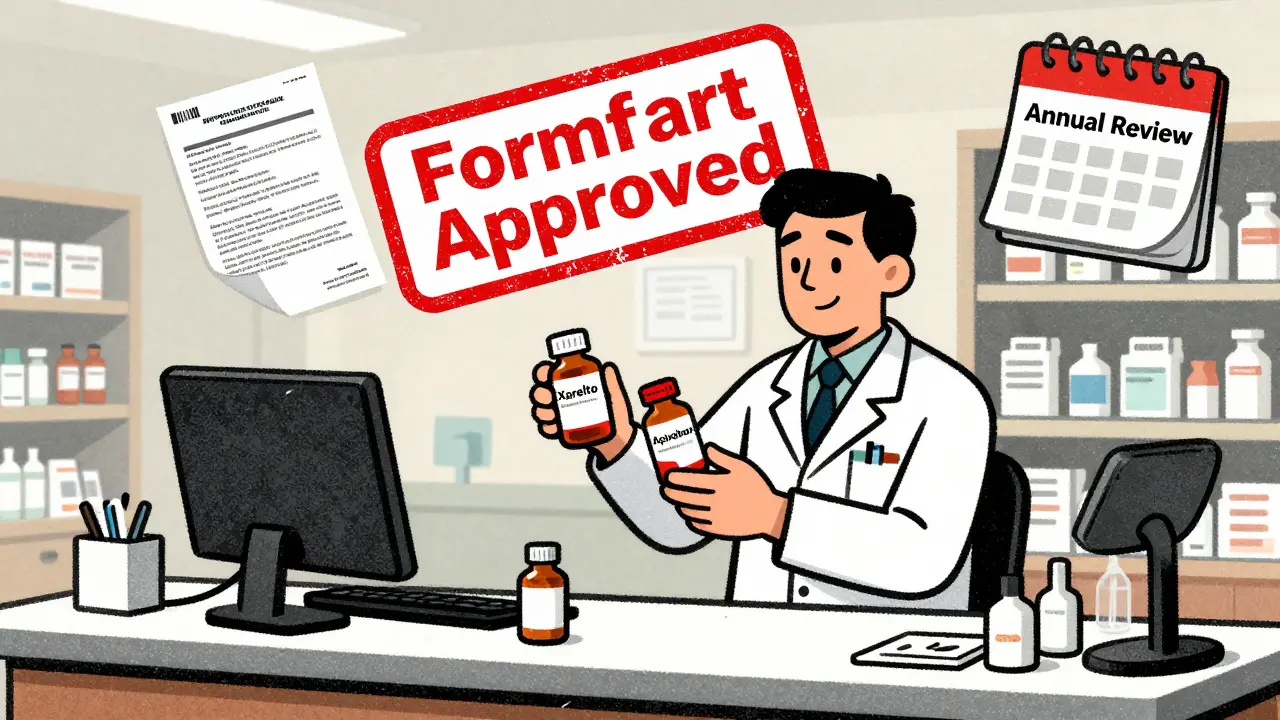
When a patient in a nursing home is switched from one blood thinner to another without their doctor’s direct order, it’s not a mistake-it’s institutional formulary policy in action. These lists, often hidden from public view, dictate which drugs hospitals and clinics can use, when they can swap one drug for another, and how those decisions are monitored. Unlike insurance formularies that decide what’s covered, institutional formularies control what’s actually given to patients inside the facility. And in states like Florida, they’re not optional-they’re legally required.
What Exactly Is an Institutional Formulary?
An institutional formulary is a curated list of medications approved for use within a hospital, clinic, or long-term care facility. It’s not just a catalog. It’s a living system built by a committee of pharmacists, doctors, and nurses to ensure that the drugs used are safe, effective, and cost-efficient. The goal? Reduce errors, cut waste, and improve outcomes-all while staying within legal boundaries. In Florida, the law (Statute 400.143) defines it clearly: a formulary lets pharmacists replace a prescribed drug with another that’s chemically different but expected to work the same way. This is called therapeutic substitution. It’s not the same as generic substitution (like swapping brand-name Lipitor for atorvastatin). Therapeutic substitution means swapping, say, Xarelto for apixaban-two different drugs in the same class. Both prevent clots, but they’re not identical. The decision isn’t made by a pharmacist alone. It’s guided by strict rules.Who Decides What Goes on the List?
Every facility with a formulary must have a Drug and Therapeutics Committee. In Florida, this committee must include three key people: the medical director, the director of nursing services, and a certified consultant pharmacist. No exceptions. These aren’t figureheads. They’re responsible for writing the rules, reviewing evidence, and tracking what happens after a substitution is made. The committee doesn’t pick drugs based on price alone. They look at clinical studies, real-world outcomes, and side effect profiles. A drug might be cheaper, but if it causes more falls in elderly patients, it gets kicked off the list. The American Journal of Health-System Pharmacy found that well-run formularies reduce adverse drug events by 15% to 30%. That’s not just savings-it’s lives saved. The list is updated regularly. New drugs come out. Old ones get recalled. Evidence changes. Facilities must review their formulary at least once a year and keep all policies on file. If a state inspector shows up, they need to hand over the documents-no excuses.How Substitutions Actually Work in Practice
Let’s say a patient is admitted to a nursing home with a prescription for warfarin. The facility’s formulary only includes dabigatran as the preferred anticoagulant because it doesn’t require weekly blood tests and has fewer food interactions. The pharmacist can legally substitute it-without calling the prescribing doctor-because the formulary allows it. But here’s the catch: the patient’s original doctor didn’t know this would happen. The patient didn’t know either. And when they’re discharged to a hospital that uses warfarin, they get switched back. That’s a real scenario reported by a pharmacist on Reddit in March 2024. The confusion isn’t theoretical-it leads to dosing errors, missed refills, and ER visits. In long-term care, where patients stay for months or years, formularies work better. Consistency matters. In acute care, where patients come in, get treated, and leave quickly, substitutions create friction. One facility in Tampa reported finding seven dangerous drug interactions in the first year of monitoring. That’s a win. But another hospital pharmacist said, “We spend half our time explaining why a patient’s medication changed-not treating them.”
Formularies vs. Insurance Plans: Key Differences
People often confuse institutional formularies with insurance formularies. They’re not the same. Insurance formularies control what your plan will pay for. If your drug isn’t on the list, you pay more-or nothing. These are managed by pharmacy benefit managers (PBMs) and are mostly about cost-sharing. Institutional formularies control what’s physically dispensed inside the building. They’re about clinical safety, not billing. A drug might be on your insurance plan but banned in the hospital because it causes confusion in dementia patients. Or vice versa. The result? A patient might be on one drug at home, switched to another in the nursing home, then switched back in the ER-all legally, all within policy. But the system doesn’t talk to itself. Electronic health records rarely sync formulary data across facilities. That’s a gap.Why This Matters for Patient Safety
Formularies aren’t just bureaucracy. They’re a tool to prevent harm. Studies show that when formularies are well-managed, patients have fewer medication errors, fewer hospital readmissions, and better adherence. But there’s a dark side. Patients in long-term care often don’t know they’ve been switched. AARP found that 68% of residents couldn’t name their own medications, let alone explain why they changed. No informed consent. No transparency. That’s a problem. Doctors feel the pressure too. A 2023 AMA survey showed that while 62% supported formularies for safety, 78% were frustrated by the paperwork needed to get a non-formulary drug approved. One oncologist described waiting three days for approval to use a life-saving drug that wasn’t on the list. The patient’s tumor grew during the delay. The balance is thin. Too much control, and you delay care. Too little, and you risk errors.How Facilities Implement These Policies
Getting a formulary up and running isn’t easy. Florida law gives facilities 90 days to form their committee after deciding to adopt a formulary. Then comes the hard part: training. Nursing staff need the most training. They’re the ones handing out pills. They have to know which substitutions are allowed, when to flag a change, and how to document it. On average, it takes 4 to 8 weeks for staff to get comfortable with the system. The biggest headache? Electronic health records (EHRs). Sixty-eight percent of facilities in Florida reported tech issues when trying to link formulary rules to their EHR. A nurse tries to order a drug not on the list, and the system doesn’t block it-or worse, it doesn’t alert the pharmacist. That’s how errors slip through. Solutions? Work with your EHR vendor to build formulary alerts. Set up automatic notifications when a substitution occurs. Train pharmacists to be the bridge between the system and the staff.



Formularies are necessary, but the lack of transparency is insane. I work in a nursing home, and we had a guy on warfarin for 8 years. One day, they switched him to apixaban without telling him or his daughter. He ended up in the ER with a GI bleed because his INR wasn’t monitored. The pharmacy said, ‘It’s on the formulary.’ Yeah, but who’s watching the patient? Not the system.
my mom’s in a skilled nursing facility and they switched her blood pressure med without telling us. i found out because her arms were swollen. i had to call the doctor myself. why is this even legal??
Of course this is happening. You think hospitals care about patients? They care about liability and cost. This isn’t medicine-it’s corporate logistics dressed up in white coats. If your grandma’s on a drug that’s ‘too expensive’ or ‘too risky’ for their budget, they swap it without blinking. And you wonder why people distrust the system?
It’s not about ‘therapeutic equivalence.’ It’s about who gets to decide what ‘equivalent’ means. The committee? A bunch of pharmacists who’ve never held a dying patient’s hand.
And don’t get me started on EHRs. The system doesn’t alert the nurse? Of course not. Why make it easy to catch errors when you can just blame the ‘untrained staff’ later?
Florida’s law doesn’t protect patients. It protects institutions from lawsuits. If a patient dies after a substitution, the formulary becomes a shield. ‘We followed protocol.’ No one asks if the protocol was evil.
Let me be clear: this is not a clinical policy-it is a state-sanctioned pharmaceutical cartel mechanism. The Drug and Therapeutics Committee? A front for PBMs and Big Pharma lobbying. The ‘evidence’ they cite? Sponsored studies. The ‘outcomes’? Selected metrics. The ‘transparency’? A legal fiction.
And now CMS is going to rate nursing homes on this? Brilliant. Because nothing says ‘quality care’ like turning a bureaucratic compliance checklist into a financial incentive. Soon, facilities will be incentivized to maximize substitutions-not patient outcomes. The algorithm will reward efficiency, not humanity.
Watch for the next phase: AI-driven formularies that auto-replace drugs based on insurance reimbursement rates disguised as ‘real-time outcomes.’ The patient becomes a data point. The doctor, a clerk. The pharmacist, a gatekeeper for the algorithm.
This is not innovation. This is medical feudalism.
I appreciate the nuance here. Formularies are a double-edged sword-great for reducing errors, terrible when they’re invisible. I’ve seen patients get confused because their meds changed mid-transfer, and no one explained why. The real fix isn’t more rules-it’s communication. Pharmacist-led discharge huddles. Medication reconciliation that actually includes the patient’s voice. A simple note in the EHR: ‘Patient was switched from X to Y per formulary-notify PCP.’ That’s it.
Also, families should ask for the formulary copy. Most places have it. They just don’t hand it out unless you ask. Knowledge is power, even in a broken system.
OMG this is literally the government letting Big Pharma run the show through backdoors!! They swap your meds because some pharma rep gave a free lunch to the ‘committee’!! I read somewhere that Xarelto’s maker pays kickbacks to hospitals in Florida!! And now they’re using AI to make it even sneakier?? You think your grandma’s safe? She’s a lab rat in a white coat suit!!
They don’t care if she bleeds or falls or forgets her own name-they just want the $$$ to keep flowing to the boardroom!! And you think the EHR glitch is an accident? NO. It’s designed to hide the swaps!!
Someone needs to sue. Like, NOW. This is medical slavery with a compliance badge!!
Look, I get why formularies exist. We’re drowning in polypharmacy, especially in elderly populations. But the way this is implemented? It’s like trying to fix a leaking roof by replacing all the shingles with plastic ones that look the same but melt in the sun. The system assumes everyone’s the same-same metabolism, same lifestyle, same understanding of their own health. But people aren’t widgets. A 92-year-old with dementia and kidney disease isn’t a 55-year-old with atrial fibrillation who works out.
And the training? Four to eight weeks? That’s not enough. Nurses are overworked, understaffed, and expected to be pharmacists now. The real issue isn’t the formulary-it’s the staffing ratios. If you don’t have enough hands to explain a substitution, you shouldn’t be making one.
Also, let’s talk about the ‘informed consent’ loophole. You can’t legally refuse a substitution? That’s not consent-that’s coercion dressed up as policy. If you don’t know what’s being swapped, you can’t consent. Period.
I work in hospice care. We had a patient who was stable on warfarin for 11 years. They switched him to rivaroxaban without telling his family. He started getting confused. We had to call the doctor. He said, ‘I didn’t authorize that.’ The pharmacist said, ‘It’s on the formulary.’ I cried. Not because I’m emotional-I’m just tired of seeing people treated like inventory.
Please, if you’re in a facility, ask for the formulary. Write down your meds. Bring a notebook. Be the annoying one. It matters.
It’s heartbreaking. 🥺 I had my dad on Eliquis for 3 years-he was doing great. Then, after a hospital transfer, he got switched to apixaban (same thing, right?)... but the dosing was different. He started stumbling. We didn’t catch it for 5 days. I’m so angry at how little we’re told. 💔 I wish they’d just say: ‘We’re changing your meds because it’s cheaper.’ At least then we’d know what we’re dealing with.
Also, why is no one talking about the fact that patients with dementia can’t even *ask* if their meds changed? They’re just... swapped. Like a lightbulb. 😢
Oh, so now we’re supposed to trust a bunch of hospital bureaucrats who’ve never treated a real patient to decide what drugs we get? This is how you get people dying because some committee decided ‘apixaban is cheaper than Xarelto’ and called it ‘equivalent.’
Equivalence? There’s no such thing. Every drug has a fingerprint. Every patient has a history. You don’t swap a heart medication like you swap coffee brands.
And don’t give me that ‘reduced errors’ nonsense. You reduce errors by training staff. Not by locking them into a spreadsheet.
This isn’t medicine. It’s a corporate audit.
They’re coming for your meds next. This is Step 1 of the Great Pharmaceutical Takeover. First, they control what you get in the hospital. Then they control what your insurance pays for. Then they’ll force you into AI-driven drug protocols based on your social security number. Soon, you won’t be allowed to take your own prescribed medicine unless the algorithm says so.
Florida’s law? A Trojan horse. The real goal isn’t safety-it’s centralization. The same people who run your Medicare Advantage plan are the ones on those committees. They’re not doctors. They’re accountants with stethoscopes.
Next thing you know, your insulin will be rationed by a spreadsheet. And you’ll be told it’s ‘evidence-based.’
As someone who’s worked in 3 different countries’ healthcare systems, this is classic US: ‘We’ll fix it with policy, not people.’ In Germany, they have formularies too-but the patient gets a printed sheet explaining the swap. In Japan, the pharmacist calls the prescribing doctor before switching. Here? You get a new pill bottle and a shrug.
It’s not about cost. It’s about culture. We treat patients like billing codes. Other countries treat them like humans. The difference isn’t in the law-it’s in the heart.
I’ve been a hospital pharmacist for 18 years. Let me tell you: formularies save lives. We’ve cut adverse events by over 20% in our facility since we started tracking. But you’re right-the system is broken. The problem isn’t the list. It’s the lack of communication. We don’t have time to call every doctor. We don’t have time to explain to every family.
But here’s the fix: EHR alerts that auto-populate a note to the PCP when a substitution happens. A simple pop-up: ‘Patient switched from warfarin to apixaban. Please review.’ That’s it. No new laws. No committees. Just tech that works.
And yes-we need to train nurses better. But we also need to stop blaming them when the system fails them.
Wait, so you’re saying it’s okay to swap drugs without consent because it’s ‘evidence-based’? But what if the evidence was funded by the drug company that makes the substitute? What if the original drug was cheaper and just as effective? What if the patient had a bad reaction last time they were switched? What if-
Oh right. None of that matters. Because ‘policy.’
This isn’t healthcare. It’s a logic puzzle designed by someone who’s never held a dying person’s hand. And now they want to automate it with AI? Brilliant. Let’s let an algorithm decide who lives and who bleeds out.
Next up: AI chooses your funeral. Because why not?
They’re lying. All of it. Formularies aren’t about safety-they’re about control. You think they care if you live or die? No. They care if you’re a liability. If you’re old, poor, or on Medicaid? You get the cheap version. If you’re rich? You get the brand name. That’s the real formulary.
And the ‘committee’? It’s full of pharma shills. They get paid to pick the drugs that make the most money. The ‘clinical evidence’? Written by the same company that sells the substitute.
Florida’s law? A cover. The real law is: Money talks. Patients shut up.
Just want to add to what @AndrewQu said: if your facility doesn’t have a simple EHR alert for substitutions, demand it. We built one at our hospital-just a pop-up that says ‘Substitution made per formulary. Notify PCP?’ with a checkbox. Took 3 weeks. Cut follow-up errors by 40%. No new hires. Just better tech.
Also-patients can refuse. Just say ‘I want my original med.’ They can’t force a swap. You have rights. Use them.