
Most people think if you can't drink milk without bloating or cramps, you have lactose intolerance. But that’s not always true. Some folks have no symptoms even when their bodies can’t digest lactose. Others feel awful after a sip of yogurt-but it’s not lactose at all. Getting this right matters, because cutting out dairy without reason can leave you low on calcium and vitamin D, especially if you’re a teen, pregnant, or older.
What Actually Happens When You’re Lactose Intolerant?
Lactose is the sugar in milk and dairy products. To digest it, your body needs an enzyme called lactase. If you don’t make enough of it, lactose passes undigested into your colon. There, bacteria feast on it and produce gas, acid, and fluid. That’s what causes the bloating, cramps, diarrhea, and flatulence. It’s not an allergy. It’s not “bad gut.” It’s a simple enzyme shortage.
Most adults naturally stop making lactase after weaning. That’s normal. In fact, about 68% of the global population has some degree of lactase deficiency. But not everyone has symptoms. In the U.S., roughly 30 to 50 million people are lactose intolerant, with higher rates among Asian, African, Native American, and Hispanic populations. Yet, many of them still eat dairy without trouble-because tolerance isn’t all or nothing.
How Do You Know If It’s Lactose or Something Else?
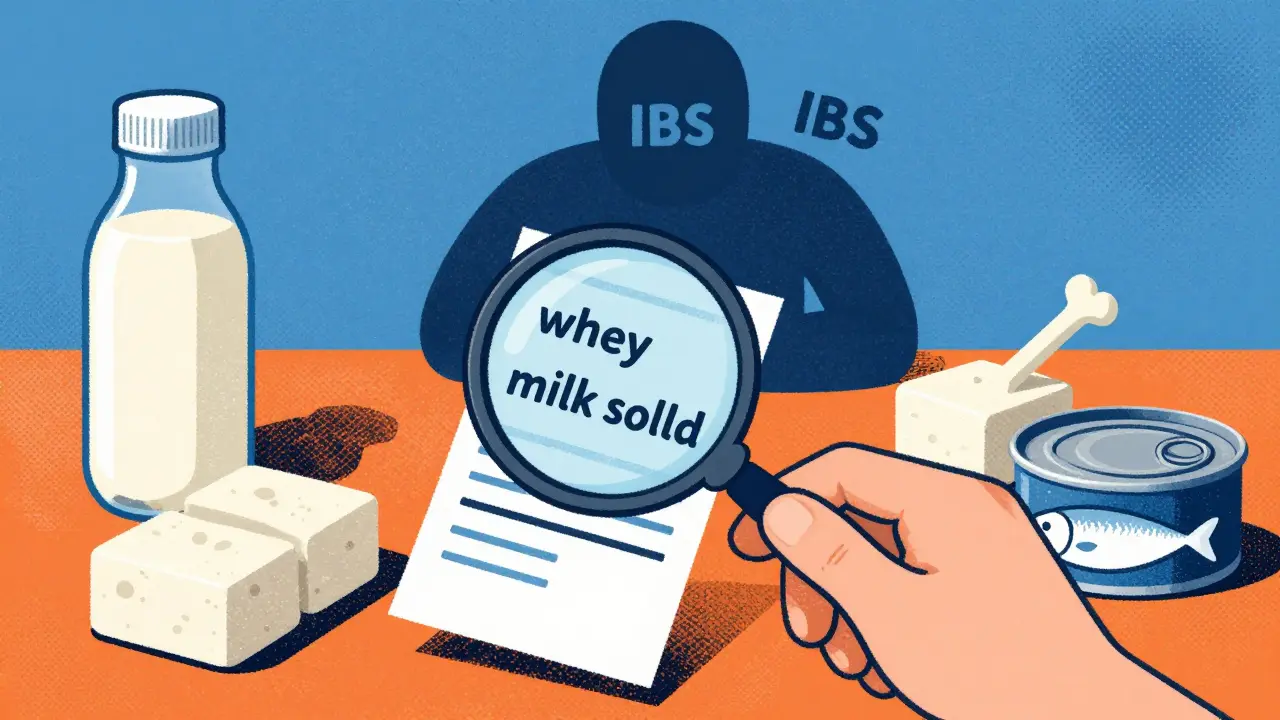
Doctors often mistake lactose intolerance for IBS. Both cause similar symptoms: belly pain, gas, loose stools. But IBS is a functional disorder-your gut is overly sensitive, but not damaged. Lactose intolerance is a chemical mismatch. The key difference? With lactose, symptoms come on 30 minutes to two hours after eating dairy. With IBS, triggers are broader: stress, caffeine, fatty foods, even artificial sweeteners.
Here’s the catch: 25% of people with IBS also have lactose malabsorption. That means they might feel better avoiding dairy-but not because they’re “intolerant.” They’re just one part of a bigger puzzle. That’s why jumping straight to a dairy-free diet isn’t the answer.
How Is It Diagnosed?
There are three main ways to find out if lactose is the culprit.
- The hydrogen breath test is the gold standard. You drink a solution with 25 to 50 grams of lactose (about 2 cups of milk). Then, your breath is tested every 30 minutes for 2 to 3 hours. If hydrogen levels rise more than 20 ppm above baseline, it means lactose is being fermented in your colon. This test is 90% accurate-but it’s not perfect. If you have SIBO (small intestinal bacterial overgrowth), you’ll get a false positive. You also have to fast for 12 hours and avoid antibiotics for four weeks before the test.
- The lactose tolerance blood test checks your blood sugar after you drink lactose. If your glucose doesn’t rise by at least 20 mg/dL, your body isn’t digesting it. But this test has a 20% error rate because of how fast your stomach empties. It’s rarely used anymore.
- The elimination and challenge diet is the simplest and often the most accurate for everyday life. You cut out all dairy for 2 to 4 weeks. If your symptoms disappear, you then slowly add back small amounts of milk or yogurt. If they come back, it’s likely lactose. Many people find this more useful than a lab test because it shows what actually happens in their real life.
For babies and young kids, doctors use a stool acidity test. Undigested lactose turns stool acidic (pH under 5.5). Genetic tests can check for the C/T-13910 mutation linked to lactase non-persistence-but they only tell you if you’re genetically predisposed, not whether you’ll have symptoms.
Why the Hydrogen Breath Test Isn’t Always the Answer
Even if your breath test is positive, you might still be fine with dairy. Studies show 20 to 30% of people with a positive test can drink a glass of milk without symptoms. That’s because tolerance varies. Some people can handle 12 grams of lactose (a cup of milk) just fine. Others need to stick to 4 grams (a quarter cup). The test tells you if your body absorbs lactose. It doesn’t tell you if you’ll feel bad.
Dr. E. M. Weaver, a leading researcher, says: “A positive test without symptoms isn’t lactose intolerance-it’s lactose malabsorption.” Diagnosis should be based on your symptoms, not just a number on a machine.
And here’s another problem: access. In the UK and parts of the U.S., waiting for a breath test can take months. Meanwhile, people suffer with bloating and diarrhea, misdiagnosed as IBS. A 2022 survey found 65% of patients waited over six months for a diagnosis. Many got it wrong at first.
How Much Lactose Can You Actually Tolerate?
You don’t need to quit dairy cold turkey. Most adults can handle up to 12 grams of lactose in one sitting-about one cup of milk. If you eat it with a meal, that number jumps to 18 grams. That’s because fat and protein slow down digestion, giving your body more time to break down what little lactase you have.
Some dairy products are naturally low in lactose:
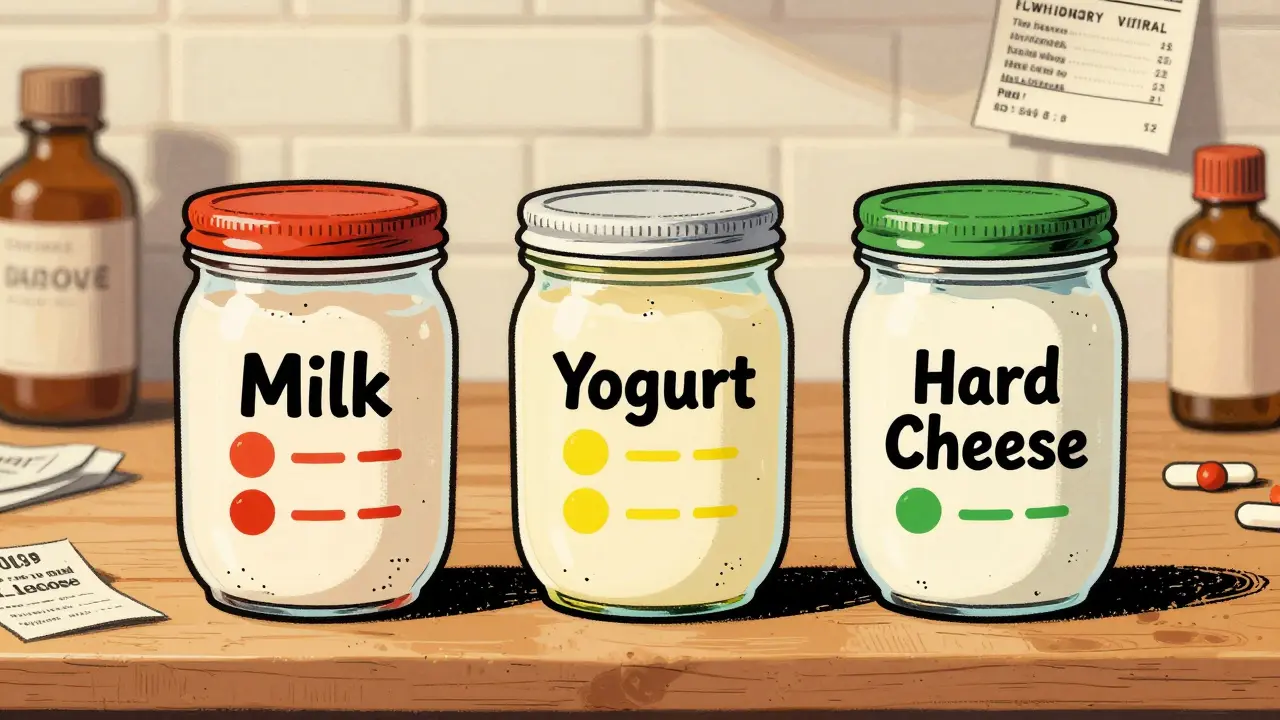
- Hard cheeses (cheddar, parmesan, Swiss): Less than 1 gram per ounce. Most people tolerate these fine.
- Yogurt with live cultures: The bacteria eat some of the lactose. Many people can eat 6 to 8 ounces without issues.
- Butter and heavy cream: Almost no lactose. Just fat.
- Lactose-free milk: Regular milk with added lactase enzyme. Same nutrients, no symptoms.
Even yogurt with live cultures can be a game-changer. In a 2021 study, people who ate 10 ounces of yogurt daily saw a 70% drop in symptoms.
What About Lactase Pills?
Over-the-counter lactase supplements (like Lactaid®) work for many people. Take 3,000 to 9,000 FCC units right before eating dairy. Studies show they reduce symptoms by 70 to 90% if taken correctly. But they’re not magic. If you eat a whole pizza with five types of cheese, no pill will save you. They’re best for small, occasional treats-like a scoop of ice cream or a latte.
They don’t work for everyone. People with very low lactase levels or those who eat large amounts of dairy regularly may still feel bloated. And they’re useless if you’re eating hidden lactose in processed foods.
Hidden Lactose Is Everywhere
It’s not just milk and cheese. Lactose is in bread, salad dressings, protein bars, soups, and even some medications. A 2022 FDA audit found 20% of products labeled “non-dairy” still contained lactose. That’s because “non-dairy” doesn’t mean “lactose-free.” It just means no milk solids. Lactose can still be added as a filler.
Check labels for these ingredients:
- Milk solids
- Milk powder
- Whey
- Milk sugar
- Curd
- Casein
- Buttermilk
And watch out for “natural flavors” or “stabilizers”-those can hide lactose too. If you’re unsure, stick to whole, unprocessed foods until you know your limits.
Getting Enough Calcium Without Dairy
One of the biggest risks of going dairy-free is calcium deficiency. Most people get 70% of their daily calcium from dairy. Without it, bone health suffers-especially in teens and postmenopausal women.
You need 1,000 to 1,200 mg of calcium a day. Here’s how to get it without milk:
- Fortified plant milks (soy, almond, oat): 300-500 mg per 8 oz serving. Choose ones with added calcium carbonate or tricalcium phosphate.
- Calcium-set tofu: 250-800 mg per half-cup, depending on how it’s made.
- Leafy greens: Kale, bok choy, collard greens (broccoli and spinach have calcium too, but it’s harder to absorb).
- Canned fish with bones: Sardines and salmon-about 300 mg per 3 oz.
- Fortified orange juice: 300 mg per cup.
Vitamin D helps your body absorb calcium. Get it from sunlight, fatty fish, eggs, or a supplement (600-800 IU daily). Many people with lactose intolerance are also low in vitamin D.
What’s New in 2025?
Diagnosis is getting faster. The LactoQuik® breath test, approved in 2022, cuts the test time from three hours to 45 minutes with the same accuracy. It’s already in use in many clinics.
There’s also new hope in probiotics. Pendulum Therapeutics’ LactoSpore® probiotic, tested in early 2023, helped people digest 40% more lactose than placebo. It’s not available over the counter yet, but it’s a sign of where things are headed.
Europe updated its guidelines in 2023, setting safe lactose limits by age: 12g for adults, 8g for kids 4-8, and 4g for kids under 4. That’s a big step toward personalized advice.
What to Do If You Think You’re Lactose Intolerant
Here’s a simple step-by-step plan:
- Write down your symptoms and when they happen. Do they always follow dairy?
- Try cutting out all dairy for 14 days. No milk, cheese, yogurt, ice cream, butter, cream, or hidden lactose.
- After two weeks, slowly add back small amounts. Start with 1/4 cup of milk. Wait 24 hours. If no symptoms, try 1/2 cup the next day.
- Once you find your limit, stick to it. Don’t try to push past it daily.
- Use lactase pills only for occasional treats, not every meal.
- Get your calcium and vitamin D levels checked by your doctor.
If symptoms don’t improve after eliminating dairy, it’s not lactose. Talk to your doctor about IBS, SIBO, or other conditions.
Final Thought: It’s Not About Perfection
You don’t need to be dairy-free forever. Most people with lactose intolerance can still enjoy some dairy-just in smaller amounts, with meals, or with help from enzymes. The goal isn’t to eliminate all dairy. It’s to eat without pain, without missing out on nutrients, and without feeling stuck.
Listen to your body. Track what works. And don’t let a lab result tell you what your own stomach already knows.
Can you suddenly become lactose intolerant?
Yes. Lactase production can drop after an illness like gastroenteritis, surgery, or prolonged antibiotic use. This is called secondary lactose intolerance. It’s often temporary. Once the gut heals, lactase levels can return. But in most cases, lactose intolerance is genetic and develops slowly over time, usually starting in late teens or early adulthood.
Is lactose intolerance the same as a milk allergy?
No. A milk allergy is an immune reaction to milk proteins (casein or whey), and it can cause hives, swelling, vomiting, or even anaphylaxis. Lactose intolerance is a digestive issue. It doesn’t involve the immune system. Allergies are rare in adults, while lactose intolerance is very common. If you have a true milk allergy, you must avoid all dairy completely-even lactose-free products.
Why do some people tolerate yogurt but not milk?
Yogurt contains live bacteria (probiotics) that help break down lactose before you even eat it. The fermentation process reduces the lactose content by up to 30%. Plus, yogurt’s thicker texture slows digestion, giving your body more time to handle what’s left. That’s why many people can eat yogurt with no issues-even if milk makes them sick.
Can kids outgrow lactose intolerance?
Primary lactose intolerance-caused by genetics-doesn’t go away. But secondary lactose intolerance, triggered by illness or injury to the gut, often improves once the gut heals. Kids under 4 rarely have genetic lactase deficiency. If a young child has symptoms, it’s more likely due to infection, food sensitivity, or another condition. Always check with a pediatrician before removing dairy from a child’s diet.
Are plant-based milks a good substitute?
They can be, but not all are created equal. Soy milk is closest to cow’s milk in protein and calcium (if fortified). Oat and almond milk are lower in protein and often high in sugar. Always choose unsweetened, calcium-fortified versions. Check the label: you want at least 300 mg of calcium per cup. Avoid rice milk-it’s low in protein and often contains arsenic.
What if I still have symptoms after going dairy-free?
Then it’s probably not lactose. Other culprits include FODMAPs (fermentable carbs in onions, garlic, apples, wheat), fructose malabsorption, SIBO, or IBS. Keep a food diary to track what triggers symptoms. A registered dietitian can help you identify patterns. Don’t assume it’s lactose just because dairy made you feel bad before.

i just cut out milk and felt way better but i kept eating cheese and yogurt and never thought twice about it
turns out i can handle like 1/4 cup of milk if i eat it with food
who knew
THIS. So many people think dairy-free means healthier, but you’re just swapping calcium for sugar-laden plant milks. I switched to fortified soy milk and added canned sardines to my salads-no more cramps, and my bones thank me. Also, hard cheese is a miracle food. Parmesan on everything.
bro i thought i was lactose intolerant until i ate a whole wheel of brie at 2am and felt fine
then i realized it was the onions in my sandwich
my gut is a drama queen 🤡
I’ve been trying to figure this out for years… and I just want to say… thank you… for writing this… so clearly… I’ve been avoiding dairy for too long… and now I’m going to try the elimination thing… slowly… with a food journal…
This article is dangerously misleading. You're implying that people can 'tolerate' lactose when the science is clear: if you lack lactase, you are biologically incapable of digesting it. The notion that 'some people feel fine' is pseudoscience. You're encouraging nutritional negligence. Calcium supplements are not a substitute for biological reality. This is irresponsible.
Yogurt and hard cheese are fine. Milk? Not so much. That’s it.
in india we don't drink milk like americans, we make paneer and ghee and yogurt
so even if you're lactose intolerant, you still get dairy without the bloating
it's all about how you process it
so now we're giving people permission to eat cheese like it's a free pass?? lmao
what about the sugar in 'lactose free' milk?? and the carrageenan?? and the fake 'calcium' they add??
you're all just being manipulated by big dairy and big pharma
go eat kale and stop lying to yourselves
My grandmother in rural Tennessee made her own butter and never had a problem. She ate buttered biscuits every morning. She was 92 when she passed. No supplements. No tests. Just food.
It’s not about being perfect. It’s about listening. Your body isn’t broken-it’s just trying to tell you something. I used to stress over every bite, but now I eat yogurt with my breakfast, take a pill if I’m having ice cream, and I’m not afraid of cheese anymore. I didn’t need a lab test to find my rhythm. I just needed patience and curiosity. And maybe a little humor. Like when I accidentally ate a whole slice of pizza and thought I was dying… turned out it was the pepperoni. Who knew?
Y’all are overcomplicating this. I used to get bloated after coffee with cream. Switched to oat milk. Still bloated. Then I tried almond milk. Still bloated. Turned out I was drinking it too fast. Slow down. Chew your damn food. And eat it with something else. Magic.
One must question the epistemological foundations of the elimination diet. The very act of self-diagnosis, unmediated by clinical instrumentation, constitutes a form of naive empiricism-relying on subjective phenomenology rather than objective biomarkers. The hydrogen breath test, despite its limitations, remains the only instrumentally verifiable modality for assessing lactase non-persistence. To privilege anecdotal experience over quantifiable data is to regress into pre-scientific modes of bodily interpretation. This article, while well-intentioned, dangerously legitimizes epistemic relativism in medical practice.