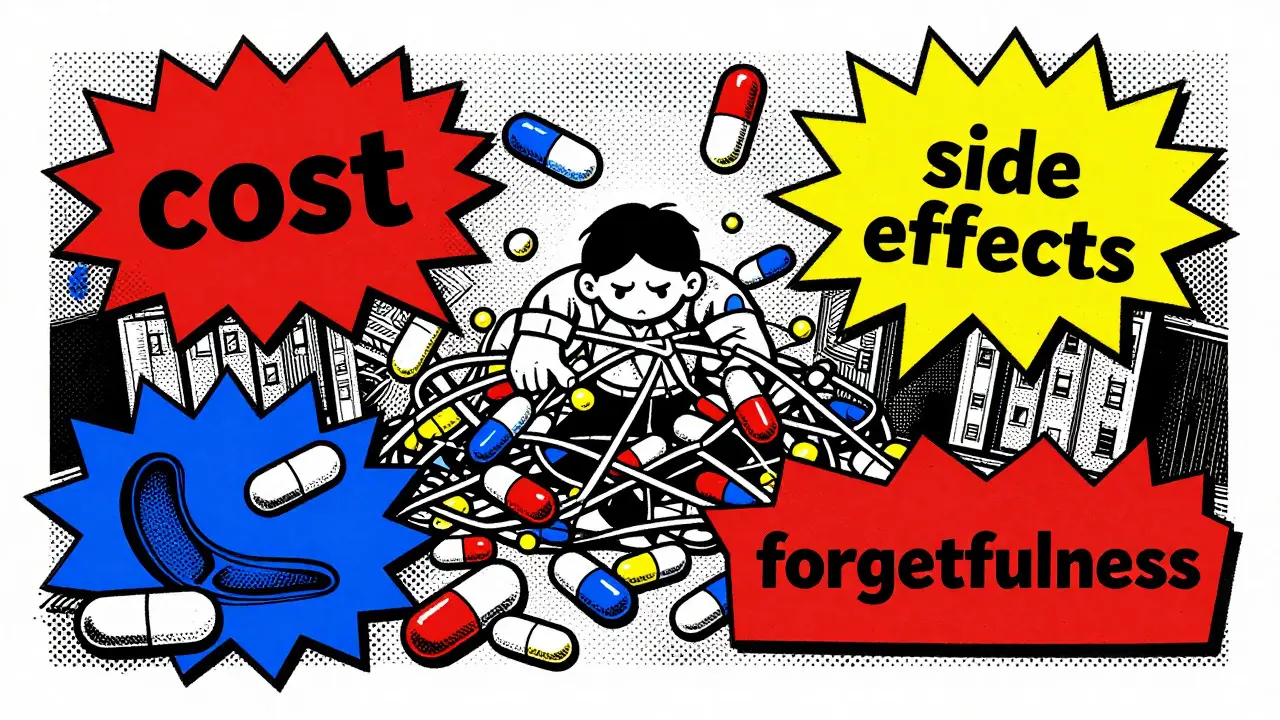
Imagine being prescribed a life-saving medication for a serious condition, only to stop taking it because the side effects are unbearable, the cost is too high, or you simply forget. Now imagine that this isn’t just about forgetting a pill-it’s about a complex web of psychological, social, and systemic barriers that prevent people from getting better. This is the reality of mental health medication non-adherence, defined as the failure of patients to follow prescribed medication regimens for psychiatric conditions. It is not a character flaw; it is a healthcare crisis.
The numbers are staggering. According to the World Health Organization (WHO), at least 80% adherence is required to achieve optimal therapeutic outcomes. Yet, global non-adherence rates in mental health treatment consistently range from 40% to 60%. For patients with schizophrenia, adherence to antipsychotic medications hovers around 50%. This gap between prescription and practice contributes to up to 25% of all hospitalizations and represents what experts call an "invisible epidemic." But here is the good news: we know exactly what helps. The solution isn't just telling people to "take their pills." It involves collaborative care, simplified regimens, and addressing the root causes of why people stop.
The Hidden Drivers of Non-Adherence
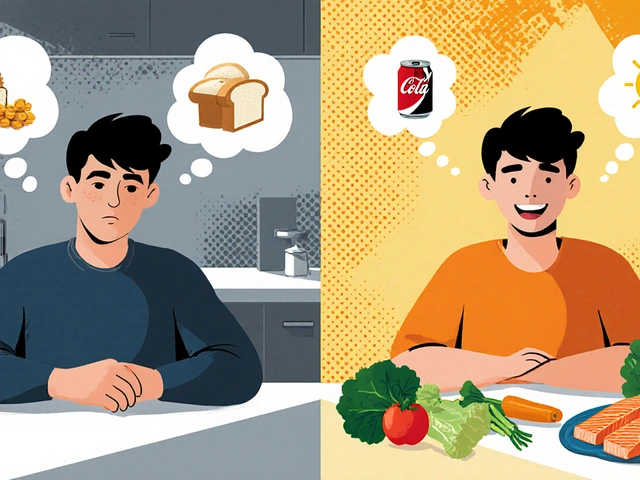
To fix the problem, we first need to understand why it happens. It is rarely just laziness or denial. Research shows that specific factors consistently drive poor adherence. One major factor is symptom severity. When someone is deeply depressed or experiencing severe psychosis, the cognitive load required to manage a daily routine becomes overwhelming. Another critical factor is insight into illness. If a patient does not believe they are sick, they see no reason to take medication that comes with potential side effects.
Social determinants play a massive role, too. Consider the homeless population. Studies show that adherence rates for homeless individuals with psychiatric conditions plummet to 26%-41%, compared to 44%-58% for those with stable housing. Without a safe place to store medication or a consistent routine, adherence drops. Similarly, elderly patients face unique challenges. A systematic review found that depression decreases the likelihood of medication adherence by approximately 40% in older adults. The complexity of managing multiple medications for physical and mental health creates a perfect storm for missed doses.
Furthermore, the structure of the prescription itself matters. Patients on multiple daily doses struggle significantly more than those on once-daily regimens. A survey by the National Alliance on Mental Illness (NAMI) found that 87% of patients who received simplified medication regimens maintained adherence, compared to only 52% on multiple daily doses. Yet, 73% reported their providers never even discussed simplifying their regimen. This disconnect highlights a critical gap in standard care.
What Actually Works: Evidence-Based Interventions
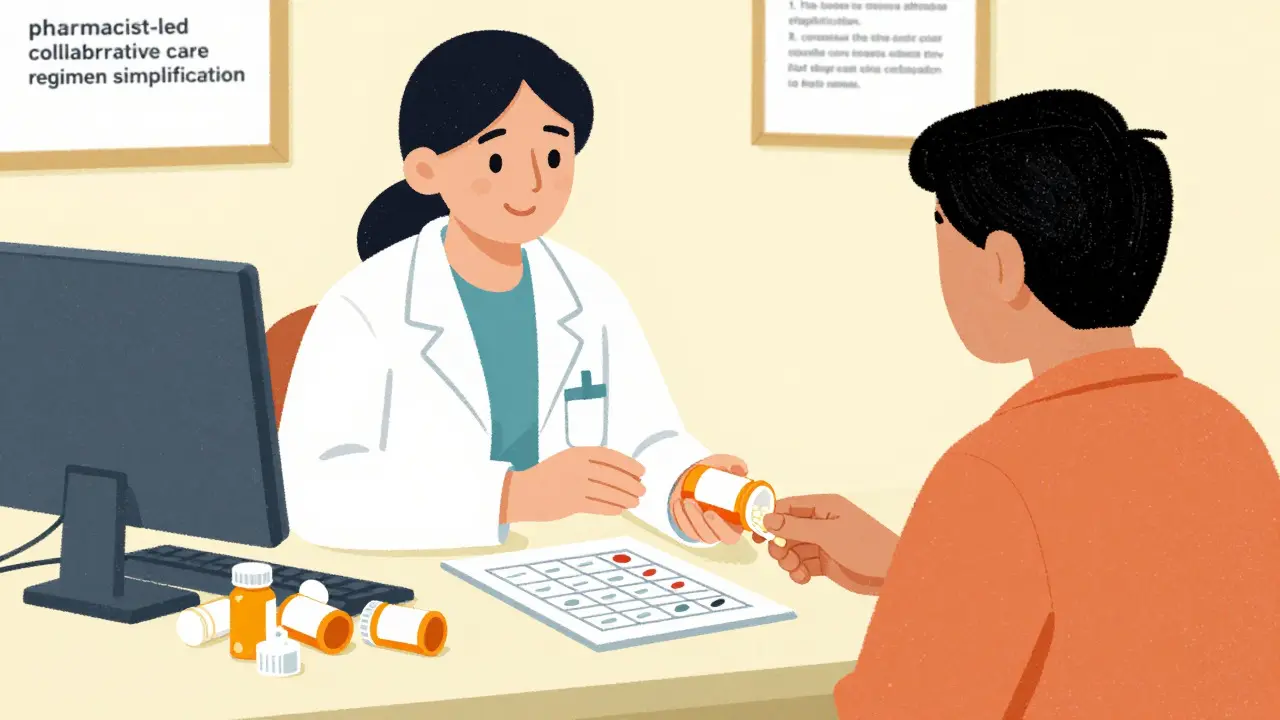
If asking patients to try harder doesn't work, what does? The evidence points clearly toward structured, supportive interventions rather than passive advice. The most impactful approach identified in recent studies is pharmacist-led collaborative care, which involves a team-based model where pharmacists work directly with psychiatrists and patients to optimize medication management.
A randomized controlled trial published in *Frontiers in Psychiatry* in 2025 compared this collaborative model against usual care. The results were striking. The collaborative group showed a mean improvement in medication adherence of 1.67, compared to just 0.69 in the usual care group. That is a 142% greater improvement. Why does this work? Pharmacists provide specialized education, monitor for side effects, and offer continuous support that busy psychiatrists often cannot provide during short appointments. They act as a bridge, translating medical jargon into actionable steps for the patient.
Digital health tools also play a role, though their impact is more modest. Apps and reminders can boost adherence by about 2%, but they are not a silver bullet. They work best when combined with human support. For instance, digital phenotyping-using smartphone data to predict adherence lapses-is emerging as a powerful tool. A 2025 study in *Nature Mental Health* showed 82.4% accuracy in predicting adherence issues 72 hours in advance using passive data collection. This allows clinicians to intervene before a patient stops taking their medication entirely.
The Role of Systemic Changes and Policy
Individual interventions are crucial, but systemic changes amplify their effectiveness. Healthcare systems are beginning to recognize that adherence is a quality metric, not just a patient responsibility. Kaiser Permanente’s Northern California region implemented a pharmacist-led Medication Regimen Management program. Within 90 days, they saw a 32.7% increase in adherence rates for antipsychotic medications. More importantly, this led to 18.3% fewer psychiatric hospitalizations. This demonstrates that improving adherence directly reduces the burden on emergency services and improves patient quality of life.
Policymakers are also stepping up. The Centers for Medicare & Medicaid Services (CMS) now incorporate medication adherence metrics into quality measures that affect plan payments. In 2025, MIPS Measure #383 requires providers to report on the Proportion of Days Covered (PDC) for antipsychotic medications. A PDC of at least 0.8 (80%) is required for adequate performance. This financial incentive pushes healthcare organizations to invest in adherence programs. However, implementation is challenging. A 2024 study found that 63% of community mental health centers faced significant workflow disruption when trying to integrate pharmacists into care teams, with only 41% maintaining the program beyond a year. Sustainability requires careful planning and resource allocation.
| Intervention Type | Effectiveness Metric | Key Benefit | Limitation |
|---|---|---|---|
| Pharmacist-Led Collaborative Care | Up to 40% increase in adherence | Personalized support, side effect management | Requires staffing and workflow integration |
| Regimen Simplification | 87% adherence rate (vs 52% for complex) | Reduces cognitive load, easier to remember | Not always clinically feasible for all conditions |
| Digital Reminders/Apps | ~2% increase in adherence | Low cost, scalable, immediate feedback | Low engagement over time, lacks human nuance |
| Long-Acting Injectables | 87% PDC (vs 56% oral) | Eliminates daily decision-making | Invasive, requires clinic visits |
Addressing Financial and Access Barriers
Even the best clinical interventions fail if patients cannot afford their medication. Cost is a primary driver of non-adherence. Successful programs implement cost-transparency tools to help patients find affordable options. In New Zealand, for example, the Pharmac scheme ensures access to essential medicines, but gaps remain for newer or specialty drugs. Globally, insurance coverage limitations prevent many from accessing specialist support like pharmacist-led care. Reddit users in mental health forums frequently cite insurance denials as a major barrier, with 64% reporting that coverage limits prevented them from seeing a medication specialist.
Another innovative solution is the use of long-acting injectable antipsychotics. These medications, administered every few weeks or months, bypass the daily hassle of pills. The FDA’s 2024 guidance highlights improved adherence as a key benefit, with studies showing 87% Proportion of Days Covered for injectables versus 56% for oral formulations. While not suitable for everyone, they represent a vital option for patients who struggle with daily routines.
Practical Steps for Patients and Providers
So, what can be done right now? For patients, the first step is open communication. Tell your provider if side effects are bothering you or if costs are prohibitive. Ask if your regimen can be simplified. Many patients do not know that once-daily dosing is an option. For providers, integrating adherence checks into every visit is crucial. Use predictive analytics to identify high-risk patients-those with prior hospitalizations or missed appointments-and proactively reach out.
Healthcare systems should invest in training. Pharmacists need 40+ hours of specialized education in psychiatric medication management to effectively join care teams. Psychiatrists need training in collaborative care models. Documentation from the American Society of Health-System Pharmacists indicates that systems achieving >30% adherence improvements typically link adherence outcomes to clinician performance evaluations. Making adherence a shared goal aligns incentives and improves care.
Finally, address the mental health symptoms that hinder adherence. Feelings of worthlessness or suicidal ideation can paralyze a patient’s ability to self-care. Interventions that specifically target these symptoms show more significant adherence improvements than general education programs. Treating the mind helps the body heal.
Why do so many people stop taking mental health medication?
People stop for various reasons including side effects, cost, lack of insight into their illness, complex dosing schedules, and social instability. Up to 60% of patients globally exhibit some level of non-adherence due to these multifaceted barriers.
What is the most effective way to improve medication adherence?
Pharmacist-led collaborative care is currently the most effective intervention, showing up to 40% increases in adherence. This model combines professional expertise with personalized patient support.
How does homelessness affect medication adherence?
Homelessness drastically reduces adherence rates to 26%-41%. Lack of storage, routine, and access to healthcare services makes consistent medication management extremely difficult without targeted support programs.
Can simplifying medication regimens help?
Yes. Patients on once-daily regimens have an 87% adherence rate compared to 52% for those on multiple daily doses. Simplification reduces cognitive load and forgetfulness.
What is the Proportion of Days Covered (PDC)?
PDC is a metric used to measure medication adherence. A PDC of 0.8 (80%) means the patient had the medication available for 80% of the days in a given period. It is widely used in healthcare quality measures like CMS MIPS.
Are long-acting injectables a good alternative?
For many patients, yes. Long-acting injectables show an 87% adherence rate compared to 56% for oral medications. They eliminate daily decisions and are particularly helpful for those with routine challenges.