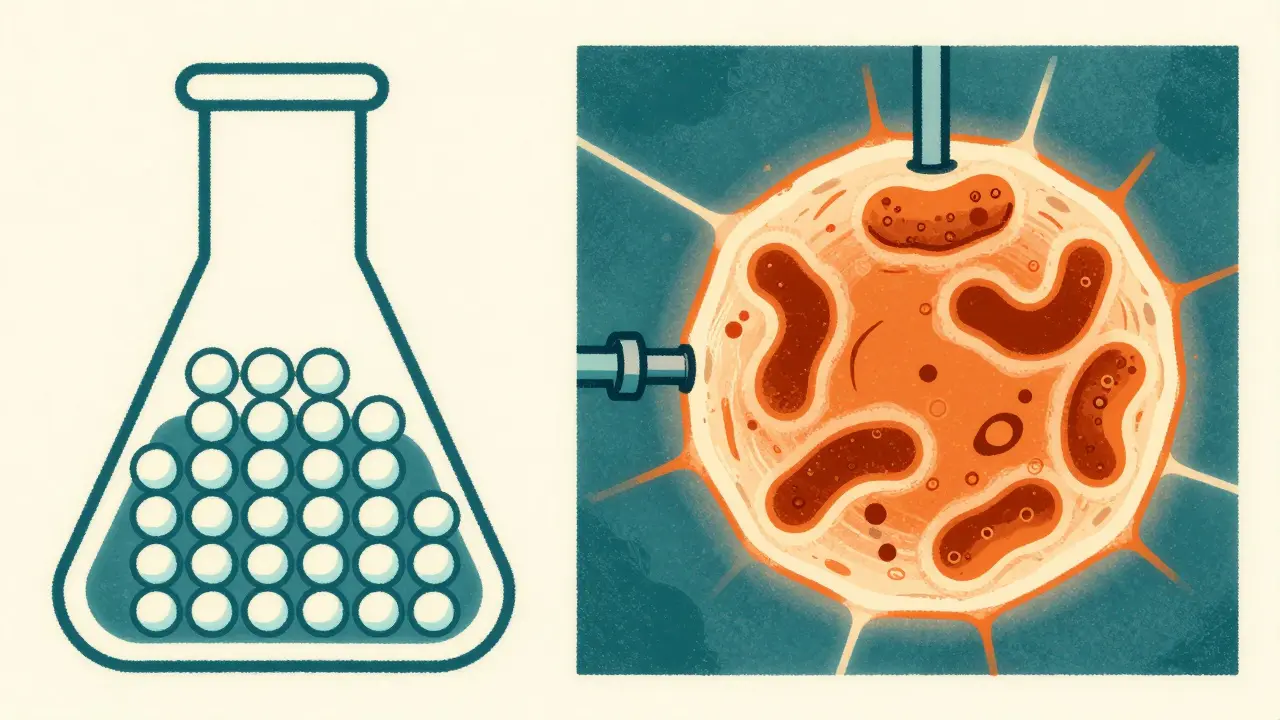
Imagine buying a batch of handmade cookies. Even if you use the exact same recipe every time, one batch might be slightly crispier or have a bit more chocolate in some bites than the last. You wouldn't call them "defective"-they're just natural variations of a complex process. In the world of medicine, lot-to-lot variability is very similar. When we deal with Biologics, we aren't dealing with simple chemical formulas, but with living cells that act as tiny factories. This means no two batches are ever truly identical.
For patients and doctors, this can feel unsettling. Does a different "lot" of a drug mean it won't work the same way? Is a biosimilar actually the same as the original? The short answer is that while there is natural variation, it is carefully managed to ensure your treatment stays effective and safe. Let's break down why this happens and why it doesn't mean your medicine is unstable.
Why Biologics Aren't Like Standard Pills
To understand why variability happens, we first have to look at how these drugs are made. Most medications, like aspirin or a standard generic blood pressure pill, are small-molecule drugs. These are made through chemical synthesis-basically a precise recipe of chemicals mixed in a beaker. The result is a molecule that is exactly the same every single time. If you have a generic version of a small-molecule drug, it is a chemical twin of the original.
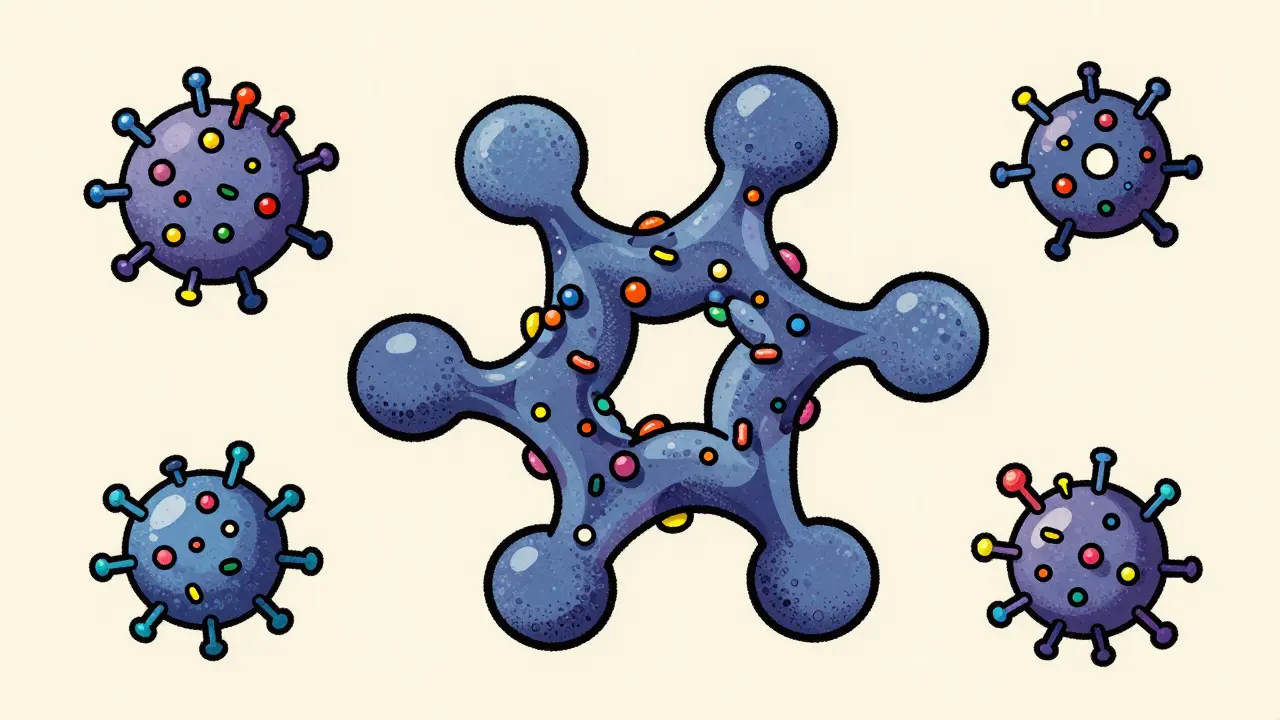
Biologics are a different beast entirely. They are large, complex proteins made inside living cells, such as CHO (Chinese Hamster Ovary) cells. Because they rely on biological processes, they are prone to "mood swings." Even in a highly controlled lab, the cells can produce millions of slightly different versions of the same protein. This is what we call inherent variation.
A common example of this is Glycosylation, which is essentially the process of adding sugar molecules to the protein. Think of it like frosting on a cake; most cakes will have the same amount of frosting, but some might have a slightly different swirl or a few more sprinkles. These sugar patterns can change slightly from one lot to the next, but for the vast majority of patients, these differences don't change how the medicine works in the body.
The Big Difference: Biosimilars vs. Generics
There is a common misconception that a Biosimilar is just a generic version of a biologic. This is actually a dangerous oversimplification. In the eyes of the FDA, biosimilars are not generics. While a generic drug must be an exact copy, a biosimilar is "highly similar" but not identical.
Why can't we make an exact copy? Because we can't "program" the living cells to produce a 100% identical protein every time. Instead, the goal is to ensure there are no clinically meaningful differences in safety and effectiveness. If the reference product (the original brand-name biologic) has a certain range of natural variation between its own lots, the biosimilar just needs to fit within that same range.
| Feature | Small-Molecule Generics | Biosimilars |
|---|---|---|
| Structure | Simple, small molecules | Complex, large proteins |
| Production | Chemical synthesis | Living cell cultures |
| Consistency | Identical copies | Highly similar, but not identical |
| Regulatory Path | ANDA (Bioequivalence) | 351(k) pathway (Analytical/Clinical) |
How the FDA Controls the Chaos
If every batch is a little different, how do we know it's safe? The FDA doesn't just hope for the best; they require a "totality of the evidence" approach. This means manufacturers must use advanced tools, like high-resolution mass spectrometry, to map out every tiny variation in the protein's structure. If the variations in the biosimilar match the variations seen in the original brand-name drug, it's generally considered acceptable.
One of the most critical designations you'll see is Interchangeable Biosimilars. Not all biosimilars are created equal. To be labeled "interchangeable," a product must undergo a "switching study." In these trials, patients are flipped back and forth between the original drug and the biosimilar multiple times. If the patients show no decrease in effectiveness and no increase in risk during these switches, the drug earns the interchangeable status. This allows a pharmacist to switch a patient's medication without needing a new prescription from the doctor.
The Real-World Impact in the Lab
While we usually talk about the drugs patients inject, lot-to-lot variability is a huge headache for the people running the tests in medical labs. Testing reagents-the chemicals used to measure things like your HbA1c for diabetes-are also often biological. When a lab gets a new lot of reagents, they can't just plug them in and start testing.
If a new lot of reagents is slightly off, it can create a "bias." For instance, a documented case showed that a change in reagent lot caused patient results to increase by an average of 0.5%. While that sounds small, it could lead a doctor to change a patient's medication dose based on a result that was actually just a result of a different batch of chemicals. To fight this, labs use "moving averages"-a technique where they track the average of all patient results in real-time to spot sudden shifts that signal a problematic new lot.

Is This Variability a Risk for Patients?
It's natural to wonder if a "bad lot" could exist. In reality, the strict manufacturing controls for biologics are far more intense than those for standard pills. Because biologics are so expensive and complex to make, companies invest heavily in monitoring. Most lot-to-lot variation is "within-product variation," which is normal and expected. It's like how your heart rate varies throughout the day; it's still your heart, and it's still functioning normally.
The real risk isn't the variation itself, but the failure to detect it. This is why the regulatory bridge between the reference product and the biosimilar is so wide. By ensuring that the biosimilar's "fingerprint" of variation matches the original's, the industry ensures that your body doesn't perceive the change as a foreign threat, which helps prevent adverse immune reactions.
Looking Ahead: The Future of Precision
We are moving into an era of even more complex drugs, such as antibody-drug conjugates and cell therapies. These will be even more sensitive to manufacturing changes. However, our ability to see these changes is improving. We are shifting from "testing a few samples" to "characterizing the entire lot." As analytics get better, the "gap" between different lots will shrink, and the confidence in biosimilarity will grow.
As of 2024, there are over 50 approved biosimilars in the U.S., and that number is climbing. This growth is driving prices down and making life-saving treatments for autoimmune diseases and cancer available to more people. Understanding that "not identical" doesn't mean "not the same effect" is key to embracing these medical advancements.
Are biosimilars just generic versions of biologics?
No. Unlike generics, which are exact chemical copies, biosimilars are highly similar but not identical. This is because biologics are made from living cells, making an exact copy scientifically impossible. However, they are designed to have the same clinical result as the original.
What is glycosylation and why does it matter?
Glycosylation is the attachment of sugar molecules to a protein during production. Because this process is biological, it can vary slightly between batches (lots). This is a primary source of lot-to-lot variability, and regulators check these patterns to ensure the drug remains safe and effective.
Can I switch between different lots of the same biologic?
Yes. Natural variation exists even within the brand-name drug itself. The FDA manages this by ensuring that all lots of a specific product fall within an acceptable range of variation so that the clinical performance remains consistent for the patient.
What makes a biosimilar "interchangeable"?
An interchangeable biosimilar has met additional requirements, including a "switching study" where patients alternate between the original and the biosimilar. This proves that switching back and forth doesn't increase safety risks or lower effectiveness.
Does lot-to-lot variability affect laboratory test results?
Yes, it can. If a laboratory's testing reagents change lots, it can sometimes introduce a bias in the results. Labs prevent this by using verification protocols and monitoring "moving averages" of patient data to catch any sudden shifts.



The distinction between a small-molecule generic and a biosimilar is a critical point of confusion for many patients. It is important to emphasize that the analytical characterization required for biosimilars is significantly more rigorous than the bioequivalence studies used for generics. The use of mass spectrometry allows for a level of precision that ensures the primary sequence and post-translational modifications remain within the established range of the reference product.
Right, "carefully managed" is the phrase they always use. I bet the a-range of variation is just a convenient way to hide the fact that they're pumping out slightly different chemicals to see which ones stick. It's a goldmine for the big pharma giants to just tweak a molecule and call it a new "lot" while keeping the patents alive through a loophole. Totally convenient for them, not for us.
Living cells as factories? More like biological Trojan horses! They tell us it's just a "swirl of frosting" but who knows what else is hiding in those proteins. The government is just playing a game of pretend with these "interchangeable" labels while we're the lab rats in a giant experiment. Wake up!
It is truly a marvel of human ingenuity to see how we balance nature and science :) The idea that imperfection can be managed to save lives is a beautiful philosophy. Let us embrace this progress with an open heart! 🌟
The cookie analogy, while quaint for the layperson, is fundamentally reductive. One must consider that the ontological difference between a baked good and a monoclonal antibody is vast. To suggest that a clinical outcome can be simplified to "sprinkles" on a cake ignores the systemic complexity of protein folding and the precarious nature of immunogenicity. It is quite amusing that we must resort to such juvenile metaphors to explain basic biochemistry.
Whoa, the part about the lab reagents is wild. Imagine your doctor changing your meds just because the lab got a new batch of chemicals. That is absolutely terrifying! Glad they have the moving averages to catch that though.
Oh honey, I've always known that the high-end biologics are just superior. It's so cute that people are just now realizing that not all batches are the same. I only trust the top-tier brands anyway, because why settle for "highly similar" when you can have the absolute gold standard? It's just basic taste in medicine, really!
This is so hlepful. I felt such anxiety about switching to a biosimilar last month, thinking it was just a cheap copy. Reading about how the FDA checks the "fingerprint" of the drug really calms my heart. It's just amazing how much work goes into making sure we stay safe even with these biological variashuns.
American biotech leads the world. Period. The FDA's 351(k) pathway is the global gold standard for safety.
We need to be more assertive about demanding transparency in how these switching studies are conducted. If the industry wants us to trust interchangeable biosimilars, they should make the raw data from those trials more accessible to the clinicians on the front lines. It's not enough to just say it's "managed"; we need to see the metrics.
The PK/PD profiles for these biosimilars are usually spot on. Just gotta keep the Glycan mapping tight to avoid any immunogenic response. Let's keep pushing for more accessibility!
This information is just laaaaaovely! It's so importent for everyone to understand that a little bit of variation isn't a catastrophy! Keep pushing throuogh your treatments and stay strong, everyone! You're all doing amazing work for your healthh!
Complexity is the only true constant in nature... isn't it? The dance of proteins is a slow, winding road... a river that never flows the same way twice... yet we try to cage it in a vial... how poetic... how tragic...