QTc Risk Estimator & Monitoring Guide
QTc Interval Analyzer
Enter your corrected QT (QTc) value in milliseconds (ms) to visualize the clinical risk zone.
Device Comparison Tool
Select a device to see its capabilities for QT monitoring:
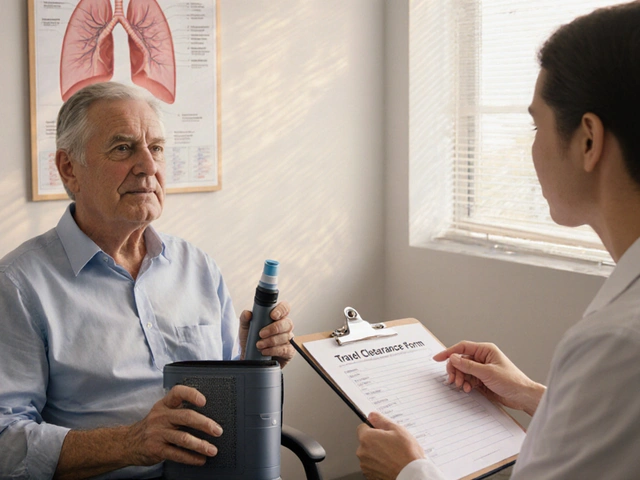
Imagine being on a medication that could potentially trigger a fatal heart rhythm, but instead of spending your days tethered to a hospital monitor, you're simply wearing a watch. This isn't science fiction; it's the new reality of cardiac safety. For people taking certain antipsychotics, antibiotics, or antiarrhythmics, the risk of QT interval prolongation is a constant worry. When the heart takes too long to recharge between beats, it opens the door to torsades de pointes-a dangerous type of ventricular tachycardia that can lead to sudden cardiac death. Traditionally, the only way to track this was via a clinical 12-lead ECG, but wearables are changing the game by bringing that monitoring into the living room.
Quick Summary: Heart Safety on Your Wrist
- The Goal: Detecting QT prolongation early to prevent sudden cardiac arrest.
- Top Tech: Devices like the Apple Watch and KardiaMobile 6L are now clinically validated for QT measurement.
- Accuracy: Some handheld devices are noninferior to hospital-grade ECGs, staying within ±20 ms of standard readings.
- The AI Shift: New deep learning models are automating the detection of prolonged intervals, reducing the need for manual doctor review.
What Exactly is QT Safety?
To understand why wearables matter, you first have to understand the QT interval. In simple terms, this is the time it takes for your heart's ventricles to electrically activate and then reset. If this window stretches too long-often due to medication side effects or genetic conditions-the heart becomes unstable.
The real danger starts when the corrected QT (QTc) interval exceeds 500ms. At this point, the risk of a catastrophic rhythm event spikes. Because many drugs can cause this change unexpectedly, doctors need a way to watch the heart in real-time, not just during a five-minute appointment once a month. This is where Wearable ECGs come in, turning a snapshot into a movie of your heart's behavior.
The Heavy Hitters: Apple Watch vs. KardiaMobile
Not all wearables are created equal. While many gadgets claim to track "heart health," only a few have the clinical backing to be used for QT safety. The two most prominent examples are the Apple Watch (Series 4 and later) and the KardiaMobile 6L.
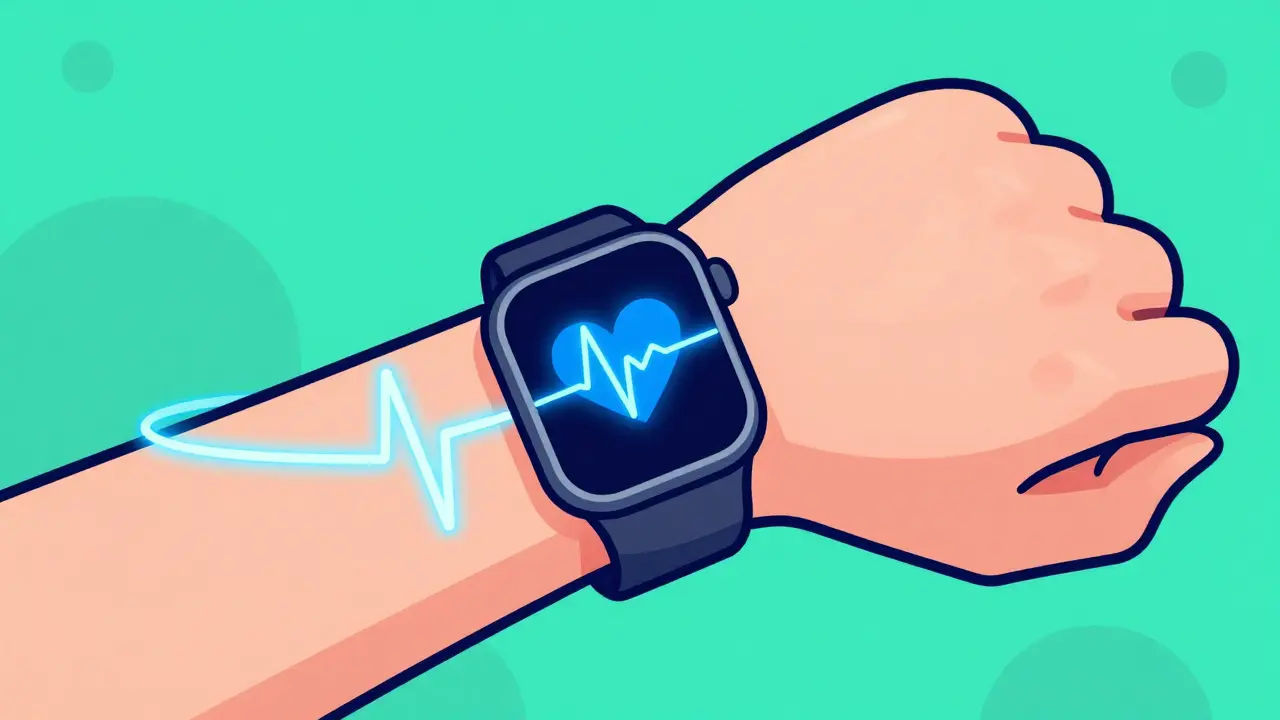
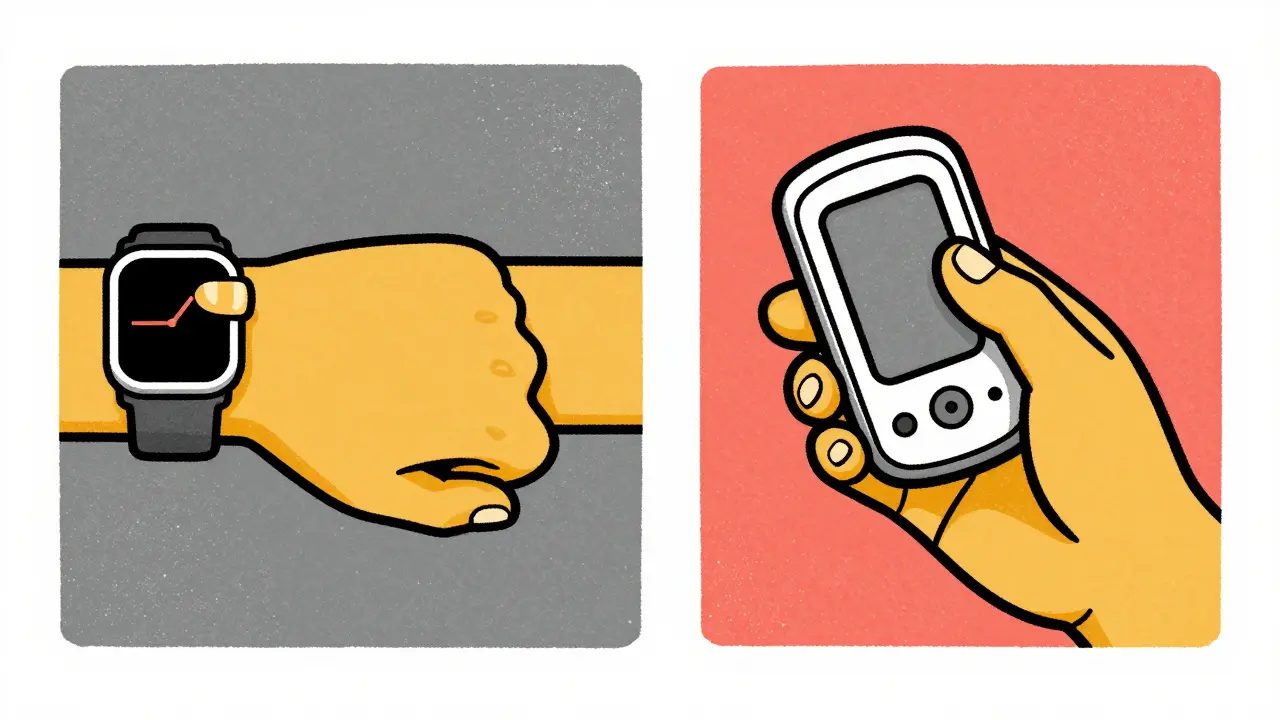
The Apple Watch is the ultimate convenience. By placing a finger on the digital crown for 30 seconds, users complete a circuit that records a single-lead ECG. Research published in Scientific Reports showed a strong correlation (up to 0.914 for QT mean) when compared to the gold-standard 12-lead ECG. It's a powerful tool for spotting trends, though it lacks the multi-dimensional view of a clinical setup.
If you need something closer to a hospital experience, the KardiaMobile 6L is the go-to. Unlike a watch, it's a dedicated wireless device. It captures a 6-lead ECG by having the user touch two electrodes with their thumbs and place another electrode on their left knee or ankle. This creates a more comprehensive electrical map of the heart, providing data on leads I, II, III, aVL, aVF, and aVR. In many tests, this device has proven to be comparable to standard clinical ECGs, making it a viable option for remote patient monitoring.
| Feature | Apple Watch (Series 4+) | KardiaMobile 6L |
|---|---|---|
| Lead Count | Single-lead | 6-lead |
| Usage | Finger on Digital Crown | Thumbs + Knee/Ankle contact |
| Primary Use Case | General wellness & AFib detection | Clinical-grade remote monitoring |
| QT Accuracy | Strong correlation (up to 0.914) | Noninferior to 12-lead (±20 ms) |
| FDA Status | Cleared for ECG app/AFib | Cleared for 16+ indications incl. QT |
How the Pandemic Fast-Tracked Cardiac Tech
We owe a lot of current progress to the 2020-2021 COVID-19 crisis. At the time, many patients were treated with a combination of hydroxychloroquine and azithromycin-two drugs notorious for prolonging the QT interval. With hospitals overflowing, doctors couldn't possibly keep every patient on a bedside monitor.
The FDA stepped in during April 2020, issuing guidance that permitted the use of mobile ECGs like the KardiaMobile 6L for QT measurement. This was a pivotal moment. It shifted the perception of wearables from "gadgets" to "medical tools." Case reports from that era showed that doctors could successfully monitor high-risk patients from their homes, intervening only when the wearable signaled a dangerous trend. It proved that remote monitoring isn't just a convenience; it's a safety net.
The AI Revolution: Moving Beyond Manual Review
Here is the catch: a wearable can record a beautiful ECG, but a human still has to read it. Most people don't have a cardiologist on speed dial to check their readings every hour. This bottleneck is where Artificial Intelligence comes in.
Recent research in PLOS Digital Health has introduced deep learning models using a Residual Neural Network architecture. Instead of relying on a doctor's eye, this AI processes ECG beats from Lead-I and Lead-II streams to predict if a patient has QTc prolongation (specifically looking for intervals over 500ms). In a study of 686 patients with genetic heart disease, this technology showed immense promise in automating risk detection.
Why does this matter? Because AI doesn't sleep. It can scan thousands of hours of wearable data and flag the exact second a patient's QT interval begins to stretch. This moves us from "reactive" medicine (treating a patient after they faint) to "proactive" medicine (adjusting a dose the moment the heart shows stress).
Real-World Challenges and Pitfalls
It's not all smooth sailing. If you're using these devices, you need to be aware of a few technical hurdles. The biggest enemy of a clean ECG is skin-to-electrode impedance. If your skin is too dry or if the device isn't making a firm connection, the signal gets noisy. This "noise" can make a normal heart rhythm look like a pathology, or worse, hide a real problem.
Another issue is the learning curve. For a 6-lead recording on a Kardia device, you can't just hold it in your hand; you have to maintain contact with your leg. For the Apple Watch, the pressure on the digital crown must be consistent. If the patient isn't trained correctly, the data is useless. This is why healthcare providers emphasize that these devices are supplements to clinical care, not replacements for them.
The Future of Out-of-Hospital Care
We are heading toward a world of "outpatient drug loading." Normally, if a drug has a high risk of QT prolongation, you might have to stay in a clinic for several days while the dose is increased. With high-accuracy wearables and AI monitoring, you could potentially do this at home. You'd wear a device, the AI would monitor your QTc in real-time, and your doctor would receive an alert the moment the interval hits a danger zone.
We're also seeing the rise of "invisible" monitors-smart rings and clothing with embedded sensors. While most of these are currently focused on heart rate or sleep, the goal is to integrate the same QT-sensing capabilities into things we already wear. The end goal is a seamless safety system that protects the heart without the patient even thinking about it.
Can an Apple Watch replace a hospital ECG for QT safety?
No. While the Apple Watch is great for spotting trends and is clinically correlated with standard ECGs, it only provides a single-lead view. A hospital 12-lead ECG provides a comprehensive 3D view of the heart's electrical activity, which is still the gold standard for definitive diagnosis and acute risk assessment.
What is a "dangerous" QTc value?
Generally, a corrected QT (QTc) interval greater than 500ms is considered a high-risk zone where the likelihood of torsades de pointes and sudden cardiac events increases significantly. Always consult a physician to interpret your specific values.
How does the KardiaMobile 6L differ from the 1-lead version?
The 6L version uses electrodes on both the top and bottom of the device, requiring contact with both the thumbs and a leg (knee or ankle). This allows it to record six different leads, providing a much more detailed electrical map of the heart compared to the single-lead version.
Which medications typically require QT monitoring?
Many antibiotics (like azithromycin), certain antipsychotics, and specific antiarrhythmic drugs are known to prolong the QT interval and often require close monitoring to ensure patient safety.
Do AI models actually work for detecting QT prolongation?
Yes, emerging research using Residual Neural Networks has shown that AI can accurately infer QT intervals from single-lead ECG streams, helping to identify high-risk patients (QTc > 500ms) without requiring a clinician to manually review every single heartbeat.