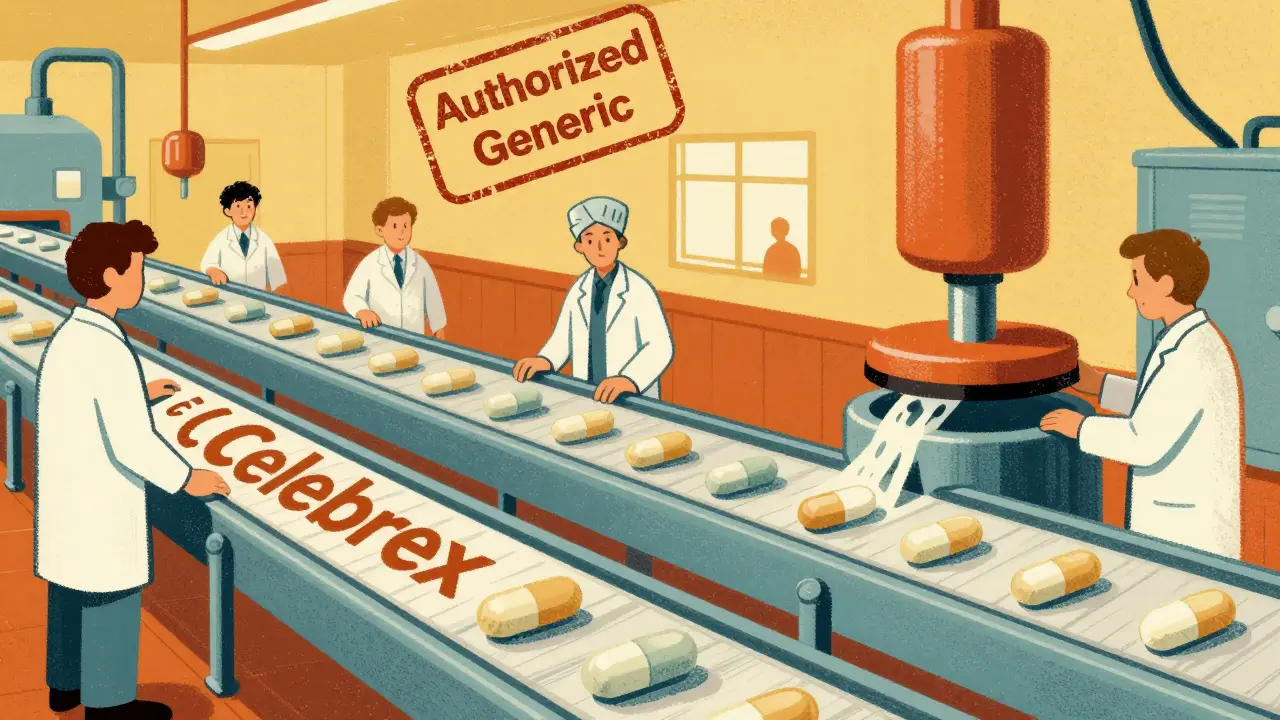
When a brand-name drug loses its patent, the market opens up for cheaper generics. But here’s the twist: sometimes, the same company that made the original drug launches its own generic version. These aren’t knockoffs. They’re exact copies - same pills, same ingredients, same factory - just sold without the brand name. This is called an authorized generic, and it’s become one of the most strategic moves in pharmaceuticals since the 1990s.
What Exactly Is an Authorized Generic?
An authorized generic is a prescription drug made by the original brand manufacturer and sold under a different label. It’s not a copy. It’s the same drug, from the same batch, in the same packaging - except the brand name is removed. You won’t see "Celebrex" on the bottle. Instead, it might say "celecoxib" with a different color or imprint. But inside? Identical to the brand. Unlike regular generics, which must prove they work the same way through expensive testing (called bioequivalence studies), authorized generics skip all that. They’re approved under the brand’s original New Drug Application (NDA). That means no new FDA approval is needed - just a simple notification. This is why they’re not listed in the FDA’s Orange Book, which tracks approved generic drugs. They’re not considered "generics" by the FDA’s regulatory definition. They’re the original product, relabeled. Examples include Greenstone’s version of Celebrex, Prasco’s version of Colcrys, and Watson’s version of Concerta. All are chemically and physically identical to the brand. Even the inactive ingredients - the fillers, dyes, binders - match exactly. That matters. For drugs with a narrow therapeutic index, like levothyroxine or warfarin, tiny differences in inactive ingredients can cause big problems. Authorized generics eliminate that risk.Why Do Brand Companies Do This?
It sounds counterintuitive. Why would a company help kill its own profits? The answer lies in timing and control. When a patent expires, the first generic company to file gets 180 days of exclusive market access under the Hatch-Waxman Act. That’s a golden window. They can charge higher prices than later generics because they’re the only option. But if the brand company launches its own authorized generic during that 180-day window, it splits the market. The first generic can’t raise prices too high - now there’s a cheaper, identical alternative. Data from Health Affairs shows that between 2010 and 2019, 854 authorized generics hit the U.S. market. About 70% of them launched before or during that 180-day exclusivity period. The Federal Trade Commission found that when authorized generics entered during this window, prices dropped 15-20% compared to markets without them. Consumers win - at least in the short term. But there’s a catch. By launching their own generic, brand companies slow down the flood of independent generic competitors. Instead of 10 companies entering the market, maybe only two do: the brand’s own version and the first generic. That reduces long-term price pressure. Critics call this market manipulation. Supporters say it’s just smart business.Authorized Generics vs. Traditional Generics: The Real Differences
Many patients think all generics are the same. They’re not. | Feature | Authorized Generic | Traditional Generic | |--------|-------------------|---------------------| | Manufacturer | Same as brand-name drug | Different company | | Active Ingredients | Identical | Identical | | Inactive Ingredients | Identical | May differ | | FDA Approval Path | Under brand’s NDA | Through ANDA | | Listed in Orange Book? | No | Yes | | Bioequivalence Testing Required? | No | Yes | | Price | Usually lower than brand, similar to generics | Typically lowest price | The big difference? Inactive ingredients. Traditional generics only need to match the active ingredient. The rest - the color, the coating, the preservatives - can change. For most drugs, that’s fine. For others, it’s not. Patients on thyroid medication or epilepsy drugs sometimes report feeling worse on a traditional generic. Switching to the authorized version often fixes it. Pharmacists see this. One Reddit user, a pharmacist, wrote: "I’ve had patients stabilized on brand who failed on generic but did fine on authorized generic. Same drug. Same fillers. Same everything."
Why Patients Get Confused
Here’s the problem: patients don’t know what they’re getting. A 2023 survey by Pharmacy Times found that 68% of pharmacists say patients are confused about authorized generics. One patient on Drugs.com wrote: "I got this ‘generic’ but it looks identical to the brand I used before - is this actually generic?" They’re right to be confused. If it looks and works like the brand, why is it cheaper? Is it fake? Is it inferior? The FDA doesn’t require clear labeling to distinguish authorized generics from traditional ones. Some manufacturers, like Greenstone (Pfizer’s arm), do a good job with packaging and documentation. Others don’t. That creates chaos in pharmacies. A 2021 survey by the National Community Pharmacists Association found that 57% of independent pharmacies reported a spike in patient questions after the FDA pushed for clearer labeling in 2019. Pharmacy systems often don’t flag authorized generics separately. A prescription might say "levothyroxine" and the pharmacy fills it with the authorized version. The patient sees the same pill, assumes it’s the brand, and doesn’t question the price. Then they get a bill and wonder why their insurance didn’t cover it as a brand. Or worse - they switch back to the brand because they think the "generic" isn’t working.How Pharmacies Are Adapting
Pharmacies are catching on. Some have updated their software to flag authorized generics in their systems. Epic Systems, one of the largest pharmacy software providers, added a special tag in their 2021 update. Internal data showed this cut identification errors by 67%. Training is still a hurdle. AmerisourceBergen’s 2022 training materials show that 73% of pharmacy technicians needed 2-3 weeks of extra education to properly explain authorized generics to patients. Staff have to learn: "This isn’t a knockoff. It’s the real thing. It’s just sold cheaper." Prescription Benefit Managers (PBMs) like Express Scripts and OptumRx are pushing authorized generics hard. Their 2021 analysis showed 28% higher utilization of authorized generics compared to traditional ones. Why? Because they’re seen as more reliable - especially for high-risk drugs. If a patient’s condition is unstable, switching to a traditional generic with different fillers could cause a relapse. Authorized generics avoid that.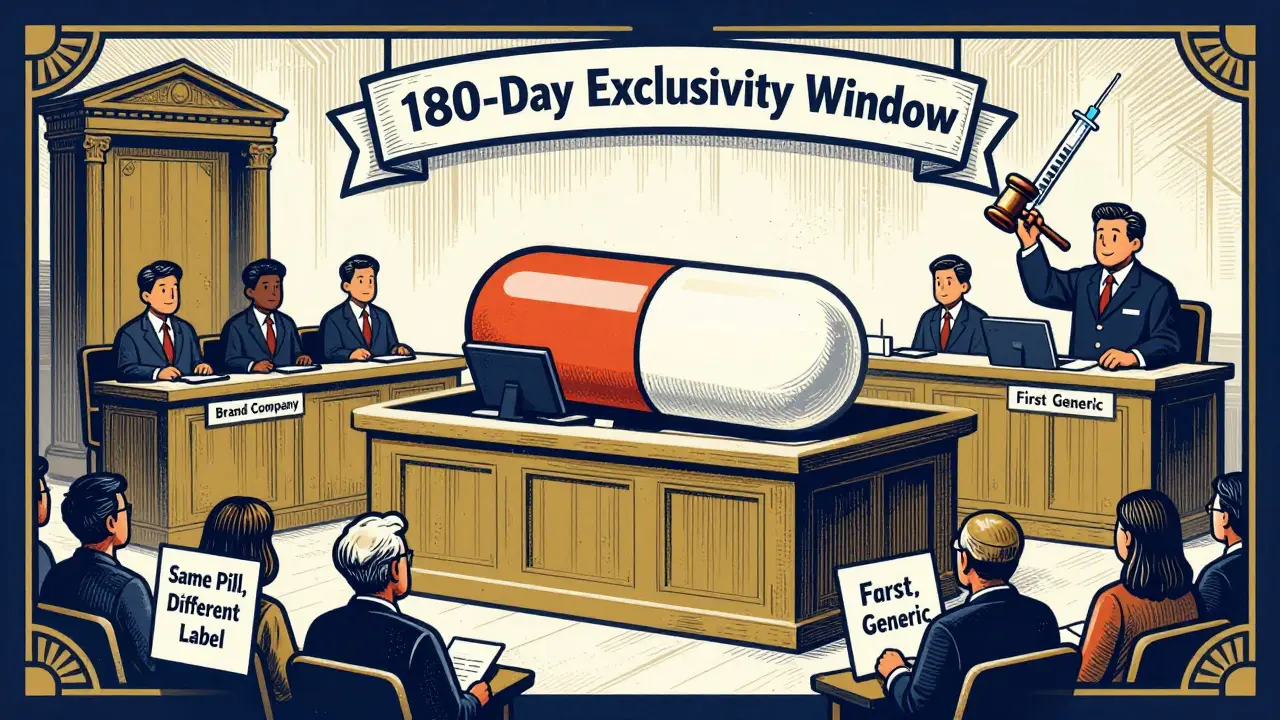
The Bigger Picture: Market Trends and Future Risks
In 2022, 38 of the top 50 brand drugs facing patent expiration had authorized generics within 12 months. That’s up from 32% in 2022. Evaluate Pharma predicts that by 2027, 45% of major brand drugs will have authorized generics. That’s a huge shift. CNS drugs - things like antidepressants, stimulants, antiseizure meds - have the highest adoption (67%) because inactive ingredients matter most. Antibiotics? Only 22%. Why? Because a slight difference in a pill for a bacterial infection won’t kill you. A slight difference in a pill for epilepsy might. But there’s growing political pushback. The "Promoting Competition in Pharmaceutical Markets Act," introduced in Congress in 2023, would ban brand companies from launching authorized generics during the 180-day exclusivity period. If passed, it could change the game. The FTC is currently studying whether the 2011 conclusions still hold - whether these drugs still benefit consumers or now just protect profits. Meanwhile, the FDA updated its Authorized Generic Drugs list in October 2025. It now includes 1,247 products - up from 854 just five years ago. The trend isn’t slowing.What This Means for You
If you’re on a brand-name drug that’s going generic, ask your pharmacist: "Is there an authorized generic?" Don’t assume the cheapest option is the best. If you’ve had trouble with traditional generics - mood swings, side effects, unstable lab results - the authorized version might be the answer. Don’t be fooled by looks. Just because the pill looks like the brand doesn’t mean it’s the brand. And just because it looks different doesn’t mean it’s worse. Authorized generics are the real deal. If you’re a patient with a chronic condition, especially one requiring precise dosing, ask for the authorized generic. It’s not just cheaper. It’s more predictable. And if you’re confused? Ask. Pharmacists are trained to explain it. You deserve to know exactly what you’re taking.Frequently Asked Questions
Are authorized generics the same as the brand-name drug?
Yes. Authorized generics are made by the same company, in the same facility, using the same ingredients - active and inactive - as the brand-name version. The only difference is the label. They are not copies or imitations. They are identical.
Why aren’t authorized generics listed in the FDA’s Orange Book?
Because they’re not approved as generics. They’re marketed under the brand’s original New Drug Application (NDA). The Orange Book only lists drugs approved through the Abbreviated New Drug Application (ANDA) process. Authorized generics bypass that process entirely, so they don’t appear in the list.
Do authorized generics cost less than brand-name drugs?
Yes. Authorized generics are almost always cheaper than the brand-name version. They’re usually priced similarly to traditional generics, but sometimes even lower because the manufacturer doesn’t have to invest in separate marketing or approval.
Can I trust an authorized generic if I’ve had bad reactions to other generics?
Yes - and that’s one of their biggest advantages. Traditional generics only need to match the active ingredient. Inactive ingredients (fillers, dyes, coatings) can vary and sometimes cause side effects or reduced effectiveness. Authorized generics have the exact same inactive ingredients as the brand, so if you reacted poorly to other generics, switching to an authorized one may solve the problem.
Why would a brand company sell its own generic?
To protect revenue and control the market after patent expiration. By launching an authorized generic during the first generic’s 180-day exclusivity window, the brand company can prevent the first generic from raising prices too high. This keeps overall prices lower but also limits how many other generic companies enter the market.
So if it's literally the same pill, why does it cost less?? 🤔 I just got my levothyroxine switched and I was like... is this the brand?? Same exact blue pill. My pharmacist just shrugged. 😅
Oh wow. So the pharma giants are just playing chess while we’re all stuck playing checkers. Brilliant. Of course they’d launch their own generic-why let some scrappy startup steal their profits when they can do it themselves and still look like the good guy? Classic corporate hypocrisy. They call it 'market control'-I call it a monopoly with a smiley face. 🤡
One must consider the regulatory arbitrage inherent in this mechanism. The FDA’s classification framework, predicated upon the ANDA pathway, creates a structural loophole wherein the original NDA holder may circumvent competitive pressures by leveraging their preexisting approval infrastructure. This is not innovation-it is institutionalized rent-seeking under the guise of consumer benefit. The absence of Orange Book listing is not an oversight; it is a deliberate obfuscation.
Moreover, the implicit endorsement by pharmacists-‘it’s the same thing’-is ethically problematic. Patients are not informed that they are receiving a rebranded originator product, thereby undermining the very notion of informed consent in pharmaceutical dispensing.
I’ve been prescribing levothyroxine for 12 years. Patients who switch to regular generics often come back with weird symptoms-fatigue, heart palpitations, brain fog. Switch them to the authorized generic? Poof. Back to normal. It’s not magic. It’s chemistry. The fillers matter more than people think. And yes, it’s the exact same pill. Just cheaper. Why is that so hard to believe?
As a pharmacist, I’ve seen this play out a thousand times. Patients think ‘generic’ means ‘lesser.’ But authorized generics? They’re the brand’s baby-same factory, same quality control, same inactive ingredients. I always tell them: ‘If you’ve had bad reactions to other generics, this is your golden ticket.’
And honestly? The FDA’s labeling silence is a disservice. Imagine buying a BMW but getting a badge that says ‘economy sedan.’ You’d be furious. We need transparency-not corporate convenience.
Pharmacies are finally catching up, but it’s slow. Training takes time. Patients deserve to know what they’re getting. Not just what’s cheapest.
So... the FDA lets drug companies sell their own drugs as ‘generic’-without even labeling them as such-while pretending they’re ‘helping consumers’? This is why America’s healthcare system is a joke. It’s not a market-it’s a rigged casino. Big Pharma owns the table, the dice, and the dealer. And we’re the suckers paying for the drinks. And now they’re telling us to ‘ask our pharmacist’? Like that’s going to fix this? I’m not buying it. I’m not buying ANY of it.
Let’s be real: this isn’t about ‘market efficiency.’ This is a coordinated scheme. The same companies that spent billions lobbying to extend patents are now launching ‘authorized generics’ to strangle competition before it even starts. The FTC’s 2011 conclusions? Outdated. The data now shows these moves delay generic entry by 18–24 months on average. And the FDA? They’re complicit. Why? Because they’re funded by pharma user fees. Same people who wrote the rules. Same people who decide what gets listed. Same people who ignore the real harm to patients. This isn’t capitalism. It’s feudalism with pill bottles.
Hey-this is actually kind of amazing? If you’ve struggled with side effects from other generics, this could be your fix. No need to suffer. No need to overpay. Just ask your pharmacist: ‘Is there an authorized version?’ It’s simple. And it works. Seriously, try it. Your body might thank you. 💪❤️
How poetic. The pharmaceutical industry, once the herald of scientific progress, now reduces medicine to a branding exercise. The pill that heals you is no longer distinguished by its molecular structure-but by its label. We’ve moved from Hippocrates to Helvetica. The authorized generic: a Nietzschean Ubermensch of pharmaceuticals-created by the same hand that forged the original, yet stripped of its name to serve the market’s cruel calculus. How very modern.
My mom’s on warfarin. She switched from the brand to a regular generic and started having weird bruising. We switched to the authorized generic-same pill, different label-and it was fine. No more scary INR spikes. I wish we’d known this sooner. If you’re on anything with a narrow window, this is worth asking for. Not all generics are equal. And that’s okay. You just need to know the difference.
Thank you for this thorough and well-researched post. The distinction between authorized and traditional generics is critically undercommunicated, and your breakdown-especially the table-is invaluable. Pharmacists, clinicians, and patients alike would benefit from standardized educational materials. I would suggest collaborating with organizations like the American Pharmacists Association to develop a public-facing infographic. This information should be accessible, not buried in regulatory fine print.