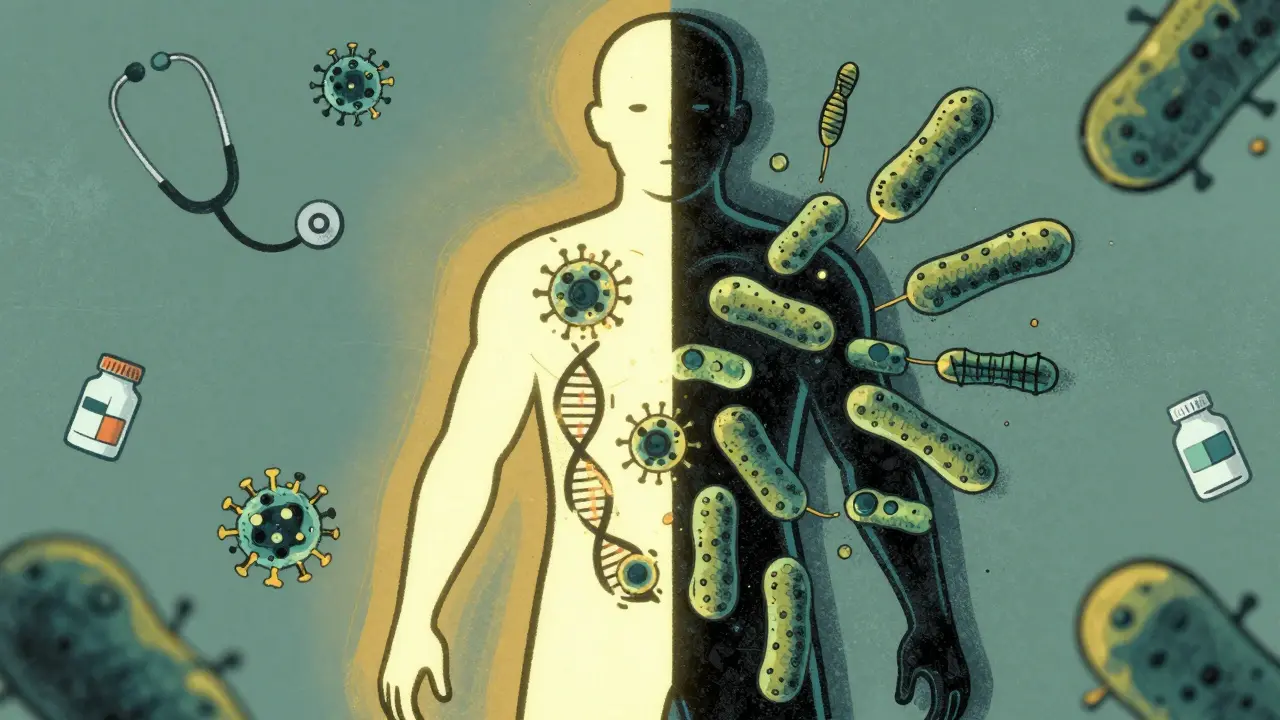
Every winter, people start coughing, sneezing, and running fevers. The big question isn’t just what’s wrong-it’s what’s causing it. Is it a virus? Or bacteria? The answer changes everything. Take antibiotics for a viral infection? They won’t help. Skip antibiotics for a bacterial one? It could get dangerous. Yet, nearly 7 out of 10 people can’t tell the difference. That’s not just confusion-it’s a public health problem.
What’s Really Going On Inside Your Body?
Bacteria and viruses aren’t just different germs-they’re completely different kinds of invaders. Bacteria are single-celled living organisms. They eat, grow, and multiply on their own. You find them everywhere: in soil, water, your skin, even your gut. Most are harmless. Some, like Streptococcus pyogenes, cause strep throat. Others, like Mycobacterium tuberculosis, cause tuberculosis. These bacteria can survive outside the body and spread through contact, air, or contaminated food.
Viruses are not alive in the traditional sense. They’re just genetic material-DNA or RNA-wrapped in a protein coat. They can’t reproduce on their own. They need to hijack your cells to multiply. Once inside, they turn your body’s own machinery into a virus factory. That’s why viruses cause illnesses like the flu, common cold, chickenpox, and COVID-19. They don’t live in the air or on doorknobs-they live in you, or they’re waiting to get in.
This fundamental difference explains why antibiotics work on bacteria but do nothing to viruses. Antibiotics attack bacterial cell walls or stop protein production. Viruses don’t have those structures. They’re not alive the way bacteria are. So, no matter how strong the antibiotic, it won’t touch a virus.
Symptoms Look Similar-But There Are Clues
Both bacterial and viral infections can cause fever, sore throat, cough, and fatigue. That’s why so many people get it wrong. But there are patterns that doctors look for.
Viral infections usually start suddenly. You feel run down. Your nose runs. Your throat itches. Fever is often low-grade-below 100.4°F (38°C). Symptoms peak within a few days and start fading after 7 to 10 days. That’s the common cold, flu, or a viral sore throat. If you’re getting better after a week, it’s likely viral.
Bacterial infections often behave differently. Fever tends to be higher-above 101°F (38.3°C). Symptoms don’t improve after 10 days. Sometimes, they get worse after seeming to get better. That’s a red flag. For example, you might have a cold that starts to clear up, then suddenly your sinuses feel worse, your mucus turns thick and yellow-green, and your fever spikes again. That’s often a secondary bacterial sinus infection.
Other signs point to bacteria: white patches on tonsils (like in strep throat), pus in the throat or lungs, or an infection that stays localized-like an ear infection or urinary tract infection. Viral infections are more likely to cause whole-body symptoms: muscle aches, headaches, and fatigue across the board.
Testing Is the Only Way to Know for Sure
Guessing based on symptoms alone leads to mistakes. In one study, 30% of people with strep throat were misdiagnosed because doctors relied only on how they looked or sounded. That’s why testing matters.
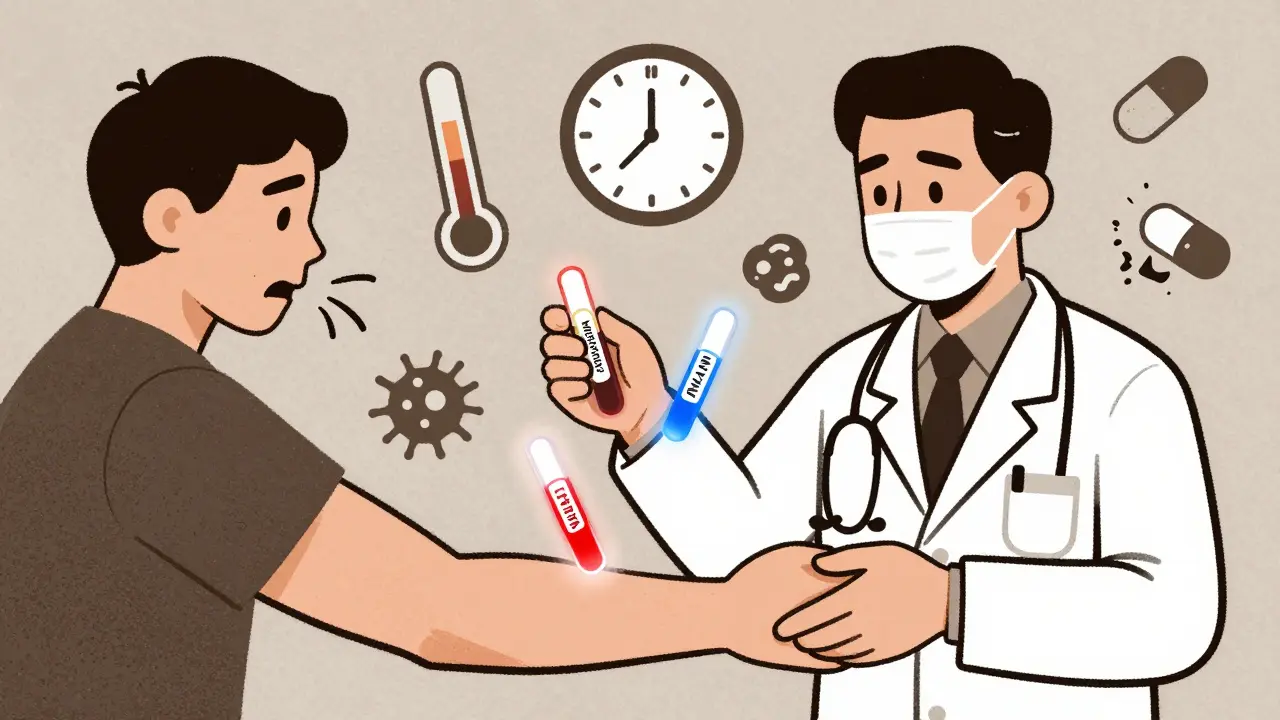
For strep throat, a rapid antigen test gives results in minutes. It’s 95% accurate at detecting group A strep. If it’s negative but the doctor still suspects strep, a throat culture is done-it’s even more accurate, at 98%. For viruses like flu or COVID-19, PCR tests are the gold standard. When done within the first 72 hours of symptoms, they catch 90-95% of cases.
There’s also a newer tool: the FebriDx test. Approved by the FDA in 2020, it checks two biomarkers in your blood-CRP (a sign of inflammation) and MxA (a protein your body makes only when fighting a virus). It tells you in 10 minutes whether your infection is likely bacterial or viral-with 94% sensitivity and 92% specificity. It’s not everywhere yet, but it’s changing how doctors make decisions.
Treatment: What Actually Works
Here’s the bottom line: bacterial infections need antibiotics. For strep throat, a 10-day course of penicillin or amoxicillin clears the infection and prevents complications like rheumatic fever. For urinary tract infections, a 3-7 day course of trimethoprim-sulfamethoxazole or nitrofurantoin is standard. You finish the full course-even if you feel better. Stopping early lets the toughest bacteria survive and multiply.
For viral infections, antibiotics are useless. Instead, treatment is about support: rest, fluids, fever reducers like acetaminophen or ibuprofen. Some viruses have targeted antivirals. For flu, oseltamivir (Tamiflu) can shorten illness by 1-2 days-if taken within 48 hours of symptoms. For severe COVID-19, remdesivir can help hospitalized patients recover faster. For shingles (caused by chickenpox virus), acyclovir reduces pain and speeds healing.
But here’s the catch: antivirals are not like antibiotics. They’re narrow, specific, and often time-sensitive. There’s no “universal antiviral” for every cold or cough. That’s why most viral infections just need time.
Why Misusing Antibiotics Is a Global Crisis
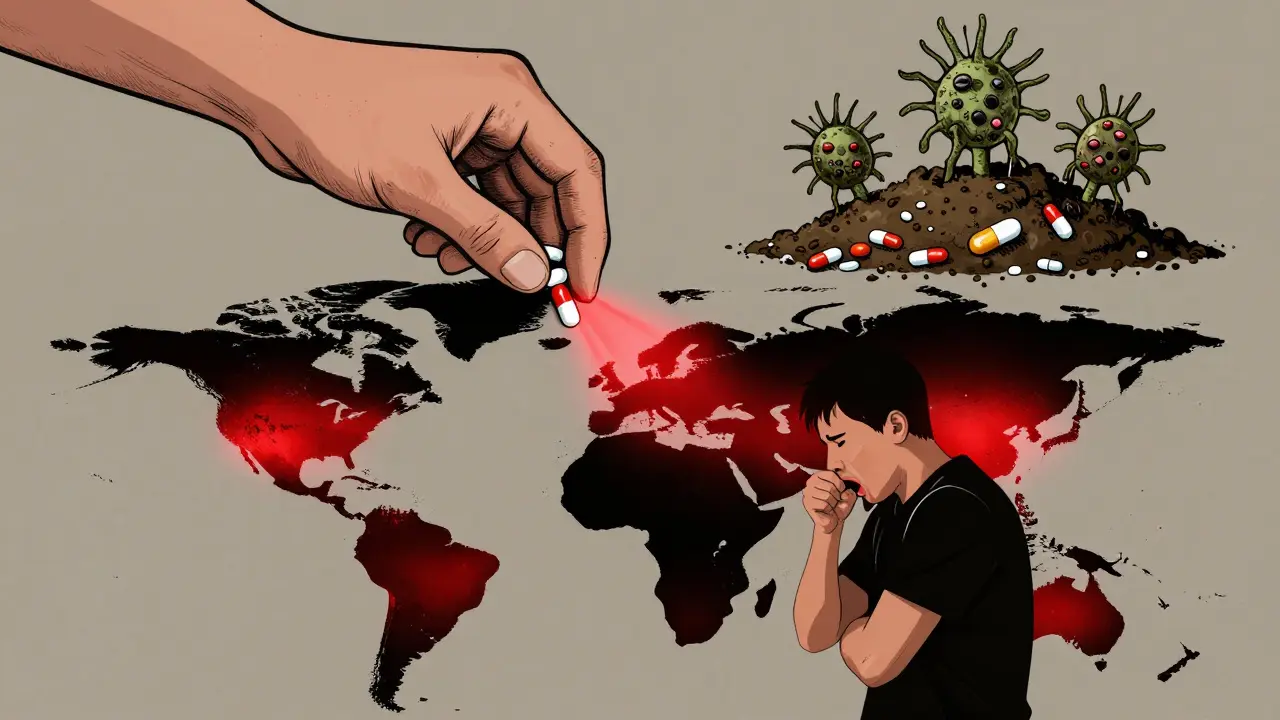
Every time you take an antibiotic when you don’t need it, you’re helping create superbugs. Antibiotic resistance isn’t science fiction-it’s happening now. In 2019, drug-resistant infections killed 1.27 million people worldwide. By 2050, that number could hit 10 million annually-more than cancer.
In the U.S., doctors prescribe 47 million unnecessary antibiotic courses every year-mostly for viral colds and bronchitis. That’s not just wasteful. It’s dangerous. These drugs wipe out good bacteria in your gut, leaving you vulnerable to deadly infections like Clostridioides difficile, which causes 223,900 cases and 12,800 deaths each year in the U.S. alone.
And it’s not just about you. When you take antibiotics unnecessarily, resistant bacteria spread to your family, your coworkers, your community. The World Health Organization calls antibiotic resistance one of the top 10 global health threats. Resistance to common antibiotics like penicillin and azithromycin has jumped from 5.8% in 2017 to 17.3% in 2023.
When Should You See a Doctor?
You don’t need to panic over every sniffle. But here’s when to get checked:
- Fever above 101°F (38.3°C) lasting more than 3 days
- Symptoms that get worse after starting to improve
- Sore throat with white patches or swollen tonsils
- Difficulty breathing, chest pain, or coughing up blood
- Symptoms lasting longer than 10-14 days
- Severe headache, stiff neck, or confusion
For kids, watch for ear tugging, refusal to eat, or extreme fussiness. For older adults, even mild symptoms can turn serious fast.
What You Can Do Right Now
Don’t pressure your doctor for antibiotics. Ask: “Could this be viral?” “Do I need a test?” “What happens if I wait?” Most doctors will appreciate you being informed.
Get vaccinated. Flu shots, pneumococcal vaccines, and COVID boosters reduce your chance of getting sick-and prevent complications that lead to antibiotic use.
Wash your hands. Cover your cough. Stay home when you’re sick. Simple actions stop both bacterial and viral germs from spreading.
And if you’re prescribed antibiotics? Take them exactly as directed. No skipping doses. No stopping early. No saving leftovers for next time. That’s how you protect yourself-and everyone else.
The Bigger Picture
This isn’t just about your cold or your child’s ear infection. It’s about the future of medicine. If we keep treating viruses like bacteria, we’ll run out of effective antibiotics. We’ll face surgeries, cancer treatments, and even simple cuts becoming deadly again.
Scientists are working on solutions: phage therapy (using viruses to kill bacteria), narrow-spectrum antibiotics that target only bad bugs, and universal coronavirus vaccines. But none of this matters if people keep asking for antibiotics for the flu.
Knowing the difference between bacterial and viral infections isn’t just medical knowledge-it’s a responsibility. Your choices today affect how well medicine works for your kids, your parents, and your neighbors tomorrow.
Can a viral infection turn into a bacterial one?
Yes. Viral infections like the flu or COVID-19 can weaken your immune system and damage your airways, making it easier for bacteria to invade. About half of hospitalized COVID-19 patients develop secondary bacterial pneumonia. That’s why doctors sometimes prescribe antibiotics during severe viral illness-not to treat the virus, but to prevent or treat the bacterial complication that follows.
Do antibiotics kill good bacteria too?
Yes. Antibiotics don’t distinguish between good and bad bacteria. They wipe out the bacteria in your gut, mouth, and skin. This can lead to diarrhea, yeast infections, and increased risk of C. diff. That’s why doctors now recommend narrow-spectrum antibiotics when possible-drugs that target only the specific bacteria causing the infection, not everything in your body.
Why do some doctors still give antibiotics for colds?
Sometimes it’s pressure from patients. Other times, it’s uncertainty. It’s hard to tell a viral infection from a bacterial one without testing. Some doctors prescribe antibiotics as a safety net-especially with children or older patients. But guidelines from the CDC and WHO are clear: don’t prescribe antibiotics for viral upper respiratory infections. Better testing tools and patient education are helping change this habit.
Can I get a bacterial infection from someone with a viral infection?
Not directly. You can’t catch strep throat from someone with the flu. But you can catch the virus, then develop a secondary bacterial infection yourself. For example, after a cold, you might get a bacterial sinus infection. Or after the flu, you might develop pneumonia. The virus sets the stage-the bacteria take advantage.
Are there natural remedies that work for viral infections?
Rest, fluids, and over-the-counter symptom relievers are the most effective. Honey can soothe a cough in adults and kids over 1 year. Saline nasal sprays help with congestion. Zinc lozenges might slightly shorten a cold if taken within 24 hours of symptoms. But no herb, supplement, or essential oil has been proven to cure or kill viruses. Don’t waste money on unproven remedies-focus on supporting your body’s own defenses.
Wow, another one of those ‘read the CDC pamphlet’ posts. Like we didn’t already know antibiotics don’t work on viruses. Congrats, you just wrote a 2000-word blog post on common sense.
It’s not just about knowing the difference-it’s about systemic failure. Primary care physicians are overworked, under-resourced, and pressured by patients who’ve been conditioned by Big Pharma ads to demand antibiotics like they’re candy. The FebriDx test? Brilliant. But it’s not in every clinic because insurance won’t cover it. This isn’t ignorance-it’s infrastructure collapse disguised as individual choice.
And don’t get me started on the ‘natural remedies’ mythos. Honey for cough? Fine. Essential oils curing pneumonia? That’s not holistic, it’s lethal. We’ve replaced evidence with Instagram wellness influencers, and now we’re paying the price in resistant superbugs.
Meanwhile, in India and Nigeria, where antibiotics are sold over the counter without prescription, resistance rates are exploding. This isn’t an American problem. It’s a global civilizational threat, and we’re treating it like a TikTok trend.
And yes, I’ve seen a 7-year-old with septic shock from a strep throat that was ‘just a virus.’ Don’t romanticize ignorance.
This is actually so helpful. I always feel guilty asking my doctor for tests, like I’m being difficult-but now I know it’s the right thing to do. I used to panic every time my kid had a fever and just beg for antibiotics. Now I ask, ‘Could this be viral?’ and it changes the whole conversation. Thank you for writing this.
One thing missing here: the role of microbiome health. People don’t realize that every time you take a broad-spectrum antibiotic, you’re not just killing bad bacteria-you’re erasing decades of symbiotic evolution in your gut. That’s why some people get chronic diarrhea or yeast infections after a course. Probiotics help, but they’re not a magic reset button. The real solution? Prevent unnecessary use in the first place.
Also, if you’re on antibiotics, avoid alcohol. It doesn’t make them less effective, but it stresses your liver when it’s already working overtime to clear infection and drugs.
I had a friend die from C. diff after a simple sinus infection. They gave her amoxicillin for a ‘viral thing.’ Three weeks later, she was in ICU. This isn’t theoretical. It’s real. And it’s happening to people we love.
Let’s be real-most people don’t care about the science. They just want to feel better yesterday. That’s why the real solution isn’t education-it’s design. Imagine a fever tracker app that analyzes symptom progression and auto-suggests ‘wait and see’ vs. ‘see doctor.’ Gamify it. Make it social. Make it easy. People respond to behavior design, not PubMed links.
Also, doctors need better diagnostic tools, not just more lectures. If you give them a $20 rapid test that’s 94% accurate, they’ll use it. If you give them a 50-page guideline, they’ll ignore it.
From a public health epidemiology standpoint, the real bottleneck isn't patient behavior-it's the lack of point-of-care molecular diagnostics in primary care settings. The FebriDx test, while promising, is still classified as a Class II device with limited reimbursement pathways. Without Medicaid/Medicare coverage and integration into EHRs, adoption remains negligible. We need policy-level intervention, not just anecdotal awareness campaigns.
So, like, I just read this whole thing and I’m like… wow. I mean, I knew antibiotics were for bacteria and not viruses, but I didn’t realize how much it affects EVERYTHING. Like, my grandpa had to stay in the hospital for a month after getting C. diff from a ‘just in case’ antibiotic for his cold. I didn’t even know that was a thing. Like, I thought C. diff was from hospitals, not from my uncle’s sinus infection. Also, I spelled ‘antibiotics’ wrong like three times. Sorry.
Great post! I’m from India and here people buy antibiotics from chemists without any prescription. My cousin took ciprofloxacin for a cold last year and now he’s allergic to all penicillins. Also, the doctor told him it was ‘bacteria’ even though he had runny nose and sneezing. So much misinformation.
Thank you for writing this. I’ve been so anxious about getting sick this winter because I don’t want to be that person who demands antibiotics. But now I feel empowered to ask the right questions. Also, I’m going to start keeping a symptom journal-when it started, how it changed, etc. Small things can make a big difference.
It’s funny how we treat medicine like a menu. ‘I’ll have the antibiotics, no, wait, maybe the antiviral, can I get a side of honey with that?’ We want quick fixes for complex biological systems. But the body isn’t a vending machine. It’s an ecosystem. And sometimes… you just have to wait. Let it run its course. It’s not sexy. But it’s true.
My niece got strep last year and the doctor didn’t test her-just prescribed amoxicillin because ‘it’s probably strep.’ She had a rash. Turns out it was mono. Antibiotics made it worse. I’m telling everyone I know: always ask for the test. Always.
One point often overlooked: the economic disincentive. Primary care visits are 10–15 minutes. Running a rapid test adds cost and time. Doctors are paid per visit, not per diagnostic accuracy. Until reimbursement models change, prescribing antibiotics will remain the path of least resistance-even when it’s wrong.
While I appreciate the effort, this article is dangerously oversimplified. You imply that all viral infections are benign and self-limiting. What about Epstein-Barr reactivation in immunocompromised patients? Or adenovirus-induced hepatitis? Or the fact that some bacterial infections-like Lyme disease-can mimic viral syndromes for weeks? This kind of black-and-white thinking is what leads to misdiagnosis. Medicine is not binary. It’s a spectrum. And your tone suggests otherwise.