
Imagine a patient undergoing chemotherapy where five different drugs work together to fight a tumor. If you swap just one of those drugs for a generic version, does the whole system still work? For single pills, the answer is usually yes. But in cancer medication combinations, the stakes are higher, and the science is trickier.
Bioequivalence is the scientific proof that a generic drug releases its active ingredients into the body at the same rate and extent as the original brand-name product. In oncology, this isn't just about cost savings; it's about ensuring that a complex cocktail of drugs doesn't lose its potency or gain unexpected toxicity. With roughly 70% of modern cancer treatments involving multiple agents, understanding these challenges is critical for patients, doctors, and pharmacists alike.
Why Combination Therapy Complicates Bioequivalence
Standard bioequivalence testing follows a strict rule: the 90% confidence interval for key pharmacokinetic parameters-specifically the Area Under the Curve (AUC) and maximum concentration (Cmax)-must fall within an 80-125% range compared to the reference drug. This standard works well for isolated molecules like oral anastrozole, which has nine approved generic versions all rated as therapeutically equivalent by the U.S. Food and Drug Administration (FDA).
However, when drugs interact, the math gets messy. In a regimen like FOLFOX (used for colorectal cancer), which combines 5-fluorouracil, leucovorin, and oxaliplatin, each component must prove its individual equivalence. But more importantly, the *interaction* between them must remain consistent. If a generic version of one drug absorbs slightly faster, it might peak in the bloodstream while another drug is still being absorbed, potentially altering how they affect each other. This is known as a drug-drug interaction (DDI), and in combination regimens, minor shifts in timing can have outsized effects on efficacy or side effects.
The Narrow Therapeutic Index Problem
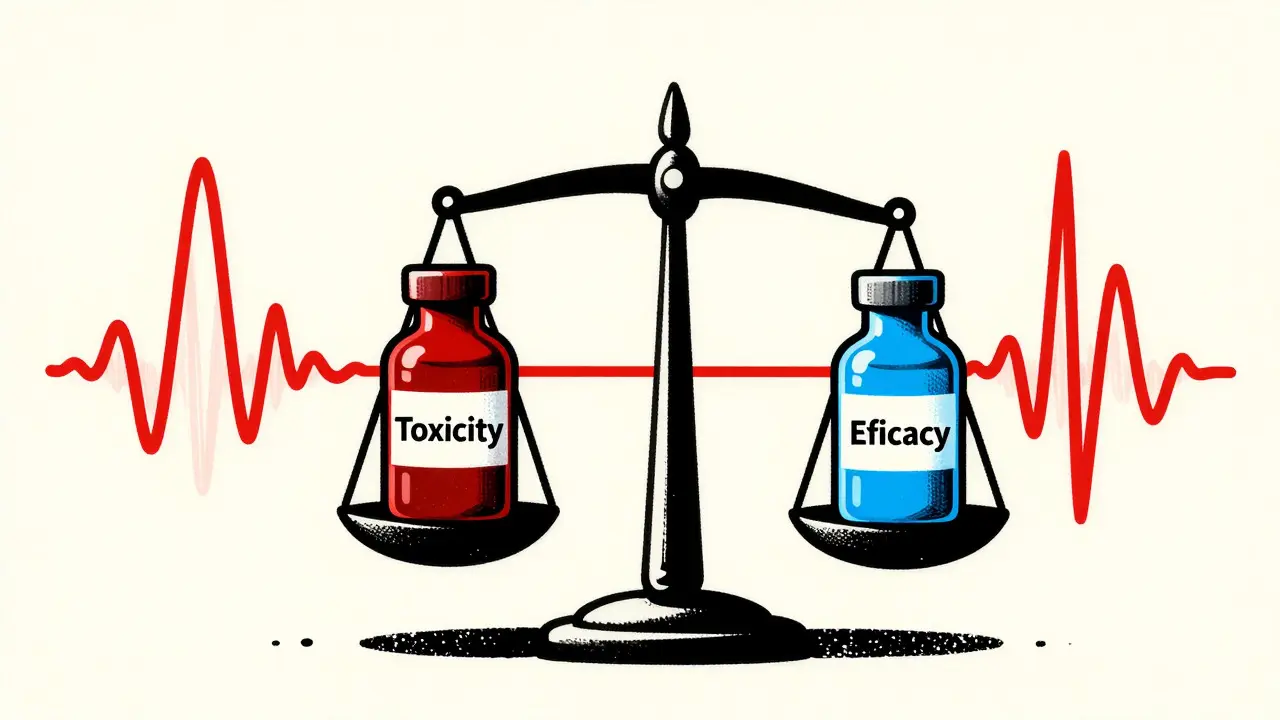
Not all cancer drugs play by the same rules. Some belong to a category called "narrow therapeutic index" (NTI) drugs. These medications have a small window between a dose that works and a dose that causes harm. Methotrexate is a prime example. For NTI drugs, the standard 80-125% bioequivalence margin is considered too loose. Experts argue for tighter limits, such as 90-111%, to ensure safety.
This distinction matters deeply in combinations. Dr. James McKinnell, Professor of Oncology at Johns Hopkins University, notes that using NTI drugs like methotrexate in combination regimens requires these stricter margins. If a generic version falls outside this tighter band, the risk of toxicity increases significantly. This is why 68% of hospital formulary committees now demand additional clinical evidence beyond standard studies before approving generic substitution in high-risk combinations.
Small Molecules vs. Biologics: A Tale of Two Standards
Another major hurdle arises from the type of drug involved. Small-molecule chemotherapy agents, like capecitabine, face relatively straightforward bioequivalence requirements. You can test them in healthy volunteers using crossover designs, comparing blood levels directly.
Biologics, such as monoclonal antibodies used in immunotherapy, are different. Because they are large, complex proteins produced in living cells, they cannot be identical copies of the brand name. Instead, they aim for "biosimilarity." This is assessed through a different regulatory pathway, often requiring comparative clinical studies rather than just pharmacokinetic data. When a regimen mixes both-like R-CHOP for lymphoma, which includes the biologic rituximab alongside small-molecule chemo agents-the bioequivalence challenge peaks. You need to prove the small molecules are equivalent *and* that the biologic maintains its specific biological activity, all while managing their combined impact.
| Feature | Small-Molecule Chemo | Biologics (Immunotherapy) | Combination Regimens |
|---|---|---|---|
| Primary Standard | Bioequivalence (PK parameters) | Biosimilarity (Clinical + PK) | Component BE + Interaction Assessment |
| Typical Margin | 80-125% | Case-by-case (often tighter) | 90-111% for NTI components |
| Testing Method | Crossover studies in healthy volunteers | Comparative clinical trials | Modeling/Simulation + Clinical Data |
| Main Risk | Dose variability | Immunogenicity differences | Altered drug-drug interactions |
Real-World Impact: Safety and Cost
The debate isn't just theoretical. A 2023 survey of 250 oncology pharmacists in the United States found that 57% had witnessed unexpected toxicity or reduced efficacy after substituting a single generic component in a combination regimen. One documented case involved generic vincristine in R-CHOP therapy, where formulation differences led to higher peak plasma concentrations, resulting in increased neurotoxicity for the patient.
On the flip side, successful substitutions yield massive savings. Generic trastuzumab biosimilars for breast cancer have saved $6,000-$10,000 per cycle while maintaining nearly identical progression-free survival rates (37.7 months vs. 37.2 months). The global market for generic oncology drugs reached $38.7 billion in 2023, accounting for 42% of total spending. Yet, the potential for further savings-estimated at $14.3 billion annually in the U.S.-is currently held back by hesitation over combination therapy risks.

Navigating the Regulatory Landscape
Regulators are aware of these gaps. The FDA launched the Oncology Bioequivalence Center of Excellence in 2024 to tackle complex regimens. They are also endorsing physiologically based pharmacokinetic (PBPK) modeling. This computer-based approach simulates how drugs move through the body, allowing scientists to predict interactions without waiting for years of clinical trial data. Similarly, the European Medicines Agency (EMA) is piloting "combination bioequivalence" assessments that look at the entire regimen rather than just individual parts.
For healthcare providers, practical tools are emerging. The Gulf Cooperation Council’s Oncology Formulary Committee developed a decision analysis tool weighing manufacturing quality, regulatory alignment, and cost. Meanwhile, institutions like UCSF use real-time alerts in electronic health records to flag when a proposed generic substitution involves a narrow therapeutic index drug, reducing inappropriate swaps by 63%.
What Patients Should Know
If you are starting a new cancer treatment, ask your doctor about the specific components of your regimen. Are any of them narrow therapeutic index drugs? Is the regimen a fixed-dose combination or separate administrations? Understanding these details helps you make informed decisions if your insurance or hospital suggests a generic alternative. While generics offer significant financial relief, the right choice depends on the specific chemistry of your treatment plan.
What is the main difference between bioequivalence and biosimilarity?
Bioequivalence applies to small-molecule drugs and proves they release the same amount of active ingredient into the bloodstream at the same rate. Biosimilarity applies to biologics (large protein drugs) and demonstrates that the generic version is highly similar to the original in terms of structure, function, and clinical effect, though not identical.
Why are combination therapies harder to test for bioequivalence?
In combination therapies, drugs interact with each other. Changing one component can alter how the others are absorbed or metabolized. Therefore, proving that each generic part is equivalent individually isn't enough; regulators must also ensure the overall interaction profile remains unchanged to maintain safety and efficacy.
What is a narrow therapeutic index (NTI) drug?
An NTI drug has a small margin between the dose that provides therapeutic benefit and the dose that causes harmful side effects. Examples include methotrexate and digoxin. For these drugs, bioequivalence standards are stricter (often 90-111%) because even small changes in blood levels can lead to toxicity or treatment failure.
How much do generic cancer drugs save the healthcare system?
Generic oncology drugs currently represent about 42% of total oncology spending, reaching $38.7 billion globally in 2023. The American Cancer Society estimates that fully appropriate generic substitution could save the U.S. healthcare system an additional $14.3 billion annually, provided bioequivalence challenges in combination therapies are properly managed.
Should I worry if my oncologist switches me to a generic drug?
Generally, no, especially for single-agent therapies with established track records. However, for complex combination regimens involving narrow therapeutic index drugs, it is wise to discuss the specific rationale with your pharmacist or oncologist. Ask if the generic has been vetted for compatibility with your other medications and if there are any known formulation differences.